
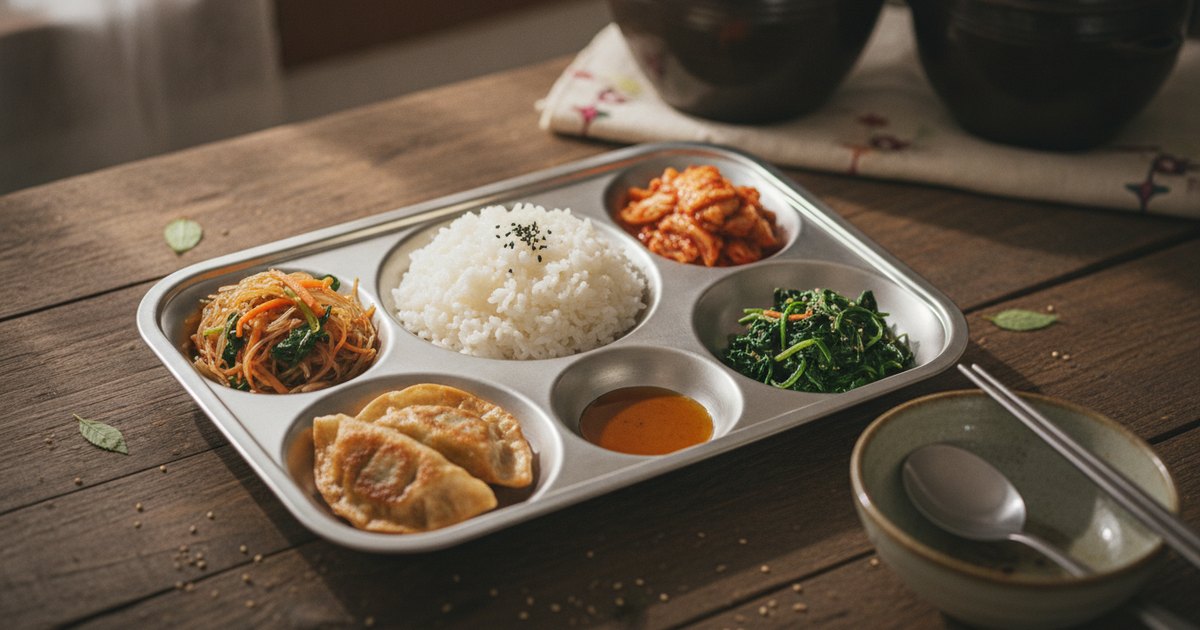
If you've watched enough Korean dramas set in high schools — and at this point, most of us have — you've seen the cafeteria scenes: students jostling in line with partitioned trays, arguing over banchan portions, slurping soup while gossip flies across the table. Those scenes aren't just atmospheric filler. Korean school food is a genuine cultural institution, and it says a lot about how Korean society thinks about meals, community, and daily nourishment.
Whether you're a home cook trying to understand Korean food beyond the restaurant experience, or you're just curious what's behind those iconic tin lunchboxes that show up in every 1980s-era Korean film, this guide goes deep. We'll trace the history from the postwar dosirak era all the way to today's impressively organized school cafeteria system — and we'll show you exactly how to bring a little of that school-lunch energy into your own kitchen.
The Dosirak: Korea's Original School Lunch
Before there were cafeterias, there was the dosirak (도시락) — the compartmentalized lunchbox that defined Korean childhood for generations. The word itself traces back to 18th-century Early Modern Korean, but the rectangular tin form that became iconic was actually introduced during the Japanese colonial period (1910–1945), a direct parallel to the Japanese bento box. Similarly, gimbap — seaweed rice rolls that often appeared alongside the dosirak — emerged in this same period from Japanese norimaki.
Post-Korean War, school meal programs launched not with hot cafeteria food but with distributed powdered milk for elementary students during a severe food crisis. Home-packed dosiraks in cheap tinplate containers made from scrap metal were the norm. By the 1970s and 1980s, the dosirak had settled into its golden era: a thin rectangular tin, sometimes called a "German Silver" container for its alloy construction, with a latch that could hold a tightly packed meal through a morning's worth of bus rides and classroom chaos.
These containers conducted heat quickly. That detail matters, because it set up the most beloved lunch ritual of an entire generation.
The Classroom Radiator Ritual
In winter, every Korean elementary school classroom had a coal-briquette heater at its center. Every student who arrived early enough claimed a prime spot on or near that heater for their dosirak. The tins would sit warming through the morning, slowly releasing the smell of sautéed kimchi, pink fish sausage, and sesame oil into the classroom air. By lunchtime, the rice was warm, the banchan fragrant, and the contents of every tin had been gently stewing in their own heat for hours.
This wasn't just a practical workaround for cold school buildings. It was a shared ritual — a daily event with a social dimension. Whose banchan smelled best? Who had the richest kimchi? Which fortunate student had a fried egg tucked under the rice? The radiator was a leveler and a conversation starter in equal measure.
What Was Actually Inside That Tin
The classic dosirak was built around economics. In 1970s Korea, fresh meat was expensive and refrigeration was limited. The banchan that filled these lunchboxes were economical, shelf-stable, and punchy enough in flavor to survive a morning in a tin. A typical spread:
White rice — packed tight and dense into the bottom of the tin, still carrying residual warmth.
Boon-hong sausage (분홍소시지) — Korea's distinctive pink pork-and-cornstarch fish sausage, sliced and pan-fried until the exterior has a lightly caramelized crust. The interior stays bouncy, almost springy — nothing like Western sausage. The starch content gives it density that survives reheating without drying out. Today it's sold at H Mart and Korean grocery stores under brands like Lotte or Jinhan, and it's worth trying just for the nostalgia factor.
Myeolchi bokkeum (멸치볶음) — dried baby anchovies stir-fried with minced garlic, gochugaru, soy sauce, and a honey glaze until every anchovy is coated in a glossy, sticky lacquer. When properly made, these are intensely savory-sweet with a gentle bite, not remotely fishy. They're one of those banchan that has never gone out of fashion, appearing in both the dosirak era and on cafeteria trays today. If you want to explore the wider world of these small-plate dishes, our banchan guide covers them in detail.
Sautéed kimchi (볶음김치) — not fresh kimchi, but older, well-soured kimchi pan-fried in sesame oil with a pinch of gochugaru until it softens and turns jammy. The sharp sourness mellows in the pan; what you're left with is deeply flavored and complex. This is why kimchi that's been fermenting for at least 3–4 weeks (ideally longer) is the correct choice. Our guide on how to make kimchi will get you to that stage if you're starting from scratch.
Optional but frequently present: a gyeran mari (thin rolled egg omelet) or a sprinkle of gim (dried seaweed flakes) over the top of the rice.
The Shake: Korea's Most Beloved Lunch Ritual
Before a single chopstick was lifted, there was the shake.
Students would take their fully latched tin dosirak and shake it vigorously — four or five firm shakes — before opening. This wasn't mischief. It was method. The motion redistributed everything: kimchi juice soaked into the rice, fragments of sausage and egg tumbled between layers, heat spread evenly. The result was an improvised bibimbap — a spontaneous mixed rice bowl created at the desk before eating began.
This also made practical sense for desk dining. Picking through separate compartments with chopsticks while seated at a school desk is awkward; a pre-mixed bowl of rice coated in savory-sweet juices is much more manageable. If you've made bibimbap at home, you already understand the underlying logic: rice that has absorbed a punchy, flavored sauce is infinitely more satisfying than plain rice eaten alongside separate components.
The ritual was culturally significant enough that nostalgia restaurants in Korea today serve special "dosirak meals" in tin boxes, specifically designed to be shaken before eating. It's one of those small, tactile food memories that Koreans who grew up with the dosirak era describe with genuine affection.
The Modern Korean School Cafeteria
As Korea industrialized and prosperity expanded through the 1990s and 2000s, the dosirak gradually gave way to school cafeterias. The home lunchbox, once a source of status and pride, became associated with economic hardship; a cafeteria lunch became the norm. And what emerged was a school meal system that holds up well by international standards.
The Tray Layout
Every student receives a partitioned tray with a logical, consistent layout:
- Lower left compartment: Rice — rotating varieties including white, multigrain, and sometimes glutinous sprouted-grain blends
- Lower right compartment: Hot soup or jjigae (stew), changed daily
- Upper compartments: Kimchi (always present, non-negotiable) plus 2–3 additional banchan
- Accompanying drink: Milk or an alternative
The rice-to-banchan ratio reflects bapsang balance philosophy: banchan are seasoned assertively not because Koreans want salty food, but because each banchan is meant to flavor several bites of rice as you eat them together. Tasting a piece of jangjorim on its own and finding it intensely salty is correct — against a full mouthful of plain rice, it becomes exactly right.
Soups and Stews on Rotation
The soup slot rotates through a substantial list. Miyeok-guk (seaweed soup with beef broth) appears regularly — and in some schools, specifically on students' birthdays, continuing the Korean tradition of this soup as a birthday dish. Sundubu-jjigae (soft tofu stew), nurungji (scorched rice soup with a gentle nutty flavor), budaejjigae (army stew, predictably popular), chicken kalguksu (hand-cut noodle soup), and even abalone porridge on special occasions have all been documented in school menus.
Proteins and Banchan
Around 3–4 school lunches per week in Korea are pescatarian or seafood-focused. Rotating proteins include bulgogi, beef short ribs, braised pork, various chicken preparations, and seafood. Banchan documentation includes gyeran mari, myeolchi bokkeum, jangjorim (soy-braised beef and hard-boiled eggs), dotori-muk (acorn jelly), sweet potato fries, spicy cucumber salad, and a rotating cast of seasonal vegetables. Kimchi appears every single day, regardless of what else is on the tray.
Modern school cafeterias also operate under detailed nutrition guidelines overseen by licensed nutrition teachers (yeongyangsaem). Each meal is calibrated for appropriate protein, vegetable, and calorie content by age group. It's a more nutritionally intentional system than its Western equivalents in many respects.
Recreating Korean School Lunch at Home
You don't need a tin box or a classroom radiator to capture the spirit of the dosirak. The classic banchan are genuinely some of the most approachable Korean dishes to learn at home, and they hold well in the refrigerator for 3–5 days — making them practical for real weekday lunchbox prep.
Myeolchi Bokkeum (Glazed Dried Anchovies)
You need small dried anchovies — specifically the type labeled 잔멸치 (small myeolchi), around 2–3 cm (¾–1 inch) long. These are sold at H Mart in the dried goods aisle, and occasionally at Whole Foods in the international section. Do not use the large broth anchovies (국물 멸치); they're too thick and will taste bitter when stir-fried.
Toast 60g (2 oz / 1 cup loosely packed) of small dried anchovies in a dry pan over medium heat for 2–3 minutes, stirring constantly, until they smell nutty and turn faintly golden at the edges. Remove from the pan. Add a thin coat of neutral oil, then fry 2 cloves minced garlic for 30 seconds until fragrant. Return the anchovies to the pan with 1 tablespoon (15 ml) soy sauce, 1 tablespoon (15 ml) honey or corn syrup, and ½ teaspoon (2.5 ml) gochugaru. Toss constantly over medium-high heat for 60–90 seconds until the glaze coats every anchovy and looks glossy rather than wet. Pull from heat and finish with ½ teaspoon (2.5 ml) sesame oil.
The result should be sticky-glossy, savory with a controlled sweetness and a low-level background heat. If yours taste predominantly fishy, your anchovies may be stale — fresh dried anchovies should smell nutty when toasted, not pungent.
Packing a Proper Dosirak Box
Rice temperature is the most critical variable. Allow freshly cooked short-grain or medium-grain rice to cool uncovered for 5–10 minutes before packing — warm but not steaming. Hot rice releases moisture inside a closed container, condensing on the banchan and making everything wet and gummy. Press it gently but firmly into your container. Sautéed kimchi and myeolchi bokkeum are ideal dosirak companions because both are dry enough not to leak.
For ingredient sourcing beyond anchovies: boon-hong sausage is available at H Mart (Lotte brand is the standard), gochugaru can be found at H Mart or online (look for the coarse grind), and sesame oil is available at most major grocery chains including Whole Foods and Trader Joe's.
Common Mistakes to Avoid
1. Buying the Wrong Anchovies
The large 국물 멸치 broth anchovies are too thick and intensely flavored for stir-frying into banchan. They won't pick up the glaze properly and taste bitter when cooked this way. You specifically want 잔멸치 — the small, slender ones around 2–3 cm (¾–1 inch) long, sold in a separate package at Korean grocery stores. If the bag doesn't specify size, check the anchovies visually before buying.
2. Burning (or Under-Reducing) the Glaze
Myeolchi bokkeum succeeds or fails entirely on the glaze, and the window between "not quite done" and "burned and acrid" is under 30 seconds. Stay over medium-high heat, toss constantly, and pull the pan the moment the glaze looks shiny and clings to every anchovy without pooling in the bottom of the pan. If you're unsure, pull it slightly early — residual heat will finish the job. A burned glaze produces a bitter bitterness that no amount of extra seasoning can fix.
3. Packing Steaming-Hot Rice
This is the most common beginner dosirak mistake. Hot rice creates condensation inside a sealed container, soaking into your banchan and turning the rice surface gummy. The five-minute rest on the counter makes a tangible difference. Rice should feel warm to the touch but produce no visible steam before it goes into the box.
4. Using Fresh Kimchi for Sautéed Kimchi Banchan
Fresh kimchi is too bright, too wet, and too high in water content for pan-frying. It releases liquid and steams in the pan rather than sautéing, producing a soft, watery result instead of the jammy, concentrated flavor you want. For kimchi bokkeum, use kimchi that has been fermenting for at least 3–4 weeks — you want clear sourness and a slightly deflated texture. Press excess liquid from the kimchi before it goes into the pan. It should sizzle sharply the moment it hits the oil; if it hisses and steams, it's too wet.
5. Over-Sweetening the Banchan
The dosirak tradition is built on balance: the sweetness in myeolchi bokkeum or sautéed kimchi exists to cut and round the salt, not to dominate. If your banchan tastes primarily sweet, you've buried the umami backbone. Begin with less honey or corn syrup than the recipe calls for, taste before adding more, and remember that these banchan will be eaten with plain rice — a degree of assertive seasoning is intentional and correct.
6. Skipping the Lid Check Before the Shake
If you're doing this properly at home, the shake is worth experiencing — it genuinely transforms the texture of the meal. But check your container latch twice before you shake. Most modern bento boxes and glass containers are not designed for vigorous shaking, and the consequences of an improperly sealed lid are messy and immediate. The traditional tin dosirak had a fold-over wire latch specifically for this purpose; if you're using a modern box, apply gentle shakes rather than the full wrist-snap version.
Frequently Asked Questions
Is Korean school food actually nutritious, or is it mostly rice and fried things?
Modern Korean school cafeterias operate under detailed nutritional guidelines managed by licensed nutrition teachers (yeongyangsaem). Each meal is calibrated for protein, vegetable variety, and age-appropriate calorie content. While white rice is always present, so is a rotating cast of seasonal vegetables, fermented foods, legumes, whole-grain rice blends, and lean proteins. Kimchi appears daily and contributes probiotics, fiber, and vitamins C and K. By global comparison, it's one of the more nutritionally comprehensive school meal systems.
Where can I find dosirak lunchboxes outside Korea?
Compartmentalized stainless steel bento-style boxes — functionally identical to the dosirak format — are widely available on Amazon, at H Mart, and at stores like MUJI. Search for "stainless steel bento box" or "tiffin box." Traditional tin dosiraks with the fold-over wire latch are harder to find new, but occasionally appear on eBay or at Korean nostalgia specialty shops in cities with large Korean communities.
What's the difference between a dosirak and gimbap for school lunch?
Gimbap — seaweed-wrapped rice rolls — emerged from a similar historical period as the dosirak and served a parallel purpose: a portable, self-contained meal. Where the dosirak is a compartmentalized box with rice, soup, and banchan kept separate until the shake, gimbap integrates all ingredients inside the roll in a hand-held format. Historically, many Korean lunchboxes included both: a section of gimbap alongside a small container of banchan. Today, convenience store gimbap is one of the most common quick lunches for Korean students.
Why does Korean school food always include kimchi, without exception?
Kimchi is nutritionally dense and is understood within Korean food culture as a necessary component of any proper meal — not optional or interchangeable. School meal guidelines specifically require it. Beyond the nutritional rationale, it's also functional: kimchi's acidity, umami, and heat provide the contrast that makes plain rice satisfying rather than monotonous. A tray without kimchi would simply feel incomplete in a way that's difficult to articulate to someone outside the culture — similar to the instinctive wrongness of a Japanese meal without miso soup, or a French meal without bread.
Can I make myeolchi bokkeum vegetarian?
The anchovy is integral to the dish, but if you want a similar flavor profile without it, roasted pumpkin seeds, edamame, or cubed firm tofu tossed in the same soy-honey-gochugaru glaze produce a genuinely tasty result. It isn't myeolchi bokkeum, but it has the same sticky-savory-sweet character that makes the original so addictive. For a fuller picture of vegetarian-friendly banchan options, our banchan guide has you covered. ```