
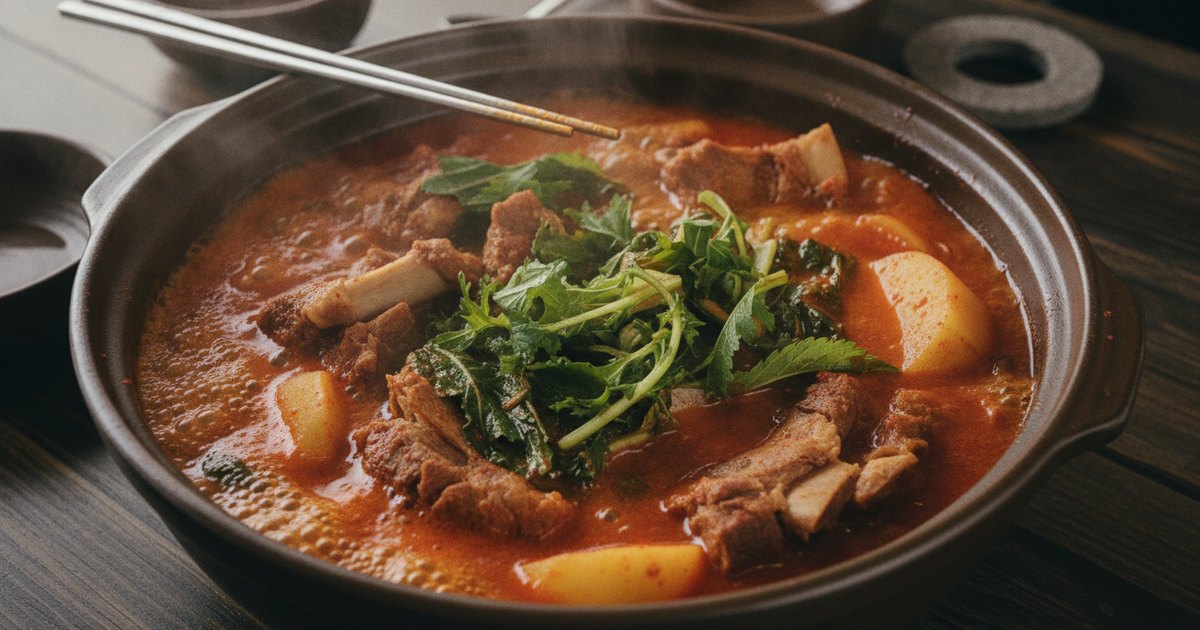
If there is a Korean soup that commands a table the moment it arrives, gamjatang is it. The turbulent, brick-red broth. The pork bones that barely fit the bowl. The cloud of perilla-scented steam that reaches you before the bowl even lands. Gamjatang (감자탕) — commonly translated as spicy pork bone soup or pork spine and potato stew — is one of Korea's great cold-weather workhorses, equally at home at a 3 a.m. street cart table after a long night out as it is at a Sunday family dinner spread.
This is not a quick weeknight dish. But what you get in return — a broth that is simultaneously funky, fiery, collagen-rich, and strangely clean — is unlike anything else in Korean cooking. Once you understand the logic of the dish (and especially what happens at the bone-prep stage), it becomes remarkably approachable even for home cooks who have never worked with bones before.
What Is Gamjatang?
Gamjatang is a hearty Korean soup built around slow-simmered pork spine bones (등뼈, deungttalgol) or neck bones (목뼈, mokttalgol). The broth is flavored with a pre-mixed seasoning paste that combines gochugaru, doenjang, gochujang, garlic, and typically perilla seed powder — a layered, fermented complexity that pure chili-based soups simply don't deliver. Potatoes, napa cabbage, perilla leaves, and sometimes bean sprouts round out the pot.
The name causes mild confusion: gamja (감자) means potato in modern Korean, which makes "gamja-tang" sound like it simply means potato soup. But food historians note the name likely derives from an older term — a Chinese-character word (堪者湯) that referred to a pig's neck or spine bone, not the vegetable. The potato entered the dish later and is now so essential that the etymological debate is mostly academic. What matters is that both the bone and the potato earn their place.
Gamjatang also holds a specific cultural role as a 해장국 (haejangguk) — a restorative hangover soup. The collagen-rich bone broth, the capsaicin heat from gochugaru, and the umami depth of fermented doenjang have made it the go-to recovery meal across generations.
The Star Ingredient: Choosing Your Pork Bones
The cut matters enormously. You want pork spine bones (등뼈) for the most traditional result. They are knobby, cartilage-rich, and packed with marrow. Working around the joints to pull away tender meat and dig into the marrow with a chopstick is the intended experience — messy, intimate, and deeply satisfying.
Neck bones (목뼈) are the common alternative. They carry more actual meat per bone, which makes them slightly more accessible for Western diners who may be unfamiliar with the spine-bone approach. Flavor is nearly identical.
What to avoid: pork ribs, pork shoulder, or any boneless cut. The entire soul of gamjatang is the collagen from the bones — without it, the broth lacks that silky body-coating quality that makes it so restorative. You can add a higher volume of water with bone-in cuts than you can with meat alone, and the broth will still develop flavor.
One important note: the phrasing "waxy potatoes preferred" appears in some Western adaptations of this dish. In practice, most Korean home recipes use standard all-purpose or medium-starch potatoes (think Yukon Gold) with perfectly good results. Some starchy breakdown into the broth is not a flaw — it adds body. The real goal is to cut the potatoes large enough that they don't disappear entirely.
Finding Ingredients in Western Kitchens
Pork spine or neck bones: H Mart and Korean or Chinese grocery stores stock both cuts reliably, often labeled in English as "pork neck bones." Many Latin American grocery stores and African American butcher shops also carry neck bones at excellent prices, since the cut is essential in Southern US cooking (neck bone stew, neck bone and rice). At standard US supermarkets like Whole Foods or Kroger, check the pork section — neck bones are increasingly available. If you don't see them, ask the butcher counter directly.
Gochugaru: H Mart carries multiple brands. Whole Foods stocks a limited selection. Amazon has consistent options. Do not substitute Italian red pepper flakes — they contain seeds, have a sharper heat, and entirely miss the fruity, mildly smoky character of Korean chili flakes. In an emergency, use ¼ to ⅓ the amount of cayenne and accept that the flavor will diverge. See our complete gochugaru guide for buying recommendations and substitution ratios.
Doenjang: Available at any Korean grocery and online. Do not substitute Japanese miso interchangeably — doenjang is notably funkier and less sweet. White miso is a serviceable emergency substitute (use slightly more, since it's milder), but the depth shifts considerably. For more on sourcing and using doenjang, see our doenjang deep dive.
Perilla leaves (kkaennip): H Mart and Korean groceries are reliable sources. Some Japanese groceries carry shiso, which is a close relative with a similar minty-anise profile (slightly more anise-forward). If you cannot find either, simply omit — the soup is still excellent without perilla leaves.
Deulkkae-garu (perilla seed powder): This is the ingredient that separates a good gamjatang from a great one. It adds a nutty, herbaceous quality and slightly thickens the broth in a way nothing else replicates. Find it at Korean grocery stores. If unavailable, skip it rather than substitute — ground sunflower seeds are sometimes suggested, but the flavor profile diverges noticeably.
The Seasoning Paste: Where the Real Flavor Lives
Unlike many stews where spices are added and simmered from the beginning, gamjatang uses a pre-mixed seasoning paste (양념장, yangnyeomjang) that is stirred into the broth only after the bones have finished their long simmer. This two-stage approach is deliberate and important: the bones first develop a clean, clear base broth, then the paste transforms it into something complex and aggressively flavored.
The paste has three main pillars:
Gochugaru provides the heat and the vivid brick-red color. The burn from gochugaru is slower-building and fruitier than cayenne — it doesn't hit you immediately but develops over the course of the meal, which is part of gamjatang's appeal.
Doenjang is the funky, umami backbone. It reads in the background rather than upfront — you might not be able to identify it in the finished broth, but its absence would be immediately obvious. The fermented depth it adds cannot be replicated with soy sauce or salt alone.
Gochujang adds body, a touch of natural sweetness from the fermented rice in its base, and layers of complexity that pure gochugaru lacks. Together, the two chili products complement each other: gochugaru provides heat and color, gochujang provides body and fermented depth.
Key Vegetables and Their Roles
Potatoes should be cut into large chunks — halves or thick wedges for medium-sized potatoes. Smaller pieces will disintegrate in the 20 minutes they spend in the seasoned broth, muddying the broth with starch. They should be fork-tender but visually intact when you serve.
Napa cabbage (배추, baechu) becomes silky and almost melting after 8–10 minutes in the simmering broth. It absorbs flavor aggressively and adds a gentle sweetness that balances the chili heat. Traditional recipes sometimes call for young, small napa cabbage (풋배추, putbaechu), which is slightly more tender with a greener, more vegetal flavor. Standard napa from any well-stocked grocery is completely acceptable.
Perilla leaves (깻잎, kkaennip) are added at the very end and just wilted in the hot broth. They release a distinctive herbal aroma — minty, faintly anise-like — that perfumes the entire soup. This is your signal that the dish is done.
Soybean sprouts (콩나물, kongnamul) are optional but common. They add a pleasant crunch that persists even after simmering and contribute a light, grassy freshness that lifts the richness of the broth.
Technique Notes: How to Actually Make It Work
The Two-Part Bone Prep Is Not Optional
Soaking and blanching are often skipped in the interest of time. This is the most consequential shortcut you can take. Blood and myoglobin locked in the bone marrow and surrounding tissue make broth murky and give it a metallic, slightly liver-like aftertaste that no amount of simmering or seasoning will correct. The soaking water drawing out pale pink liquid is the visible proof that the process is working. After soaking, the blanch — started in cold water to draw impurities out gradually — produces a vigorous rise of grey foam that tells you exactly how much debris you are removing. After blanching, rinse every bone individually. The combined process adds 45 minutes to the recipe, but the resulting broth is a fundamentally different product.
The Gentle Simmer Makes the Broth
After reassembling the pot with fresh water and aromatics, simmer the bones at a gentle, steady pace — small bubbles consistently breaking the surface. A vigorous rolling boil during this two-hour stage clouds the broth through emulsification and can introduce slight bitterness. If your stove runs hot, crack the lid or use a heat diffuser. The broth at the end of this stage should be clear and golden-beige, not milky or cloudy. A milky, opaque broth indicates the heat was too high — it is still safe and flavorful, but the flavor profile shifts toward the richer, heavier style of seollongtang (a different Korean bone soup intentionally made milky through aggressive boiling).
Dissolve the Paste Completely
When you stir the seasoning paste into the broth, add it in two or three additions rather than all at once, and whisk or stir vigorously. Doenjang and gochujang clump when dropped into liquid passively. Small undissolved clumps of doenjang will taste sharply pungent if someone bites into one — dissolving them fully gives you even, consistent flavor throughout the bowl.
What to Serve With Gamjatang
Gamjatang is traditionally served with steamed short-grain white rice (bap, 밥). Spoon broth over the rice and mix as you eat — the broth makes an extraordinary sauce. A modest selection of banchan (Korean side dishes) is standard: kimchi is non-negotiable, pickled radish (danmuji) adds brightness, and seasoned spinach (sigeumchi namul) provides a cool herbal counterpoint. For a full overview of Korean side dishes and how to compose a balanced spread, see our banchan guide.
A Korean stone pot (ddukbaegi, 뚝배기) keeps gamjatang at an almost dangerously hot temperature throughout the entire meal — if you own one, this is its moment. Otherwise, serve in deep, wide bowls and move quickly. This soup is best eaten hot enough to steam.
Common Mistakes to Avoid
1. Skipping or Shortcutting the Soak and Blanch
The most common first-timer error, and the one with the most impact. Without soaking, blood and myoglobin remain in the marrow and connective tissue. Without blanching, denatured proteins rise into the broth as grey scum and stay there. No amount of skimming during the long simmer fully recovers from skipped blanching. The fix is simply to do both steps properly: 30–60 minutes soaking in cold water, then a 5–7 minute hard boil started in cold water, followed by rinsing each bone individually. If your soaking water is still quite dark red after 30 minutes, give it another 15.
2. Simmering at Too High a Heat
A common instinct when cooking bones is to keep the heat up — the logic being that more heat means more extraction. In gamjatang, this backfires. A hard boil during the long simmer emulsifies fat into the broth (creating the milky appearance associated with seollongtang, which is correct for that soup but not this one), and extended aggressive boiling can introduce bitterness from the bone marrow. What you are looking for: small, lazy bubbles breaking the surface at irregular intervals. If your pot is rattling and churning, your broth will be cloudy and less clean-tasting than it should be.
3. Adding the Seasoning Paste Too Early
Some recipes add gochugaru and doenjang to the initial broth-building stage. The problem: doenjang simmered uncovered in a hot broth for two hours can turn sharp and slightly acrid, and gochugaru loses its bright, fruity character with extended cooking. The paste should go in only after the bones are tender and the aromatics are removed — then you simmer with the vegetables for another 20–25 minutes at most. This preserves the integrity of every component in the paste.
4. Cutting Potatoes Too Small
Potato pieces smaller than about 4 cm (1½ inches) across will partially disintegrate during the 10-minute potato simmer, releasing starch into the broth and turning it thick and cloudy. Cut potatoes into large, chunky wedges or halves. They should be fully tender when you test them — a chopstick or fork should slide in without resistance — but visually whole. If you notice the broth thickening toward the end of the potato cook, that is your signal the pieces were too small.
5. Failing to Taste and Adjust at the End
Gamjatang's seasoning can shift considerably between when you add the paste and when you serve — the vegetables absorb salt, the heat from gochugaru mellows slightly, and the broth concentrates as it simmers. A final tasting after the perilla leaves wilt is not optional. The specific adjustments: a small addition of fish sauce corrects under-saltiness without adding fishiness (the sauce disappears into the broth at small quantities); an extra pinch of gochugaru restores heat that has mellowed; a splash of soup soy sauce (gukganjang) adds color and depth without the saltiness of fish sauce. Taste for all three before serving.
6. Using Generic Chili Flakes Instead of Gochugaru
Italian-style dried red pepper flakes or cayenne have a different heat profile, color, and flavor than Korean gochugaru. Italian flakes contain seeds that contribute bitterness. Cayenne is significantly hotter (roughly 4–5x, depending on the variety) and lacks the mild fruitiness of gochugaru. If you substitute 2 tablespoons of cayenne for 2 tablespoons of gochugaru, the soup will be inedibly hot and the color will be darker and less vibrant. The correct emergency ratio: use ¼ to ½ teaspoon of cayenne for every tablespoon of gochugaru called for. Tracking down actual gochugaru — at H Mart, Whole Foods, or online — makes a measurable difference to the final dish.
Frequently Asked Questions
Can I make gamjatang in an Instant Pot or electric pressure cooker?
Yes — pressure cooking reduces the bone simmer from 90–120 minutes to about 35–40 minutes. After the standard soak and blanch (do not skip these even with a pressure cooker), add the bones, 1.8L (7½ cups) water, and aromatics to your Instant Pot. Cook on High Pressure for 35–40 minutes with a 10–15 minute natural pressure release. Remove aromatics, stir in the seasoning paste, add potatoes, and pressure cook again for 4 minutes with a quick release. Add the leafy vegetables and green onions using the Sauté function and simmer for 3–4 minutes. The broth will be slightly less clear than stovetop but just as flavorful — a very good trade-off for a weeknight.
What is the difference between gamjatang and seollongtang?
Both are long-simmered Korean bone soups, but the similarities end there. Seollongtang (설렁탕) uses beef bones and is intentionally cooked at a vigorous rolling boil for many hours to produce a milky-white, mild, collagen-saturated broth — it arrives at the table pale and subtle, seasoned by each diner at the table with salt and green onion. Gamjatang uses pork bones, is simmered gently to maintain clarity, and is aggressively pre-seasoned with a fermented chili paste. The eating experience is entirely different: seollongtang is quiet and restorative; gamjatang is assertive and fiery.
How spicy is this recipe, and how do I adjust the heat?
The recipe as written — 2 tablespoons gochugaru plus 1 tablespoon gochujang — produces a medium-spicy soup. The heat is present and builds over the meal but should not overwhelm. For a milder version, reduce gochugaru to 1 tablespoon and gochujang to ½ tablespoon. For significant heat, increase gochugaru to 3 tablespoons and add 2–3 additional fresh chilies (Korean or Thai) directly into the paste. The heat level in the finished broth will always be slightly lower than the paste tastes raw, because simmering mellows capsaicin.
Can I make gamjatang ahead, and how does it reheat?
Gamjatang actually improves after a night in the refrigerator — the flavors meld and deepen, and the fat solidifies on top and can be skimmed cleanly (if you prefer a leaner broth). Reheat gently over medium-low heat, stirring carefully. The potatoes will be softer on reheating, which is acceptable. Leftover broth without the solids is excellent as a base for Korean instant noodles (ramyeon) or as the liquid in a quick kimchi fried rice. Refrigerate for up to 4 days; freeze the broth (without potatoes and leafy vegetables) for up to 3 months.
What if I cannot find perilla leaves or perilla seed powder?
The soup is genuinely excellent without them — these are traditional additions that deepen the herbal character of the dish, but gamjatang was eaten long before perilla became standard in every version. For the leaves, shiso (common at Japanese grocery stores) has a similar flavor profile and wilts beautifully in hot broth. For the seed powder, simply omit — ground sesame seeds add a different kind of nuttiness but are not an accurate substitute for deulkkae-garu's specific flavor. Your gamjatang will still be bold, satisfying, and deeply Korean without either. ```