
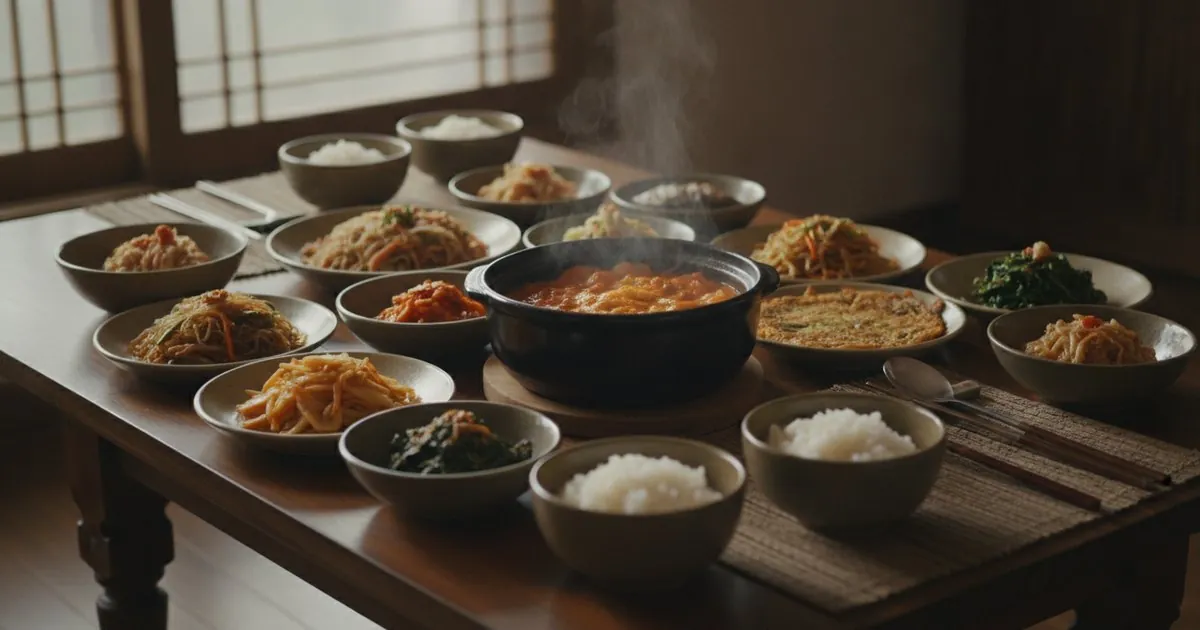
If you’ve ever started a K-drama at 10pm and ended up frantically Googling “Korean restaurant near me” at midnight, you already understand the problem. Korean television does something almost unfair with food: it turns a pot of instant ramyeon into a romantic proposition, a street cart of tteokbokki into a cathartic cry-fest, and a piece of hand-pulled sugar candy into the most suspenseful five minutes you’ve ever watched.
Food in K-dramas is never just food. It’s the visual language of love, grief, loneliness, and belonging — and the camera always, always lingers on it. This guide unpacks the most iconic food scenes in K-drama history, the cultural weight behind them, and the practical knowledge to bring those moments into your own kitchen.
Why Food Hits Different in K-Dramas
The standard Korean greeting isn’t “How are you?” It’s “밥 먹었어?” (Bap meogeosseo? — “Did you eat?”). Food is embedded so deeply in Korean culture that it functions as a proxy for emotional wellbeing, care, and connection. K-drama writers exploit this instinctively.
Every dish carries a specific emotional register that Korean audiences read immediately:
- Ramyeon eaten alone at 2am signals existential exhaustion; offered to someone at the door signals romantic interest
- Tteokbokki at a street cart is comfort food for characters going through hard times — practically a supporting character in many dramas
- Korean BBQ is a social ritual where who sits where and who flips the meat exposes power dynamics before anyone has spoken a word
- A packed dosirak (도시락) lunch box signals parental devotion — or foreshadows its loss
- Convenience store triangle gimbap, eaten standing at a counter at midnight, conveys loneliness more efficiently than any monologue
This is all rooted in the Korean concept of jeong (정) — an untranslatable emotional bond combining affection, loyalty, and shared history. K-drama writers don’t explain jeong; they just show a bowl being passed over a garden wall, and the meaning travels instantly. Western viewers feel it even without the vocabulary for it.
The Ramyeon Invitation: Korea’s Most Loaded Question
“라면 먹고 갈래?” (Ramyeon meokgo gallae? — “Do you want to eat ramyeon before you leave?”) is arguably the most culturally loaded food phrase in Korean entertainment history. What sounds like a simple dinner offer is, in the right context, a romantic invitation delivered with maximum plausible deniability.
The phrase originated in the 2001 film One Fine Spring Day (dir. Hur Jin-ho) and has been recycled, winked at, and built upon across dozens of dramas since. In Goblin (2016), the early bonding scene between Gong Yoo and Kim Go-eun plays the trope with knowing irony. Crash Landing on You, What’s Wrong with Secretary Kim, and Mystic Pop-up Bar all deploy variations of it — and every time, the audience collectively holds its breath.
What makes the scene work dramatically is that the double meaning functions simultaneously. Both people know what’s actually being asked, both know the other knows, and both choose to engage with the surface reading anyway. Plausible deniability and full disclosure, stacked perfectly on top of each other.
Making Ramyeon the K-Drama Way
The crucial detail: the cultural weight here rests on instant ramyeon, not artisanal ramen. This matters. The dish’s power comes partly from its everydayness — it’s the meal anyone can make at midnight from cupboard ingredients.
The technique that produces the right result:
- Use Shin Ramyun (신라면) for the spiciest, most authentic result, or Ottogi Jin Ramen for a milder profile. Both are available at H Mart; Shin Ramyun now appears at many Whole Foods and Costco locations.
- Use 400ml (about 1¾ cups) of water — slightly less than the package specifies. The sauce should be thick enough to coat the noodles, not brothy.
- Add 1 egg during the last 90 seconds: crack it directly into the pot, cover briefly, and pull the pot off heat while the white is just set and the yolk is still runny.
- Finish with sliced green onions, a few drops of sesame oil, and — counterintuitively but correctly — a single slice of processed cheese laid on top. It melts into the broth and rounds out the heat in a way that feels almost engineered.
- Eat it from the pot at the stove. This is non-negotiable for the full experience.
The diagnostic sound: you want a steady active simmer, not a rolling boil that disintegrates noodles before they absorb flavor.
Dalgona Candy in Squid Game: The Childhood Treat That Gripped 142 Million People
Squid Game (2021) introduced an enormous global audience to dalgona (달고나) — also called ppopki (뽑기) by street vendors — in Episode 3, when contestants must carve shapes from a fragile sugar candy disc without cracking it. Circle, triangle, star, umbrella: five minutes on the clock, one slip means elimination.
The tension is amplified by history. Dalgona emerged in post-Korean War mid-1950s Korea, made from nothing but sugar and baking soda, sold by street vendors for a few won. The shape-carving game was real and widely played: successfully separate your shape without cracking it, and you earned another candy for free. For children with little money, that skill represented a genuinely meaningful reward.
Seoul-based candymaker Segyero Dalgona, operating near Hyehwa subway station, hand-crafted 700 individual dalgonas for the Squid Game production. After the show aired, their stand went from pandemic survival mode to selling 400–500 candies per day, with customers queuing an hour and traveling from other cities. The umbrella shape — the one chosen by protagonist Seong Gi-hun — became the most-requested option from customers who had clearly watched the show and wanted to feel his specific dread.
Making Dalgona at Home
The full technique lives in our dedicated dalgona candy guide, but the essentials are two ingredients and one narrow window of timing:
- 50g (¼ cup) white granulated sugar per candy disc
- ½ tsp (2g) baking soda, pre-measured and ready before you start
- A heavy ladle or small skillet, a flat oiled surface, and a cookie cutter for the shape
Melt the sugar over medium-low heat until it reaches a warm amber — like dark honey, not pale gold, not mahogany. Add the baking soda all at once, stir hard for three seconds (it will puff dramatically), pour immediately, and press your shape in while the surface is still pliable. The window between “perfect” and “cracked” is about 30 seconds.
Reply 1988: The Neighborhood That Cooked Together
Reply 1988 (2015–2016) uses food as its central emotional language more effectively than almost any other K-drama. Set in the Ssangmun-dong neighborhood of Seoul, the show follows five families living side by side, and its defining visual image is food crossing the low walls between houses.
Mothers pass bowls of kimchi jjigae, fresh doenjang soup, sticky rice cakes, and curry over fences not as transactions but as expressions of jeong — not charity, not obligation, just the daily maintenance of collective belonging. When one family eats well, they share. When one family struggles, the others silently leave food at the door.
The scene that crystallizes this most movingly involves a simple bowl of miyeok guk (미역국) — seaweed soup — made by one mother for another mother’s birthday. In Korean culture, this soup is eaten on your birthday to honor the mother who gave birth to you. Making it for someone else’s mother is, in the drama’s logic, one of the most profound acts of care one person can extend to another.
These scenes are difficult to watch without thinking about your own neighborhood, the last time you brought someone food without being asked.
Chimaek: The Beer-and-Chicken Ritual
치맥 (chimaek = chicken + maekju/beer) appears throughout K-dramas because it’s the perfect emotional-reset food. In My Love from the Star (2013–2014), actress Jun Ji-hyun’s obsessive enthusiasm for fried chicken and beer became so strongly associated with the show that chimaek sales rose measurably in South Korea and China during its broadcast run.
The K-drama chimaek scene follows a reliable emotional arc: things have been tense, someone appears with a bucket of fried chicken, two or more people end up on a rooftop or outside a convenience store with paper cups of beer at night, and conversation becomes honest again. The food breaks the formal register.
What Western viewers sometimes miss: Korean fried chicken is double-fried, producing a crust that crackles rather than bends when you bite through it. The full double-fry method is in our Korean fried chicken guide, but briefly: first fry at 160°C (320°F) to cook through, rest 5 minutes on a wire rack, then fry again at 180°C (356°F) for 3 minutes until the coating sets to a lacquer-hard finish. That sound — the hard crack of each bite — is what the drama scenes are actually capturing.
Tteokbokki: Street Food for Hard Days
No K-drama food survey is complete without tteokbokki (떡볶이). The chewy rice cakes in their deep-red gochujang sauce appear whenever a character is suffering: eaten at pojangmacha (street food tents) in the rain, in school uniforms on the walk home, alone at a stall with eyes that are too bright.
The appeal is partly sensory: gochujang’s fermented heat delivers mild endorphin release, and the resistance of chewy rice cakes demands full physical attention that briefly crowds out circular thinking. It’s also affordable, immediate, and best shared from a communal pot — all of which serve drama writers who need to show characters becoming vulnerable together.
The diagnostic indicator for properly made tteokbokki: the sauce should coat the back of a spoon and be a deep brick-red. Orange sauce means the gochujang hasn’t fully incorporated and developed; brown sauce means it’s scorching. The rice cakes should yield to a fork but push back slightly — if they cut like tofu, they’re overdone. Full recipe in our tteokbokki guide.
Korean BBQ: Hierarchy Served Hot
Korean BBQ scenes in K-dramas function as social X-rays. In Korean dining culture, the most senior person at the table typically does not grill. Someone else — usually the youngest, or the most socially eager — takes on grill duty as a form of respect. Who cuts the meat with scissors (slicing samgyeopsal into bite-sized pieces directly on the grill) is equally loaded: it’s a technical service act, and in the right relational context, cutting someone’s meat is a gesture of quiet devotion.
It’s Okay to Not Be Okay uses this small act memorably, because the drama has built enough context around the characters that the gesture of cutting someone’s food lands with the weight of a declaration.
For home setup, a cast-iron grill pan works for smaller gatherings — the full equipment and technique guide is at our Korean BBQ at home page. The key variable on screen that’s also the key variable at home: grill temperature. You want the meat to sear audibly the moment it touches the grate, not sit in slowly building heat. If you can’t hear it sizzle immediately, the grill isn’t ready.
Convenience Store Scenes: The Geography of Loneliness
One specifically contemporary K-drama food moment is the convenience store sequence. Characters eat triangle gimbap (삼각김밥), ramyeon from a paper cup, fish cake skewers in cloudy broth, and canned coffee — alone, standing up, often after a difficult revelation. Korean convenience stores (CU, GS25, 7-Eleven Korea) are genuinely excellent food environments, but on screen they serve a specific narrative purpose: they’re neither home nor restaurant, but a liminal space where a character can exist without social obligation.
The camera holds on someone eating alone in a lit-up convenience store while darkness presses against the windows outside, and somehow it’s devastating every time.
Triangle gimbap is increasingly available pre-made at H Mart and Korean supermarkets in the US. Making them at home starts with the same fundamentals as regular gimbap — see our gimbap guide for seasoning ratios and rice technique — but the triangular shape and the characteristic crinkle-wrap are part of the eating experience that makes the on-screen moment legible.
Common Mistakes to Avoid
These are the specific failure modes that come up repeatedly when recreating K-drama food moments at home — diagnostic problems with real fixes, not general cooking reminders.
1. Burning Dalgona Because the Heat Is Too High
Dalgona contains no fat or liquid to buffer heat fluctuation, which means temperature control is everything. On medium or high heat, sugar will crystallize and scorch at the edges while the center is still granular. Fix: Use medium-low heat and expect the melt to take 3–4 minutes. Target color: warm amber, like dark honey. Pale gold means underdeveloped (too bitter and brittle to carve cleanly); mahogany means burnt (acrid). The moment you see the first wisp of smoke, pull the ladle from heat immediately — it will continue to darken from residual heat.
2. Adding Baking Soda Too Slowly to Dalgona
Once the sugar reaches amber, you have roughly 10 seconds before it starts setting. If you add baking soda in stages or stir too gently, you’ll get uneven aeration — some spots honeycombed, others solid — and the candy will shatter unpredictably when you try to carve shapes. Fix: Pre-measure baking soda before you touch the sugar. Add all of it at once and stir hard and fast for 3–4 seconds only. Pour immediately onto your prepared surface. Speed matters more than thoroughness at this stage.
3. Overcooking Ramyeon Into Mush
The 3-minute cook time on most ramyeon packages is calibrated for already-boiling water. If noodles go into water that’s merely hot, they spend extra time in suboptimal heat and emerge starchy and soft, with the broth tasting watered-down. Fix: Bring water to a hard, rolling boil before the noodles go in. Pull 30 seconds before the package time and taste: the noodles should have faint resistance at the core. They’ll continue cooking in the hot broth off heat, and they should be al dente when they reach the table.
4. Making Tteokbokki Sauce That’s Thin and Flat
When scaling tteokbokki for one or two people — the typical K-drama serving — under-reducing the sauce is the most common error. Watery sauce doesn’t cling to rice cakes, doesn’t deliver the characteristic glossy coat, and tastes flat because the gochujang hasn’t concentrated. Fix: After adding rice cakes, cook uncovered on medium heat, stirring frequently. The sauce is ready when it visibly thickens, becomes glossy, and leaves a brief trail on the pan when you drag a spoon through it — typically 8–10 minutes. If it reduces too fast before the rice cakes are cooked through, add water one tablespoon at a time.
5. Skipping the Rest Between Double-Fry Batches for Korean Fried Chicken
The chimaek crunch depends on double-frying, but the 5-minute rest between fries is just as critical as the second fry. Pulling chicken from the first fry and immediately returning it to the oil traps steam inside the crust — the coating goes soggy before the second fry can set it. Fix: Rest fried chicken on a wire rack (not paper towels, which trap steam against the crust) after the first fry. The coating should feel dry and firm to the touch before the second fry begins. If it still feels damp, give it another minute of rest.
6. Using the Wrong Rice Cake — or Skipping the Soak
Multiple types of tteok appear in Korean markets. Only the cylinder-shaped garaetteok (가래떡) is correct for tteokbokki; flat oval soup tteok disintegrates. Equally important: frozen rice cakes placed directly into sauce cook unevenly — mushy outside, hard inside. Fix: Thaw frozen rice cakes completely and soak in cold water for 20–30 minutes before cooking. The correct texture before they hit the sauce: they should flex without cracking when bent, and feel uniformly pliable throughout.
Frequently Asked Questions
What is the ramyeon invitation in K-dramas?
“라면 먹고 갈래?” (Ramyeon meokgo gallae? — “Would you like to eat ramyeon before you go?”) sounds like a simple dinner offer but functions as a romantic proposition in the right context. The plausible deniability is part of its power: both people can treat the offer as literally about food if needed. The phrase originated in the 2001 Korean film One Fine Spring Day and has been used, subverted, and built upon in dozens of dramas since.
Where can I find dalgona candy ingredients in the US?
Only white granulated sugar and baking soda — both available at any grocery store. No special equipment is needed beyond a heavy ladle, a flat surface, and a cookie cutter for shapes. The complete technique with timing and troubleshooting is in our dalgona candy guide.
What exactly is chimaek?
치맥 (chimaek) combines chicken (Korean-style fried chicken) with maekju (beer). It’s an informal comfort ritual that appears throughout K-dramas as the food that breaks social tension and allows honest conversation. The chicken is distinctly Korean-style: double-fried for a crust that cracks rather than bends, often glazed with sweet-spicy or soy-garlic sauces.
Why do so many K-drama characters eat tteokbokki when they’re upset?
Tteokbokki is cheap, hot, immediately available from street carts and pojangmacha tents throughout Korea, and the gochujang heat triggers mild endorphin release. The physical act of chewing through dense rice cakes also requires enough attention that it briefly interrupts circular thinking. Narratively, it’s also visually arresting — the deep red sauce and rising steam photograph beautifully in night scenes.
Is Reply 1988 worth watching just for the food scenes?
Without qualification, yes — though you’ll end up watching the whole thing. The drama uses food as emotional shorthand with a precision that’s genuinely affecting, and the neighborhood cooking-and-sharing scenes capture a particular kind of communal warmth that’s rare in any television genre. Have real snacks within reach. You will be hungry within the first twenty minutes, and you will not want to stop watching long enough to cook.