
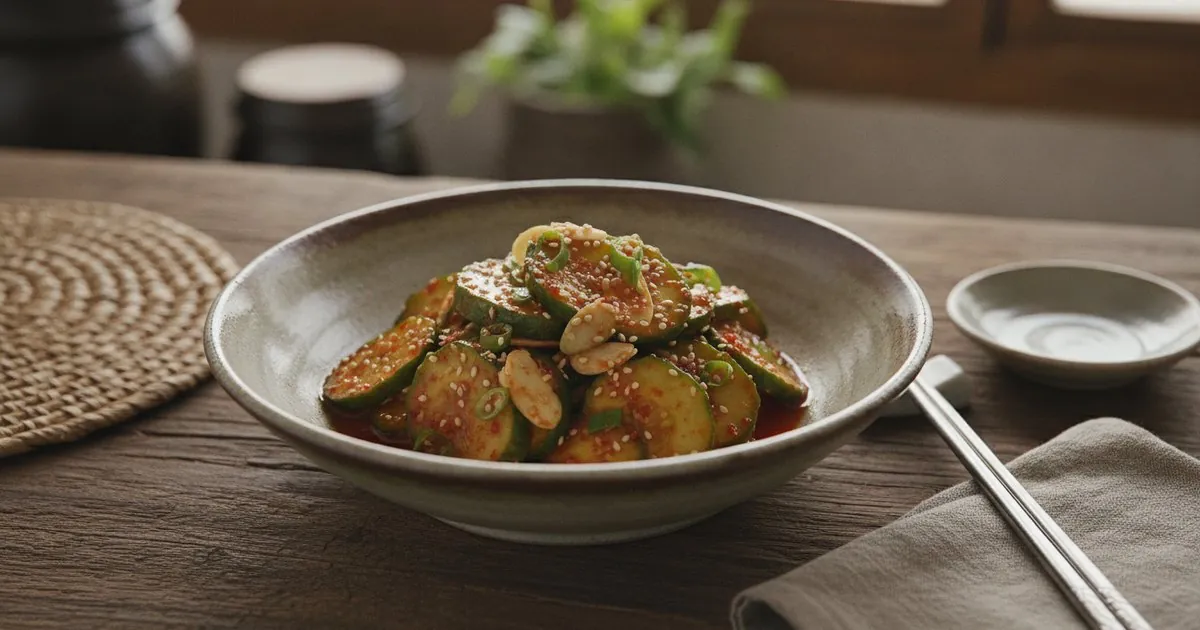
If there is one banchan that earns its place on every Korean table regardless of what else is being served, it is oi muchim. Literally “seasoned cucumber,” this is a dish of very few moving parts — sliced cucumber, a short list of bold seasonings, and a quick squeeze of your hands — and yet it somehow manages to make everything around it taste better. It is what you make when you need a fresh, punchy side dish in under 20 minutes and you want it to feel genuinely Korean rather than merely adjacent to Korean.
Unlike kimchi, there is no fermentation here, no waiting days for tangy funk to develop. Oi muchim is Korean cooking at its most immediate: sharp garlic, smoky-fruity gochugaru, toasted sesame, and cucumber that is somehow simultaneously crisp and deeply seasoned. The catch, as with most “simple” dishes, is that the details matter enormously. Get a few things right and it is exceptional. Get them wrong and you end up with a watery, pale, oddly flat salad that bears no resemblance to what you had at a Korean restaurant. This guide covers both sides of that equation.
What Exactly Is Oi Muchim?
Oi muchim (오이무침) is a muchim-style banchan. Let’s unpack that. Banchan (반찬) refers to the array of small, communal side dishes that accompany rice and soup at a Korean meal — a tradition central to Korean food culture and covered in depth in our banchan guide. Within the world of banchan, muchim (무침) describes a specific preparation style: the word comes from the verb 무치다 (muchida), meaning “to toss or dress something with seasonings.” Think of it as the Korean analogue to a dressed salad, except the seasoning is far bolder and the whole thing comes together in minutes.
What defines muchim-style dishes is their directness. Raw or briefly blanched vegetables are tossed with a seasoning blend — typically gochugaru, garlic, sesame oil, vinegar, and something savory — right before serving. No marinating for hours, no application of heat. The freshness is the point.
Oi muchim is frequently confused with two other cucumber preparations worth distinguishing: oi kimchi (fermented stuffed cucumber kimchi, which takes hours to days and involves full fermentation) and oi naengchae (a milder, more delicately dressed cucumber dish associated with formal or royal cuisine). Oi muchim is the everyday, accessible one — spicy, assertive, and designed to go with anything.
Banchan, History, and a Dish Shaped by Korean Kitchen Culture
The banchan tradition in Korea is deeply rooted, though pinpointing exactly when and how it developed is genuinely complex — food historians debate the specifics. What’s clear is that vegetable-based side dishes were central to Korean cooking long before formal historical records, driven partly by the agricultural rhythms of the peninsula and the practical need to extend and preserve seasonal produce.
By the Joseon Dynasty (1392–1897), banchan had become a codified part of Korean dining culture, particularly in court settings. The famous 수라상 (surasang) — the royal dining table — was an elaborate affair; the 12-cheop surasang (a formal twelve-dish table setting) represented the highest expression of court hospitality, though how strictly this mapped onto everyday class distinctions in ordinary households was likely far more variable than the idealized accounts suggest.
What this history gives us is a framework for understanding why a dish like oi muchim matters: it represents the democratized, home-kitchen end of a culinary tradition that prizes small, well-seasoned vegetable dishes as essential to a balanced, complete meal. It is one of the most approachable banchan to learn, and because the recipe is so minimal, it is also one of the most personal. Maangchi, whose accessible Korean cooking content has introduced millions of people outside Korea to dishes like this one, has noted that most Korean families have their own version — a small variation in the ratio of garlic to gochugaru, a splash of soy sauce instead of fish sauce, a preference for thin rounds over half-moons. This is what 손맛 (sonmat) looks like in practice: the cook’s hand, their preferences, their calibration.
Which Cucumber to Use — and Why It Matters
The cucumber variety you choose has a real, measurable effect on the finished dish. Here is how to think about it:
Korean cucumbers are the traditional choice: long, slender, thin-skinned, mildly bitter, and relatively low in seeds. The thin skin means you do not need to peel them, and the flesh stays crisp under salt without turning mushy. Find them at H Mart, Hana, 99 Ranch, or any Korean or pan-Asian grocery store. If you see cucumbers labeled “Korean” or sometimes sold loose and unmarked in Asian markets, those are almost certainly what you want.
Persian cucumbers — the small, smooth-skinned variety sold in sealed bags at Whole Foods, Trader Joe’s, and most major supermarkets — are the best widely available substitute. They have thin skin, minimal seeds, firm flesh, and low moisture content. Slice them into rounds; no peeling, no seeding needed.
English (hothouse) cucumbers — the long ones in individual plastic wrap — work well. Halve lengthwise, then slice into half-moons. They have a mild flavor and thin skin. The moisture content is slightly higher than Korean or Persian, so be thorough when squeezing.
Kirby (pickling) cucumbers: Excellent texture, firm and crunchy. A solid option if you find them.
Standard American slicing cucumbers (the thick-waxy-skinned ones at every supermarket): Use only as a last resort. The skin is tough and worth peeling. More importantly, the large seed cavity is very watery — you need to scoop out the seeds before salting, or the final dish will be waterlogged regardless of how hard you squeeze.
Whatever cucumber you use: buy it whole and cut it yourself right before making the dish. Pre-sliced or cut cucumbers have absorbed moisture from the exposed flesh, which undermines both crunch and seasoning absorption.
The Seasoning: What Goes In and Why
The ingredient list for oi muchim is short. That brevity is not an invitation to substitute freely — each component is doing specific work.
Gochugaru (고추가루) is the anchor. Korean red pepper flakes are coarser, fruitier, and smokier than cayenne or Italian crushed red pepper — think more of a dried fruit-forward heat than a sharp, narrow burn. Gochugaru is what gives oi muchim its signature red-orange color and its particular kind of warming, lingering heat. It is not interchangeable with other chile products. You can find it at any Korean grocery, and increasingly at Whole Foods (often in the international aisle) and specialty food stores. Store opened packages in a sealed bag in the freezer — it loses potency over time and stays vibrant for up to a year when frozen.
For a deeper look at Korean chile products — including the difference between gochugaru and gochujang — see our complete gochugaru and gochujang guide.
Garlic must be fresh and must be minced right before you use it. Raw fresh garlic provides the volatile aromatic compounds — the sharp, pungent bite — that is inseparable from oi muchim’s character. Jarred pre-minced garlic is fermented and often slightly bitter; it produces a flat, muted result. This is one of those ingredients where the substitution genuinely changes the dish.
Sesame oil — specifically toasted (dark) sesame oil — adds warmth and nuttiness. A tablespoon is enough; more will overwhelm. This is a finishing oil, not a cooking oil.
Rice vinegar provides gentle acidity that brightens the whole thing. White vinegar works in a pinch but is sharper; apple cider vinegar adds its own flavor that clashes slightly. Stick to rice vinegar when possible.
Fish sauce (optional) adds savory depth — a background umami that you notice in its absence. For a vegan version, omit it entirely, or replace with ½ tsp soy sauce for a different but valid umami note.
Sugar: not enough to taste sweet, but enough to round out the heat and tie the seasoning together.
Step-by-Step: Making Oi Muchim
Step 1: Salt and Squeeze the Cucumber
Slice the cucumber into uniform pieces — half-moons, rounds, or short batons, all 3–4 mm (⅛ inch) thick. Toss with ¾ tsp fine sea salt, stir well, and leave for 8–10 minutes. The surface of the cucumber should look slightly wet and the bowl should have visible liquid pooling at the bottom after this time.
Now squeeze. Pick up a handful of cucumber and compress it firmly in your fist over the sink. The goal is to remove as much internal water as possible. This step physically transforms the dish: squeezed cucumber absorbs the seasoning deeply and retains its snap; unsqueezed cucumber dilutes the dressing and goes limp within minutes.
Step 2: Build the Seasoning Paste
Combine gochugaru, garlic, green onion, sesame oil, rice vinegar, sugar, and fish sauce in a bowl large enough to toss the cucumber in. Stir until the sugar is dissolved and the dry gochugaru has absorbed the liquid — it should look like a rough, slightly glossy paste, uniformly red. Taste it: at this stage it should be assertively bold. The cucumber is bland and will absorb and dilute the seasoning as you toss.
Step 3: Toss, Taste, Adjust
Add the squeezed cucumber to the bowl. Toss with your hands or large spoons, pressing firmly so every surface gets coated. The finished dish should be a deep, even red-orange — no pale patches. Add sesame seeds and toss again.
Taste. If the heat is too sharp at the front, add a small pinch of sugar. If it tastes flat or thin, add a drop more fish sauce or a pinch of salt. If it feels heavy or slightly dull, a few more drops of rice vinegar will sharpen it. Adjust in very small amounts — it’s a short ingredient list and adjustments are immediate.
Serving and Storage
Oi muchim belongs on the table alongside virtually anything Korean. It is a natural pairing with Korean BBQ at home — the fresh crunch and heat cut through rich grilled meat perfectly. It works alongside steamed rice and a bowl of soup, or as part of a wider banchan spread. The cucumber’s crunch and the gochugaru’s heat also make it a lively addition to a bibimbap bowl.
Serve immediately after tossing for the best texture. After 30–60 minutes, the cucumber continues to release moisture and the crunch starts to soften — not bad, but different. Day-two oi muchim, refrigerated in an airtight container and drained of excess liquid, has a more intensely seasoned, marinated quality that some people actively prefer.
For meal prep: salt and squeeze the cucumber in advance and keep it dry in the fridge. Store the seasoning paste separately. Toss together 10 minutes before serving.
Common Mistakes to Avoid
1. Not squeezing the cucumber thoroughly enough. This is the number-one reason oi muchim turns out watery. Salting does the work of drawing moisture out, but you still have to physically remove it. If your finished dish has a pool of red liquid at the bottom of the bowl within five minutes, the cucumber was not squeezed hard enough. Squeeze each handful until very little additional liquid comes out. It should feel noticeably drier and somewhat compressed when done correctly.
2. Using the wrong chile — or too little gochugaru. A properly made oi muchim looks vibrantly, unmistakably red-orange. If yours is pale pink or rust-colored, you have either used too little gochugaru or substituted a different chile powder. Cayenne produces a narrow, hot spike without fruity depth; Italian crushed red pepper has a completely different flavor register. If the heat from gochugaru feels too much, reduce the quantity slightly rather than switching products — even 1 tsp will give you the characteristic flavor at a gentler heat level.
3. Using jarred or pre-minced garlic. The sharpness in oi muchim depends on raw garlic’s volatile compounds, which begin dissipating quickly once the clove is cut. Jarred garlic has already fermented slightly and lacks that punch. If your oi muchim smells pleasant but tastes strangely flat and lacks the appealing garlicky sharpness you expect, this is almost certainly the reason. Mince garlic fresh, just before you need it.
4. Cutting cucumber slices unevenly. Thick slices will be underseasonsd and crunchy at the core; thin slices will be limp. Mixed thicknesses in the same batch mean you’ll have both problems simultaneously. Take the extra 60 seconds to cut uniformly. If you own a mandoline, this is a good use for it.
5. Making it too far in advance. Oi muchim is not a dish that improves dramatically with time in the way that kimchi or braised dishes do. The window for optimal crunch is roughly 10–60 minutes after tossing. If you are making it for guests, toss the salad as the last thing you do before sitting down, not an hour before. Prep the components — sliced and squeezed cucumber, prepared seasoning paste — in advance and combine them at the last moment.
6. Over-salting during the drawing step. The ¾ tsp of salt in this recipe is calibrated to draw moisture and season the cucumber without making the finished dish too salty. Doubling the salt in the hope of speeding up moisture extraction will produce cucumber that is too salty to rescue with additional ingredients. If you realize you’ve over-salted, give the squeezed cucumber a brief rinse under cold water and pat dry — it helps, but it’s better not to need it.
Frequently Asked Questions
Is oi muchim the same thing as cucumber kimchi? No. Oi kimchi (cucumber kimchi) involves fermentation — the cucumber is stuffed or combined with a paste and left to ferment for anywhere from a few hours to several days. Oi muchim is a fresh, quickly dressed dish with zero fermentation time. They share some common seasonings — gochugaru, garlic, green onion — but the processes, textures, and flavor profiles are distinct.
Can I make oi muchim without gochugaru? You can make a sesame-garlic dressed cucumber without it, but it won’t be oi muchim — the gochugaru is what defines both the flavor and the dish’s identity. If you’re sensitive to heat, use less rather than substituting entirely. Even 1 tsp gives you the characteristic fruity-smoky flavor at a much gentler heat level.
How do I make this completely vegan? Simply leave out the fish sauce. The dish is naturally vegan without it. If you’d like to add back some savory depth, ½ tsp of soy sauce is a reasonable stand-in, though it shifts the flavor slightly.
My oi muchim looks the right color but tastes surprisingly bland. What went wrong? Two likely culprits: (1) Insufficient squeezing — residual moisture in the cucumber is diluting the dressing from the inside. (2) Old gochugaru that has lost its potency — once opened, gochugaru exposed to air and ambient temperature loses flavor compounds over weeks. If yours has been sitting open in a pantry for months, it may look red but taste mild. Store opened gochugaru in the freezer going forward.
What is the difference between gochugaru and gochujang, and can I use them interchangeably in this recipe? Gochugaru is dried, ground Korean red pepper — pure chile, no additives. Gochujang is a fermented paste made from gochugaru combined with glutinous rice, salt, and fermented soybeans; it is sticky, sweet-savory, and considerably more complex in flavor. Most oi muchim recipes call for gochugaru. A small number use a tablespoon of gochujang in combination with gochugaru for extra depth, but they are not interchangeable at the same quantities — gochujang is sweeter, saltier, and less heat-forward. Stick to gochugaru for a classic result.