
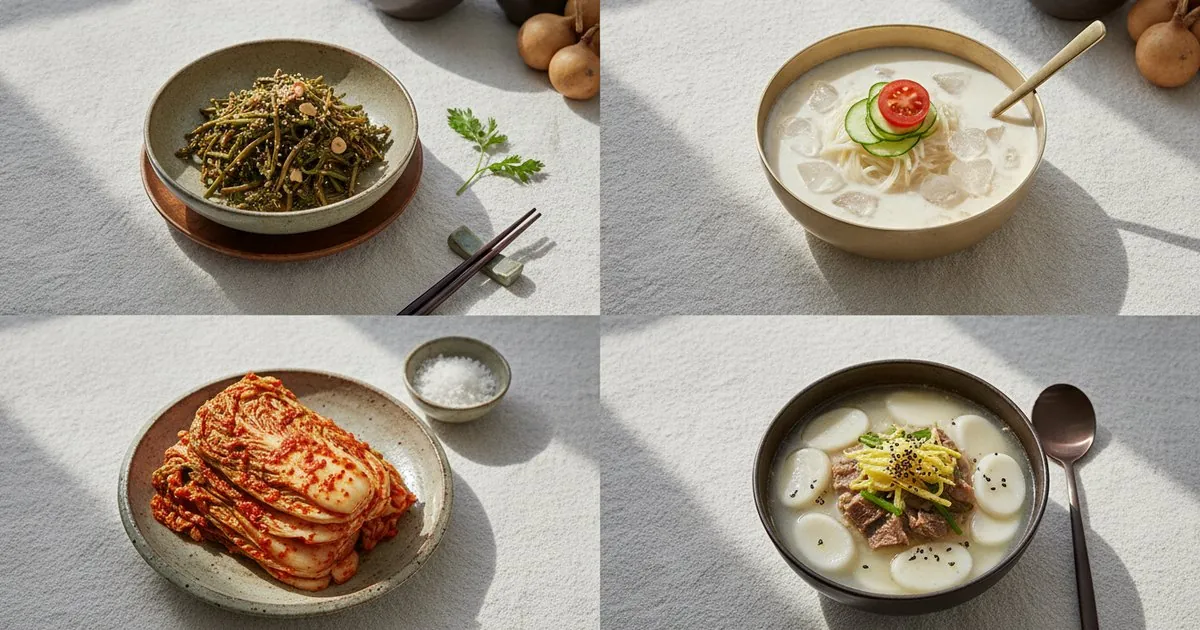
Walk into a Korean home kitchen in November and you won’t just find dinner being prepared — you’ll find winter being negotiated. Massive ceramic onggi pots are being scrubbed. Napa cabbages are stacked in the yard. The whole family is rolling up their sleeves. This is kimjang, the communal kimchi-making ritual, and it doesn’t happen randomly. It happens at a very specific window of time dictated by a 3,000-year-old agricultural calendar.
This is the essence of Korean seasonal eating: not a trend, not a wellness fad, but a deep-running system that connects every meal to the turning of the Earth. If you’ve ever wondered why Koreans eat scorching hot soup on the hottest days of summer, or why a specific rice porridge appears only on the winter solstice — this guide answers those questions from the ground up.
The 24 Jeolgi: Korea’s Micro-Season Calendar
Most Westerners think in four seasons. Traditional Korean culture thinks in 24.
These are the jeolgi (절기) — micro-seasons of approximately 15 days each, inherited from the East Asian lunisolar calendar and listed as a UNESCO Intangible Cultural Asset. While China and Japan share the same framework, Korea adapted the jeolgi to its own climate, crops, and culinary customs with remarkable specificity.
Here’s a condensed tour of the full year through jeolgi:
| Period | Jeolgi | ~Date | What It Signals |
|---|---|---|---|
| Winter | Sohan / Daehan | Jan 6 / Jan 21 | Small Cold → Great Cold |
| Spring begins | Ipchun | Feb 4 | Spring’s threshold — auspicious characters hung above doors |
| Spring deepens | Gyungchip | Mar 5 | Insects wake from hibernation; wild greens emerge |
| Spring equinox | Chunboon | Mar 20 | Balance of yin and yang |
| Rain season | Gokwoo | Apr 20 | ”Rain on grain” — premium first-flush teas harvested now |
| Summer begins | Ip-ha | May 5 | Heat builds; women began tending silkworms |
| Peak summer | Daeseo | Jul 22 | Maximum heat — samgyetang season |
| Autumn begins | Ipchoo | Aug 7 | The harvest outcome begins to be determined |
| Autumn equinox | Chooboon | Sep 22 | Cool nights, chrysanthemum wine time |
| Frost arrives | Sanggang | Oct 23 | Persimmons at peak; first hard frosts |
| Winter begins | Ipdong | Nov 7 | 🔴 Kimjang trigger — kimchi made within 5 days of this date is said to taste best |
| Winter solstice | Dongji | Dec 21–22 | Red bean porridge (patjuk) eaten to ward off evil spirits |
The practical value of this system is staggering. Each jeolgi tells farmers (and cooks) exactly which ingredients are at their nutritional peak, which preservation techniques are needed, and which medicinal foods will support the body through the coming transition. It’s a living almanac — and Korean cuisine is its output.
The Philosophy That Makes It All Tick
Before diving into specific seasonal foods, you need two core principles that govern why Koreans eat what they eat, when they eat it.
1. Iyeolchiyeol (이열치열): Fight Heat with Heat
This is the principle that baffles most Westerners: on the hottest days of Korean summer — during Daeseo in late July — the traditional response is to eat something hot. Specifically, samgyetang, a whole young chicken stuffed with glutinous rice, ginseng, garlic, and jujubes, simmered for hours until the broth is a rich, opaque ivory.
The logic is sound: consuming hot food induces sweating, which cools the body through evaporation and — according to both hanbang (traditional Korean medicine) tradition and emerging food science research — helps the body adapt to the thermal stress. It’s counterintuitive to a Western palate raised on iced drinks and cold salads, but once you try it on a sweltering August afternoon, the lingering warmth feels genuinely restorative rather than punishing.
2. Yak-sik-dong-won (약식동원): Food and Medicine Share the Same Root
Published research in the Journal of Ethnic Foods (Springer Nature) identifies this principle as the philosophical foundation of Korean food culture. There is no clean line between eating for pleasure and eating for health — a properly prepared seasonal meal is medicine.
This connects to the five-element system (오행, ohaeng): each season corresponds to an element, a taste, and a color that supports specific organs and energy systems:
- Spring (Wood): Sour flavors, green foods — liver and gallbladder support
- Summer (Fire): Bitter flavors, red foods — heart and circulation
- Late Summer (Earth): Sweet flavors, yellow/orange foods — digestive system
- Autumn (Metal): Pungent/spicy flavors, white foods — lungs and immunity
- Winter (Water): Salty flavors, dark/black foods — kidneys and vitality
This is why five-grain rice (ogokbap, 오곡밥) uses five different grains and why the iconic bibimbap — with its riot of colorful toppings — isn’t just beautiful. It’s structurally balanced across the five-element color spectrum.
Season by Season: What Koreans Eat and Why
🌱 Spring (Ipchun → Ip-ha, Feb–May): The Forager’s Season
Spring in Korea is about what pushes through the soil before anything has been planted. The star ingredients are wild mountain greens — namul (나물) — including:
- Ssukgat (쑥갓): Crown daisy, slightly bitter, blanched and dressed with sesame oil
- Dureup (두릅): Fatsia shoots, briefly blanched and served with gochujang dip
- Gosari (고사리): Bracken fern, dried then reconstituted, stir-fried with garlic and soy
These early greens are intensely prized because they represent first growth — the most concentrated expression of the season’s rising energy. Their bitterness is intentional: according to the five-element framework, bitter spring greens support liver function after winter’s heavy, salty preservation foods.
For Western cooks: many of these namul greens are available dried or vacuum-packed at H Mart year-round. Fresh equivalents worth exploring include fiddlehead ferns (gosari substitute) and young spinach or arugula (for the peppery bitterness of ssukgat).
☀️ Summer (Ip-ha → Ipchoo, May–August): The Heat Strategy
Korean summer food is a masterclass in managing extreme heat — both external and internal. The two opposite strategies work in tandem:
Hot foods for sweat-cooling: Samgyetang (삼계탕) on Boknal — the three hottest “dog days” of summer, falling during Soseo and Daeseo. The ginseng is not decoration; it’s a genuine adaptogen with measurable effects on cortisol response. Ginseng quality matters: look for Korean red ginseng (hongssam) over other varieties for this application.
Cold foods for immediate cooling: Naengmyeon (냉면) — buckwheat noodles in an icy, tangy beef broth or with a punchy gochujang sauce (bibim naengmyeon). Bingsu (빙수) — shaved ice dessert loaded with red bean paste, rice cakes, and fruit — is the summer dessert. We’ve got a full deep-dive on bingsu right here if you want to try making it at home.
Fermented cooling: Cold dongchimi (water kimchi) and yeolmu kimchi (young radish kimchi) appear in summer. Their gentle acidity and high water content are genuinely thirst-quenching in a way that plain water isn’t.
🍂 Autumn (Ipchoo → Ipdong, Aug–November): The Harvest Table
Autumn is when Korean cuisine reaches its most spectacular abundance. The marker ingredient is the baechu (배추) — napa cabbage — which reaches peak density and sugar content in late October after the first cold snaps.
Other defining autumn foods:
- Hobak (호박): Pumpkin and squash, roasted or made into savory pancakes (hobak jeon)
- Kkot-gae (꽃게): Blue crab, peak season September–October; famously used in raw soy-marinated crab (ganjang gejang)
- Ssal (쌀): New-crop rice (haetsal) harvested from mid-October; its slightly sticky, sweet character is markedly different from older rice. If you can find it at Korean supermarkets in October–November, buy it.
- Chrysanthemum wine and persimmon: Traditional autumn beverages and snacks tied to the Sanggang jeolgi
❄️ Winter (Ipdong → Daehan, Nov–Feb): Preservation and Deep Warmth
Winter cooking in Korea is preservation cooking. The cold is an ingredient — literally, the outdoor temperatures during Ipdong create the ideal fermentation conditions for kimchi. Soups and stews (jjigae, guk) dominate: thick doenjang jjigae (fermented soybean paste stew), warming galbi-tang (short rib soup), and sullungtang (ox bone broth simmered for 12+ hours until milky white).
Dongji (winter solstice, ~Dec 21): One of the most specific food-calendar connections in Korean culture. Patjuk — red bean porridge with small white rice cake balls — is eaten in every home. The red color is meant to repel evil spirits and illness during the longest night of the year. The rice balls (saealsim) are added in a number equal to your age plus one; the extra ball is for the year ahead.
Kimjang: The Event That Defines Korean Winter
No discussion of Korean seasonal eating is complete without kimjang (김장) — the communal annual kimchi-making that UNESCO recognized as an Intangible Cultural Heritage of Humanity in 2013.
The timing window is precise: within approximately five days before or after Ipdong (November 7th), when daytime temperatures hover around 0–5°C (32–41°F) and nights dip below freezing. This temperature profile is not arbitrary. Too warm and fermentation races ahead unpredictably. Too cold and the cabbage won’t absorb the paste properly before freezing solid.
A family might make anywhere from 50 to 200 heads of cabbage worth of kimchi in a single weekend — enough to last through winter. The scale requires the whole family (and often neighbors) to work together. If you want to try making your own kimchi at home, our complete kimchi guide walks you through the process in manageable batches.
Bringing Seasonal Korean Eating Into Your Western Kitchen
You don’t need to live in Seoul to eat by the Korean calendar. A few practical translations:
- Shop ethnically by season: Korean grocery stores (H Mart, Hanahreum) stock produce that follows Korean seasonal patterns more accurately than Western supermarkets. The stock literally changes around the jeolgi transitions.
- Start with Ipdong: Make a batch of kimchi in early November. The temperature in most Northern Hemisphere kitchens/refrigerators approximates the conditions naturally.
- Apply iyeolchiyeol consciously: This coming August, make a pot of hot ginger chicken broth (dakguk) on the hottest day and note the physiological response. Most people are genuinely surprised.
- Use gochujang year-round but seasonally: In summer, gochujang-based cold sauces (bibim applications); in winter, gochujang in braises and stews. Our gochujang deep-dive covers all the variations.
- Source namul greens dried: Gosari, doraji (bellflower root), and mugeun-chi (aged kimchi) are all available dried or jarred at Asian grocery stores and increasingly on Amazon.
Common Mistakes to Avoid
1. Treating Jeolgi Like Western Seasons (and Missing the Windows)
The most common error is collapsing the 24-season system into “spring/summer/fall/winter” and missing the narrow windows where specific traditions apply. Kimjang done two weeks late — after temperatures have dipped and stayed below freezing — produces kimchi that doesn’t absorb the paste evenly. The outer leaves ferment before the inner core gets seasoned. Check a jeolgi calendar app (several are available in English) and target the Ipdong window specifically.
2. Making Samgyetang with the Wrong Ginseng
Iyeolchiyeol demands a hot, fortifying soup — but if you use fresh raw ginseng slices (available at Western health food stores) instead of dried Korean red ginseng (hongssam) or whole dried ginseng roots, you’ll get a faint, almost medicinal bitterness without the deep warming character the dish relies on. Look for ginseng roots at Korean grocery stores specifically, not supplement aisles. The broth should turn a pale golden amber and smell intensely earthy-sweet within the first hour of simmering.
3. Blanching Namul Greens Too Long
Spring wild greens should be blanched in aggressively salted boiling water for 30–90 seconds maximum, then plunged immediately into ice water. Over-blanching (3+ minutes) destroys the delicate bitterness that is the entire point of these greens within the five-element framework. The color should hold vivid green; anything olive-drab is overcooked. Squeeze firmly but don’t wring — excess water dilutes the sesame oil dressing.
4. Patjuk Rice Balls That Dissolve in the Porridge
The small rice cake balls (saealsim) for dongji patjuk should be firm enough to hold shape in hot red bean broth, which means the glutinous rice flour (chapssal-garu) dough must be kneaded with just-boiled water and rested for 10 minutes before rolling. Dough mixed with cold water produces balls that crack and fall apart. Balls that are too large (bigger than 2 cm / ¾ inch) won’t cook through evenly — the center stays raw while the outside turns gummy. Roll them to marble size.
5. Using Regular Cabbage for Kimjang (the Texture Failure)
Western green cabbage is denser, drier, and tougher than Korean napa cabbage (baechu). When salted for kimjang, it doesn’t achieve the correct wilted-but-still-snappy texture that lets the paste penetrate every layer. The result is kimchi with a rubbery exterior and raw-tasting interior even after weeks of fermentation. Napa cabbage is now widely available at mainstream supermarkets (Whole Foods, Trader Joe’s) in autumn — buy it there if you can’t reach an H Mart.
6. Skipping the Fermentation Rest Period for Summer Water Kimchi
Dongchimi (winter radish water kimchi) and its summer equivalents need time at room temperature — typically 24–48 hours at 20–22°C (68–72°F) — before refrigeration, to activate fermentation and develop that characteristic clean, lightly fizzy sourness. Cooks who refrigerate immediately end up with brine that never sours and radish that tastes raw and aggressively salty. When the brine starts to look slightly cloudy (not milky — cloudy) and you can detect a faint tang, it’s ready for cold storage.
FAQ
Q: Do I need to follow the full 24-season system, or can I just use the four main seasons as a guide?
The four-season framework gets you about 70% of the way there and is a perfectly reasonable starting point. The 24 jeolgi matter most for three things: kimjang timing (Ipdong window is critical), premium ingredient windows like first-flush tea (Gokwoo) and new-crop rice (post-Sanggang), and the solstice/equinox celebration foods like patjuk. Start with those and layer in more detail as you become comfortable.
Q: Is iyeolchiyeol (fighting heat with heat) actually supported by science, or is it folk belief?
Both, honestly. The sweating response to hot food is physiologically documented — eating hot spicy food genuinely increases perspiration, which can lower skin surface temperature. The ginseng and adaptogen components in samgyetang have measurable effects in peer-reviewed research, though the full picture is complex. Whether it makes you feel cooler is largely individual. The broader point is that it’s a coherent system that millions of people have used for centuries with apparent benefit.
Q: Where can I find a jeolgi calendar in English?
Search “Korean 24 solar terms 2026” and you’ll find multiple English-language resources with exact dates. Some Korean food apps (Maangchi’s app, Naver’s English food section) incorporate seasonal guidance. The dates shift by one or two days between years but are consistent in structure.
Q: Can I make kimjang-scale kimchi in a Western apartment without a traditional onggi pot?
Yes — food-grade plastic buckets (5-liter / 1.3-gallon capacity, available at kitchen supply stores and H Mart) work effectively. The key is keeping the kimchi below 4°C (39°F) after the initial room-temperature fermentation phase. A spare refrigerator dedicated to kimchi storage is ideal. Many Korean-Americans use a designated “kimchi fridge” — countertop models designed specifically to maintain the narrow temperature band optimal for kimchi maturation are available online.
Q: What’s the easiest way to start incorporating seasonal Korean eating if I’m completely new to K-food?
Start with banchan — small side dishes — and let the season guide your vegetable choices. In summer, make a cold cucumber namul (oi muchim). In autumn, roast and dress kabocha squash. In winter, braise daikon in soy and ginger. These small adjustments train your palate toward the Korean seasonal mode without requiring a complete kitchen overhaul. Our banchan guide is a solid next step.