
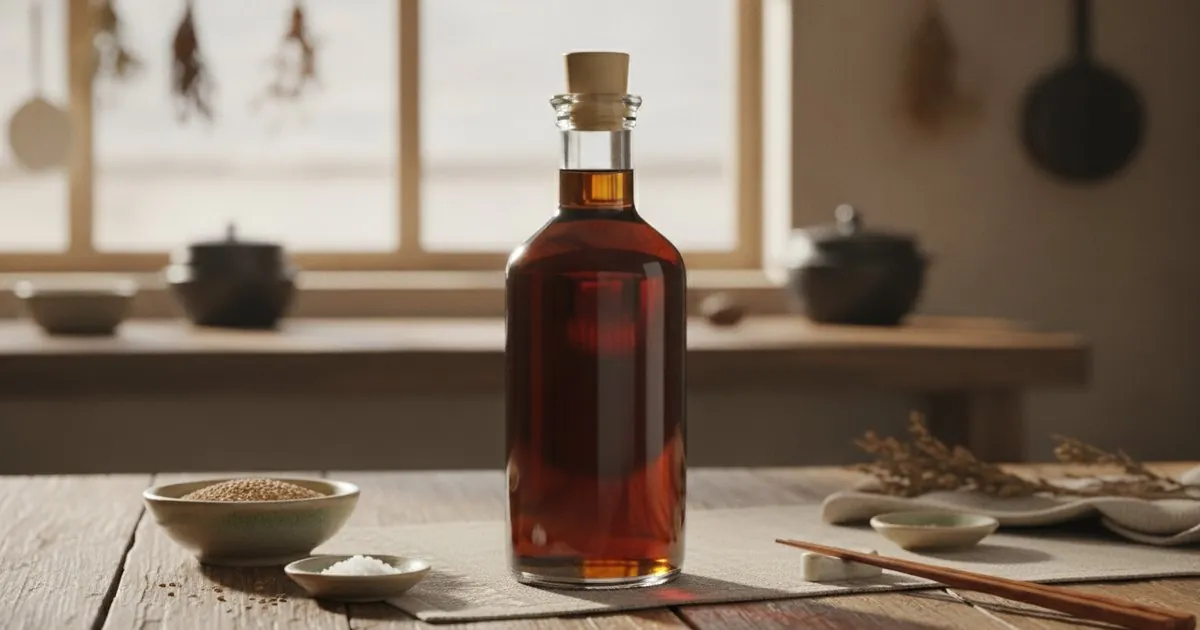
If you’ve ever cooked a Korean recipe, drizzled on a bottle of regular supermarket sesame oil, and thought something is missing — you’ve stumbled onto one of the most important flavour distinctions in all of Asian cooking. Korean sesame oil, called 참기름 (chamgireum), is not just “sesame oil with a stronger flavour.” It is a fundamentally different product, made through a radically more aggressive process, with a completely distinct aromatic profile. Once you understand why, you’ll never reach for the wrong bottle again.
What Is Chamgireum (참기름), Exactly?
The word chamgireum (참기름) translates literally as “true oil” — cham (참) meaning “true” or “genuine,” and gireum (기름) meaning “oil.” That name isn’t marketing. It reflects the deep cultural primacy of sesame oil in Korean cooking: of all the oils in the Korean kitchen, sesame was the oil. The essential one. The one that made food taste like itself.
Sesame seeds arrived on the Korean peninsula around 3,000 BC, traveling from India through China. By the time of the Three Kingdoms period (57 BC–668 AD), sesame oil was already significant enough to be recorded in the Samguk Yusa — a 13th-century chronicle of ancient Korean history — as an offering at Buddhist temples in the Silla kingdom. During the Goryeo dynasty (918–1392), yumilgwa (유밀과), a honey-sesame confection fried in sesame oil, was served at national banquets and Buddhist festivals. By the 10th century, Korea was exporting sesame oil to China.
That’s more than a thousand years of people figuring out exactly how to make this oil taste extraordinary. And they did.
Why Korean Sesame Oil Tastes So Different: The Roasting Is Everything
Here’s the straightforward answer: Korean sesame oil is made from seeds that are dry-roasted at extremely high temperatures — exceeding 210°C (410°F) — before pressing. That aggressive heat is the entire difference.
Most Western cooks encounter sesame oil from one of three traditions, and they are not interchangeable:
- Korean (chamgireum): Seeds are intensively dry-roasted, often in large woks or drum roasters, until they are deep brown and fragrant. The resulting oil is dark amber to brown, with a powerful, almost smoky roasted aroma. It is used almost exclusively as a finishing oil — never for frying.
- Japanese sesame oil: Traditionally cold-pressed, without significant roasting. The result is a pale golden oil with a clean, mild, barely-there nuttiness and a high smoke point. You can actually cook with it. Japanese cuisine uses it quite differently.
- Chinese sesame oil: Falls in the middle — roasted, but typically less intensively than Korean. The colour and flavour are both more moderate. Not wrong, but not what Korean recipes are calling for.
A peer-reviewed Korean academic study confirmed this clearly: when researchers compared Korean-grown and Chinese-grown sesame seeds side-by-side, they found no significant differences in fatty acid composition, sesamin (an antioxidant lignan), or tocopherol (vitamin E) content. The seeds themselves were nutritionally and chemically similar. But Korean sesame oil scored measurably darker in color and significantly higher in odour acceptance scores. The technique — specifically the roasting — was producing the difference, not the seed origin.
The Maillard Reaction: The Science of That Smell
If you want to understand why roasting at high temperatures creates such a distinctive aroma, the answer is the Maillard reaction — the same cascade of chemical reactions that gives bread its crust, coffee its depth, and seared steak its complexity. When heat is applied to sesame seeds, amino acids and reducing sugars react to create hundreds of new volatile aromatic compounds.
A 2025 study published in Frontiers in Nutrition, using gas chromatography-ion mobility spectrometry (GC-IMS), identified 74 distinct volatile organic compounds in hot-pressed roasted sesame oil, compared to just 4 in cold-pressed oil. That’s not a small difference — it’s a whole different aromatic world.
The most important of these compounds are pyrazines — specifically methylpyrazine, 2,5-dimethylpyrazine, and 2-ethyl-5-methylpyrazine. These are the molecules responsible for the roasty, nutty, “popcorn-like” quality that makes chamgireum so instantly recognizable. Pyrazines have an extremely low odour detection threshold, which means just a tiny amount in the oil registers powerfully on your nose and palate. In roasted sesame oil, pyrazines can account for up to half of all the volatile compounds detected. They are not subtle.
Also present: pyridines, pyrroles, thiophenes, furans, and aldehydes — a rich choir of aroma molecules that together produce the deep, warm, faintly smoky, nutty, slightly buttery character that chamgireum is known for.
In plain terms: if you open a bottle of good Korean sesame oil and can’t immediately smell it from 30 cm (12 inches) away, something is wrong with that bottle.
How to Buy Korean Sesame Oil in the West
What to Look For on the Label
- Language on label: Look for 참기름 (chamgireum) or 깨기름 (kkaegireum). Both refer to Korean-style roasted sesame oil.
- Colour check: Hold the bottle to light. Good chamgireum should be deep amber to warm brown — not pale yellow, not almost black. If it looks like pale gold, it’s not the right product for Korean recipes.
- Smell before you buy (if you can): Once opened, it should hit you immediately with roasted nuttiness. If the smell is faint or flat, the seeds were under-roasted or the oil is past its prime.
- Ingredient list: Ideally just “roasted sesame oil” or “roasted sesame seeds.” Avoid blends cut with other oils unless you’re buying a budget product knowingly.
- Premium domestically-pressed Korean oils: Look for labels indicating the seeds were grown and pressed in Korea (국산 참기름). These are significantly more expensive — often $15–25 USD per 160ml (5.4 fl oz) — but the flavour difference is real.
Where to Buy
- H Mart or any Korean grocery: The mothership. The Korean sesame oil section alone will have five to ten options at various price points. Ottogi (오뚜기), Beksul (백설), and CJ Haechandle brands are widely available and solid choices. For a step up, look for smaller-batch domestic Korean brands.
- Whole Foods: Carries a limited selection of toasted sesame oil, but these are often Japanese-style or Japanese-adjacent products. If the bottle is pale gold, it’s not chamgireum.
- Amazon: Reliable for Korean brands like Ottogi or Sempio if you don’t have a nearby Korean market.
- General Asian grocery stores: Often stock Chinese or Japanese sesame oil. Read the label carefully — look for “Korean” or “chamgireum” specifically.
If you’re ever unsure whether what you’ve bought is the right thing, pour a tiny drop on the back of your hand and smell it. Korean sesame oil should smell intensely roasted, like you crushed a handful of warm toasted sesame seeds. If it smells mild and clean, save that bottle for Japanese cooking and grab the right one for your Korean recipes.
How Korean Sesame Oil Is Actually Used
The Golden Rule: It’s a Finishing Oil
This is the single most important thing to understand about chamgireum: you do not cook with it. The beautiful aromatic compounds created by roasting are volatile — they evaporate rapidly at high heat. If you add chamgireum to a hot pan at the start of cooking, you’ll drive off most of what makes it special, leaving behind a slightly bitter ghost of itself.
Korean sesame oil belongs at the end: drizzled over a finished dish, stirred into a sauce off the heat, tossed through japchae noodles after they’ve left the pan, mixed into a salad dressing, folded into seasoned spinach (sigeumchi-namul).
Think of it the way an Italian cook thinks of finishing-quality extra virgin olive oil — not for sautéing, but for the final act.
How Much to Use
Korean sesame oil is intense. A little goes a long way.
- For dipping sauces and dressings: Start with 5ml (1 tsp) per 2–3 servings and taste before adding more.
- For finishing noodle or rice dishes: 5–10ml (1–2 tsp) per serving, tossed through right before eating.
- For marinades: 15ml (1 tbsp) per 500g (1.1 lb) of protein is a reasonable starting point. Note that marinating does cook off some aroma during the cooking process, so finishing with a few drops after cooking restores brightness.
- For seasoned vegetable banchan: Often as little as 3–5ml (½–1 tsp) per portion is enough. The oil coats well and distributes evenly.
When you’re making japchae or bibimbap, that final drizzle of chamgireum isn’t optional — it’s what ties the whole dish together.
Storing Your Sesame Oil Properly
Sesame oil’s natural antioxidants (tocopherols and sesamin/sesamolin lignans) give it better shelf stability than many other oils, but it is still vulnerable to light, heat, and air.
- Dark glass bottle: Good brands come packaged this way for a reason. If yours doesn’t, consider decanting into a dark glass container.
- Store in a cool, dark place: A pantry cupboard is fine for short-term use. For longer storage (more than a couple of months), the refrigerator is better. The oil may cloud slightly when cold — this is completely normal and reverses at room temperature.
- Smell-check regularly: Oxidized sesame oil smells acrid, stale, almost rancid — completely different from the warm roasted smell of fresh oil. Trust your nose. An off-smelling oil will make your food taste off.
- Use within 6–12 months of opening for best flavour, even though the “best by” date may be longer.
Common Mistakes to Avoid
1. Using the Wrong Sesame Oil
This is the most common error, and it derails entire dishes. If a Korean recipe calls for sesame oil and you use a pale Japanese-style cold-pressed sesame oil, you’ll get a flat, almost flavourless result. The dish won’t taste wrong — it’ll taste like something is missing, because something is. Diagnostic check: open your bottle. If the oil is pale gold and the smell is mild, it’s not chamgireum. Buy the right bottle.
2. Adding It Too Early (Cooking It Instead of Finishing With It)
Adding chamgireum to a screaming hot pan vaporizes its pyrazine-rich aroma within seconds, leaving only residual bitterness. The dish will smell good briefly while cooking but taste muted on the plate. Fix: Always add sesame oil at the very end — stir it in off heat, or drizzle just before serving.
3. Using Too Much
More is not more here. Because chamgireum is so aromatic and flavour-saturated, overdoing it makes dishes greasy-smelling and one-dimensional — everything tastes only like sesame. This is especially common in salad dressings and marinated vegetable dishes. Fix: Start with half what you think you need. Taste. Add more only if the sesame note is not clearly present.
4. Substituting Plain Toasted Sesame Seeds for the Oil (and Vice Versa)
Toasted sesame seeds and chamgireum are not the same thing and are not interchangeable. Seeds provide texture and visual finish. The oil provides liquid fat that carries its aroma throughout a dish and binds dressing components. Many Korean dishes — like namul (seasoned vegetables) — use both for different reasons. Fix: Don’t swap one for the other. Use them as the recipe specifies.
5. Storing It Next to the Stove
The heat radiating from a stovetop or oven will degrade sesame oil faster than almost anything else. Many home cooks keep oils near the stove for convenience — and then wonder why their chamgireum smells stale within a month. Fix: Store it in a cabinet away from any heat source. Or better yet, in the fridge.
6. Treating Budget and Premium Chamgireum as Equivalent
The price gap between mass-market Korean sesame oil and domestically-pressed small-batch versions exists for a real reason. Budget oils often use a blend of seed origins and lighter roasting to increase yield. Premium oils roasted from Korean-grown seeds have more pronounced pyrazine character and a more complex aromatic profile. For everyday cooking, a good mid-range Ottogi or Sempio is perfectly fine. But for finishing a bibimbap or cold noodle dish where the oil is a featured flavour element, the premium bottle earns its cost. Diagnostic: smell both side-by-side — the difference is immediately obvious.
Frequently Asked Questions
Can I substitute Chinese or Japanese sesame oil for Korean chamgireum?
In a pinch, yes — but expect a noticeably different result. Chinese sesame oil is the closest substitute (also roasted, though lighter), and can work reasonably well. Japanese cold-pressed sesame oil will produce a muted, almost flavourless result in dishes that depend on chamgireum’s intensity. If you’re cooking Korean food seriously and regularly, it’s worth keeping a bottle of the right product.
Why is my sesame oil bitter?
Bitterness in sesame oil has two common causes: either the oil has gone rancid (smells stale or acrid even when fresh from the bottle), or it was added directly to a very hot pan and the heat degraded the aroma compounds, leaving bitter residues behind. Check the smell when cold — fresh chamgireum should smell purely roasted and nutty. If it smells off, discard and replace. If the oil is fine but dishes taste bitter, adjust when you’re adding it (off heat, at the end).
Is Korean sesame oil healthy?
Sesame oil is high in unsaturated fats (oleic and linoleic acids), and contains natural antioxidants — sesamin, sesamolin, and tocopherols — that give it good oxidative stability. It is calorie-dense, like all oils, at approximately 45 calories per 5ml (1 tsp). The roasting process does not significantly alter the fatty acid profile. Used as a finishing oil in small quantities, as Korean cooking tradition dictates, it contributes both flavour and some nutritional benefit without being a major caloric source in a dish.
Does chamgireum go well with non-Korean food?
Absolutely. The deeply roasted, nutty character of chamgireum works beautifully as a finishing drizzle on roasted vegetables, in vinaigrettes, over grain bowls, or anywhere you’d want a warm, smoky, nutty note. It’s particularly good drizzled over hummus, stirred into a tahini-based sauce (double sesame), or used to finish a simple pasta dish. Think of it as a flavour amplifier that happens to originate in Korean cuisine.
How do I know when chamgireum has gone bad?
Fresh chamgireum smells unmistakably roasted, nutty, and warm. Oxidized or rancid chamgireum smells stale, sharp, slightly metallic, or acrid — like old nuts or crayon. You will know immediately because the smell is unpleasant rather than appetizing. Don’t cook with oil that smells off: it will transfer that bitterness to your food. Store it correctly (cool, dark, capped tightly) and use it within 6–12 months of opening to stay well within its prime.
Korean sesame oil is, genuinely, one of the most transformative ingredients in the Korean pantry. Understanding what it is — and specifically what makes it different from every other sesame oil on the market — means understanding a core mechanism of how Korean food creates its distinctive flavour. Add it to your pantry properly, use it at the right moment, and it will quietly improve everything it touches. For more on building out a Korean pantry that actually works, explore our gochujang guide and our gochugaru guide — the full flavour trinity of Korean cooking is sesame oil, gochujang, and gochugaru working together.