Dakhanmari: Korean Whole Boiled Chicken in Broth with Spicy Mustard Sauce
Make authentic dakhanmari at home — whole chicken simmered in aromatic broth with potatoes, served with a punchy spicy mustard dipping sauce. Serves 2–3.
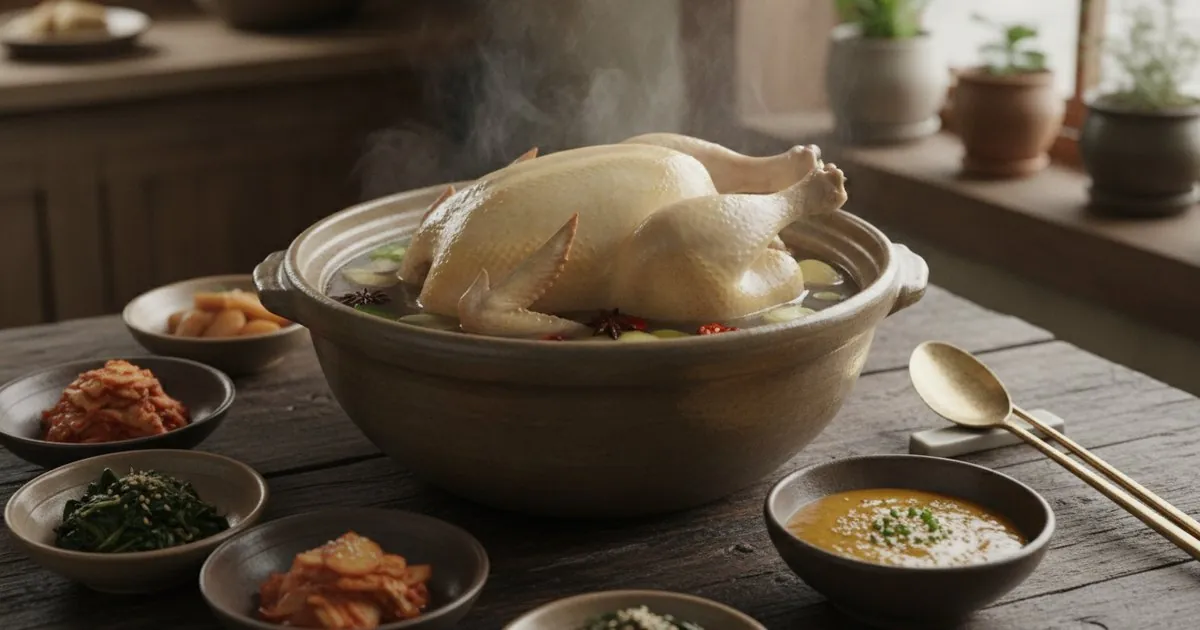
Dakhanmari — literally "one whole chicken" (닭 dak = chicken, 한 han = one, 마리 mari = the Korean counter for animals) — might be the most honest dish in Korean cuisine. A whole bird simmers in a clear, aromatic broth alongside potato chunks and green onion until the meat yields to the gentlest nudge. Then comes the reveal: a small bowl of pungent, fiery mustard sauce so sharp it registers in your sinuses the moment you dip. The pairing — mild, yielding chicken and aggressive, electric sauce — is one of the great flavor contrasts in Korean food, and it works completely.
The dish is closely associated with the narrow street near Dongdaemun History & Culture Park Station in Seoul, known colloquially as the dakhanmari alley (닭한마리 골목). The block is dense with restaurants serving this single dish: whole chickens visible through steamed windows, pots of broth bubbling at every table, the smell of garlic and ginger drifting onto the street. These restaurants have been operating since at least the 1970s and 1980s, though pinning the dish to a single inventor or origin year isn't possible — like many beloved Korean dishes, it evolved as a neighborhood specialty and stuck.
The encouraging thing for home cooks is that dakhanmari translates almost perfectly to a Western kitchen. The technique is straightforward, the timing is forgiving, and the ingredient list is short. What this dish demands is attention to a few specific details — and when you get them right, the result is both dramatically impressive and deeply comforting.
What Sets Dakhanmari Apart
Korean cuisine has no shortage of chicken dishes: dakgalbi brings wok-tossed heat and gochujang caramelization; dakbokkeumtang offers a braised, sauce-heavy rendition. Dakhanmari occupies an entirely different register. The pot is restrained, almost austere — a clear broth deliberately kept light, a whole bird cooked gently until it becomes fall-off-the-bone tender. There's no chili in the broth at all. The heat comes entirely from the sauce you dip into.
This is also a dish with a genuine communal table-side element. The pot arrives on a portable burner, stays hot throughout the meal, and you break the chicken apart together using scissors — no plating, no portioning in advance. When the chicken is nearly gone, you drop rice or noodles into the remaining broth and finish the meal with a quick kkuksu (국수, noodle soup) or juk (죽, rice porridge). Nothing is wasted, and the final bowl of rice in broth is often considered the best part of the meal.
The Broth: Deliberate and Clean
The aromatics that build the broth — quartered onion, crushed garlic, fresh ginger, whole peppercorns, a splash of mirin — are all removed before serving. Their only job is to deodorize the chicken and contribute quiet depth to the liquid. You should be able to smell their work clearly as the pot simmers: the kitchen fills with something that reads as warm, faintly sweet, and savory all at once, without any single note dominating.
A word on mirin: some recipes leave it out, but the small amount here does meaningful work. Mirin contributes a faint sweetness and rounds out any residual gaminess in the bird. It isn't equivalent to dry cooking wine, which adds mainly alcohol and acidity without sweetness, so if substituting, add a small pinch of sugar alongside the wine.
The vegetables that stay in the broth are simpler: potatoes, green onion tops, and optionally, garaetteok rice cakes and mushrooms. Potatoes are non-negotiable — they absorb the savory broth and turn creamy, becoming a secondary highlight of the dish. Garaetteok (가래떡), the long cylinder-shaped rice cakes, are optional but worth tracking down. Their slightly chewy resistance contrasts beautifully with the yielding chicken — if you're already a fan from dishes like tteokbokki, you'll know exactly what they bring here.
The Dipping Sauce: Where the Flavor Lives
This is the component that makes or breaks the dish. The sauce is a blend of Korean prepared mustard (겨자, gyeoja), soy sauce, rice vinegar, gochujang, gochugaru, and sesame oil. It should hit hard: sinus-clearing sharpness upfront from the mustard, then a slow warmth from the peppers, then a savory, slightly nutty finish from soy sauce and sesame. If the sauce is timid, the chicken tastes bland. If the sauce is electric, the chicken tastes perfect.
A critical point: Korean gyeoja is not American yellow mustard, and it is not Dijon. It is a hot, sharp, prepared mustard in the style of Chinese hot mustard — potent and slightly pungent. It's sold in small squeeze tubes at Korean grocery stores (H Mart, Zion Market, 99 Ranch) and is usually labeled 겨자 or "Korean prepared mustard" in English. If you cannot find it, the closest substitute is Coleman's English dry mustard powder reconstituted with cold water to a paste — that's the heat level you're looking for. American yellow mustard will produce a sauce that looks right but tastes flat, with almost no heat. That's a significant problem for a dish where the sauce does all the heavy lifting.
The gochujang in the sauce contributes fermented depth and body. The gochugaru layers in a cleaner, fruitier heat on top of the mustard's sharper edge. Together with the vinegar's brightness and sesame oil's roundness, the sauce ends up genuinely complex.
Taste the sauce before bringing it to the table. It should be assertive — slightly too much, if anything. It mellows the moment you use it to coat a piece of moist, mild chicken.
Sourcing Ingredients in Western Kitchens
| Ingredient | Where to Find | Best Substitute |
|---|---|---|
| Korean prepared mustard (겨자) | H Mart, Korean grocery, Amazon | Coleman's English dry mustard paste; hot Chinese mustard |
| Gochujang | Most Asian grocery stores, many Whole Foods | Worth ordering online — no real substitute |
| Garaetteok rice cakes | Korean grocery (fresh or frozen) | Omit, or use round tteokbokki-style rice cake slices |
| Gochugaru | Korean grocery, Amazon | Crushed red pepper flakes (milder, not identical) |
| Mirin | Most Asian grocery stores, some Whole Foods | Dry sherry + ½ tsp sugar, or omit with a small pinch of sugar in the broth |
For the chicken: a standard small broiler-fryer from a US supermarket typically weighs 1.3–1.5 kg (3–3.5 lbs), slightly larger than the ideal dakhanmari bird. This works fine — add 5–10 minutes to the simmering time and rely on the skewer doneness test rather than the clock. A free-range or air-chilled bird will produce noticeably richer broth; the collagen and gelatin from good-quality bones is what gives the liquid its faint body and warming quality. Bone-in is strongly recommended — boneless chicken will produce a noticeably thinner, flatter broth.
Serving and the Finishing Bowl
Set the pot on a portable induction burner in the center of the table. Give everyone a small bowl of dipping sauce. Use kitchen scissors to snip the chicken into rough portions directly in the pot — leg quarters, wings, breast sections. Dip generously before each bite. Eat with steamed rice on the side.
When the chicken is mostly gone, ladle a look at what's left in the pot: you have a savory, chicken-scented broth with potato, green onion, and whatever rice cakes are remaining. Return the pot to heat, drop in cooked thin wheat noodles (소면, somyeon) or a cup of leftover rice, cook for 2–3 minutes, and serve that as the final course. Some diners crack in a raw egg and stir in a spoonful of the dipping sauce. It's excellent. The broth that you might have underestimated at the start of the meal suddenly tastes like the most comforting thing you've eaten all week.
For side dishes, keep it light — the pot is the star. Kimchi, pickled radish, or a simple kongnamul (soybean sprout salad) work well. Our banchan guide has a full breakdown of what to pair with Korean mains.
Common Mistakes to Avoid
1. Skipping the blanching step. This is the most common shortcut that causes real, visible problems. Without blanching, blood proteins and myoglobin dissolve directly into your cooking liquid, producing a grey-brown foam that clouds the broth within the first 10 minutes and imparts a slightly off, metallic note to the flavor. The fix is a simple 3-minute blanch in boiling water before the main cook. You'll know you've skipped it if the broth turns opaque and brownish-grey despite skimming — at that point, there's no recovering the clarity.
2. Cooking at too vigorous a boil. A rolling boil does two damaging things simultaneously: it agitates proteins into suspension (making the broth permanently murky) and contracts muscle fibers in the breast meat too quickly, resulting in a texture that's stringy and dry. The correct simmer looks like a hot spring — occasional lazy bubbles drifting to the surface, the liquid barely in motion. If your stove's lowest setting is still too aggressive, half-lid the pot to let more heat escape, or move it slightly off the burner.
3. Using the wrong mustard in the dipping sauce. If the dipping sauce doesn't create an immediate sinus sensation when you smell it up close, the mustard isn't hot enough. American yellow mustard has the color but almost none of the pungency of Korean gyeoja. The sauce will taste flat and faintly sweet instead of sharp and complex. Use Korean prepared mustard tubes (labeled 겨자) or Coleman's English dry mustard reconstituted with cold water. This is the single ingredient where substitution most dramatically changes the character of the dish.
4. Adding potatoes too late. Potato chunks need 35–40 minutes of simmering to cook through completely and absorb enough broth flavor to taste integrated rather than bland. Adding them in the last 15–20 minutes leaves you with centers that are still chalky and underseasoned, or — if you try to cook them through — an overcooked chicken. Potatoes go in at the start of the main simmer, right after blanching and skimming.
5. Seasoning the broth too early. The broth reduces by roughly 15–20% over 40 minutes of simmering, concentrating the salt as it goes. If you season to taste at the 15-minute mark, the finished broth will be noticeably oversalted. Add salt only at the end, after removing the aromatics, and do it incrementally — ½ tbsp first, taste, then adjust. The broth should be lightly savory, not intensely seasoned. The dipping sauce is where the bold flavor lives; the broth's role is to be a clean, supportive backdrop.
6. Cutting the chicken before bringing the pot to the table. Beyond the loss of presentation (arriving with a whole chicken in a steaming pot is genuinely dramatic), pre-cutting the chicken means the pieces immediately begin to dry out and cool. In the pot, the chicken stays submerged in hot broth and remains moist until the moment someone picks up a piece. Cut at the table with scissors, keep the pieces in the broth, and serve directly from the pot.
Frequently Asked Questions
Can I use bone-in chicken pieces instead of a whole bird? Yes. Bone-in, skin-on thighs and drumsticks are the most practical adaptation and will still produce a flavorful broth because the bones and skin contribute the gelatin and fat the liquid needs. The dish loses its theatrical whole-bird presentation, but the flavor holds up well. Boneless, skinless pieces will produce a noticeably thinner broth — it won't be wrong, but it won't have the body or depth of the traditional version.
What if I can't find garaetteok rice cakes? Omit them, or substitute the flat round rice cakes sold in tteokbokki kits — they soften a little faster (about 5–6 minutes), so add them closer to the last 5 minutes. The dish is fully satisfying without rice cakes; their chewy texture is a bonus rather than a structural requirement.
How spicy is this dish, really? The chicken and broth contain no chili at all, so the heat level is entirely in your control via the dipping sauce. A full tablespoon of gochujang and a teaspoon of gochugaru makes a medium-hot sauce — noticeable warmth but nothing extreme. For milder palates, halve the gochugaru. For a more aggressive version, increase the gochugaru and add a small amount of finely minced raw garlic to the sauce. Children and spice-averse guests can dip in plain soy sauce instead.
Can I make components ahead of time? The broth and chicken are best made fresh — this isn't a long-simmered stock but a quick cook that depends on the bird for its flavor, and leftover boiled chicken loses texture as it sits. The dipping sauce, however, keeps well in the refrigerator for up to a week in a sealed container, and the flavor actually deepens slightly after a day as the ingredients meld. Making the sauce the night before is a good strategy.
What do I do with leftover broth? Don't discard it. The finished broth is a clean, lightly seasoned chicken stock. If you don't do the table-side noodle or rice finish at the meal itself, refrigerate the broth and use it within 2 days: as a base for congee, as a light soup with tofu and green onion, or as the cooking liquid for plain rice (which will come out faintly savory and fragrant). It also freezes well for up to a month.
Dakhanmari rewards attention to the fundamentals and punishes shortcuts — but the fundamentals are genuinely simple. Blanch the chicken, keep the simmer lazy, don't salt until the end, and track down real Korean mustard for the sauce. Do those four things and you'll have a pot of something deeply satisfying: warm, communal, and the kind of dinner where people are still at the table long after the chicken is finished, working through the last of the broth. ```
Receita
4.7 / 5 (134)
- Tempo de preparo
- 15 min
- Tempo de cozimento
- 50 min
- Tempo total
- 65 min
- Porções
- 2-3
- Dificuldade
- Fácil
Ingredientes
Modo de preparo
- Remove giblets and rinse the chicken inside and out under cold water. In a large stockpot, bring about 2 litres (8 cups) of water to a boil with the ginger slices and the white parts of 2 green onion stalks. Submerge the chicken and blanch for 3 minutes — this draws out blood and impurities that would otherwise cloud the final broth. Drain, discard the blanching water, and rinse the chicken thoroughly under cold running water until the water runs clear.
- Return the clean chicken to the pot breast-side up. Pour in 1,500 ml (6 cups) of fresh cold water — the liquid should come about three-quarters of the way up the bird; add a splash more if needed. Add the quartered onion, crushed garlic, remaining ginger slices, peppercorns, and mirin. Bring to a boil over high heat, then immediately reduce to a gentle simmer (medium-low). During the first 5 minutes, skim any grey-brown foam from the surface with a fine-mesh skimmer or ladle. After skimming, the broth should look pale golden and clear.
- Add the potato chunks directly to the simmering broth. Cover the pot with a lid set slightly ajar and cook at a steady, lazy simmer for 35–40 minutes total. Avoid a rolling boil — this both toughens the breast meat and muddies the broth. At the 30-minute mark, check doneness by pushing a chopstick or thin skewer into the thickest part of the thigh; it should slide in without resistance, and any juices that trickle out should be clear, not pink.
- While the chicken cooks, prepare the dipping sauce. Combine the Korean prepared mustard, soy sauce, rice vinegar, sugar, gochujang, gochugaru, and sesame oil in a small bowl. Whisk until smooth and the sugar fully dissolves. The sauce should be intensely sharp on the nose from the mustard, deep red from the gochujang and gochugaru, and glossy with a slightly thick consistency. Taste: adjust with more vinegar for brightness, more gochugaru for heat, or a small pinch more sugar if the mustard edge is too aggressive.
- In the last 8–10 minutes of cooking, add the green onion pieces (green tops) and, if using, the rice cakes and mushroom caps. Raw cylinder garaetteok rice cakes need about 8 minutes from cold; refrigerated or pre-soaked ones need only 5. Shiitake caps will soften in 6–8 minutes.
- Remove and discard the spent aromatics — onion quarters, garlic cloves, ginger slices — with a slotted spoon. Season the broth with salt, starting with ½ tbsp and tasting before adding more. The broth should taste clean, gently savory, and faintly sweet from the onion. It is intentionally lighter than a Western stock; its role is to carry the chicken, not dominate it.
- Bring the pot to the table, ideally set on a portable induction burner to keep everything hot throughout the meal. Serve individual dipping sauce bowls alongside. Use kitchen scissors to cut the chicken into portions directly in the pot at the table. Dip each piece generously in the sauce and eat with steamed rice. Once the chicken is mostly eaten, return the pot to heat, add cooked rice or thin noodles (somyeon), and finish the meal with a quick, comforting broth porridge or noodle soup.
As informações nutricionais são estimadas. Siga sempre práticas seguras de manuseio e preparo de alimentos.