
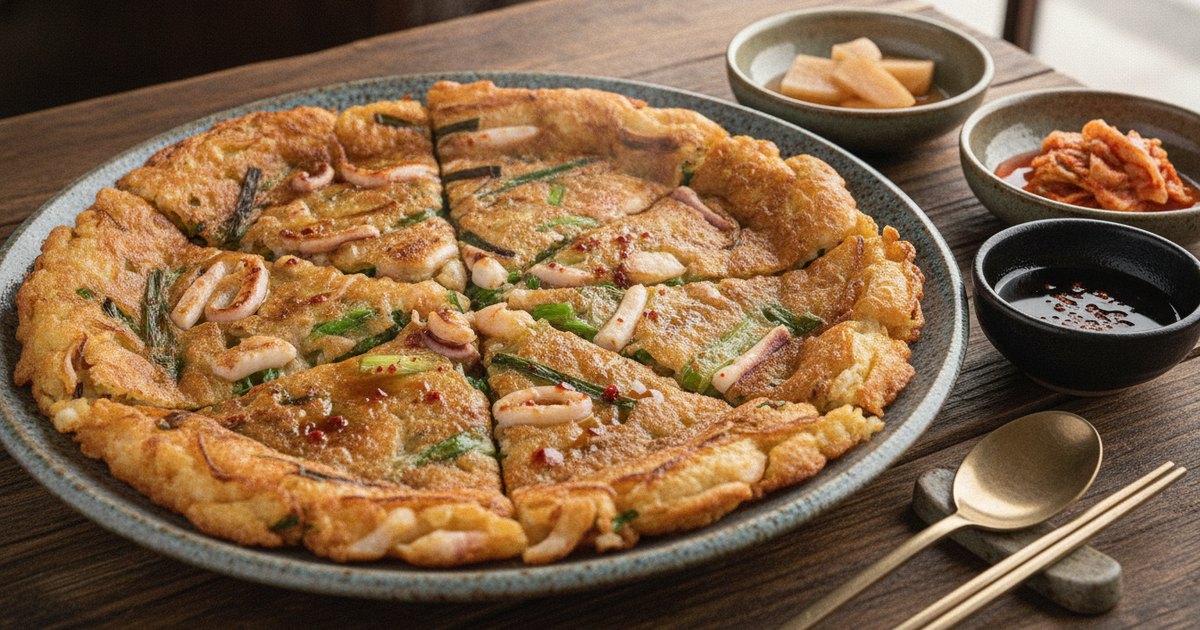
There is a Korean expression that says the sound of rain is just the sound of pajeon frying. Whether or not you take that poetically or literally, the cultural truth behind it is real: on rainy days across Korea, people head to pojangmacha street stalls, traditional makgeolli bars, and home kitchens to make haemul pajeon. The sizzle of batter hitting an oil-slicked pan does sound like a downpour, and after tasting the result, you'll understand why the craving is so deeply conditioned.
Haemul pajeon (해물파전) is the seafood-loaded version of Korea's iconic scallion pancake. Long, thin scallions are pressed into a loose savory batter studded with shrimp, squid, and whatever the sea offers that day, then pan-fried in a generous pool of oil until the exterior turns shattery and golden and the interior stays just barely custardy. Served alongside a sharp, sesame-laced dipping sauce, it is one of the most satisfying and approachable dishes in the Korean home cook's repertoire — deeply comforting, visually striking, and genuinely fast once you understand the mechanics.
What Is Haemul Pajeon?
Pajeon (파전) is a compound word: pa (파) means scallion, and jeon (전) is a broad Korean culinary category covering pan-fried dishes — from thin savory pancakes to egg-coated patties. Add haemul (해물, seafood), and you have Korea's most celebrated savory pancake. It is a dish with deep historical roots, long associated with makgeolli (막걸리), the cloudy, slightly fizzy fermented rice wine that is still pajeon's most traditional pairing. There is a reason the two are sold together on every rainy-day street corner in Seoul.
The most famous regional version is Dongnae Pajeon (동래파전), originating from the Dongnae district of Busan. This heritage-designated preparation is richer and thicker, sometimes incorporating a small amount of ground beef alongside the seafood, and is built with jjokpa (쪽파) — the slender, mild Korean spring onion that is significantly thinner and more delicate than standard Western scallions. Dongnae Pajeon is a specialty worth seeking out if you visit Busan. That said, beef in haemul pajeon is a regional marker, not a standard feature — the everyday version is pure seafood, and that is what this recipe focuses on.
The weeknight haemul-pajeon that Korean households cook is lighter, crispier, and built for speed. Think of it as Korea's answer to Italian fritto misto or Japanese kakiage: seafood-studded, deeply savory, and best eaten the moment it leaves the pan.
The Ingredients: What You Need and Why
Scallions
The scallion is the hero, not a garnish. You want about 200 g / 7 oz (roughly 2 bunches) of thin scallions. Korean grocery stores (H Mart, Hanahreum, 99 Ranch) carry jjokpa or thin Korean spring onions — these are the ideal variety, delicate enough to cook through quickly without the batter over-browning around them.
Standard American supermarket scallions work perfectly well, but the white bulb portions are often thick enough to stay underdone while the batter around them crisps up. The fix is simple: halve the white sections lengthwise before cooking. Cut all scallions to 15–18 cm (6–7 inches) — just under the inner diameter of your pan so they lay flat.
Seafood
You have genuine flexibility here. The most common home-cook combination is squid (오징어) + shrimp (새우) in roughly equal parts — squid brings a chewy, oceanic depth, while shrimp adds sweetness and color. Oysters, clams, mussels, and scallops are all excellent additions or substitutions. Korean grocery stores typically sell pre-mixed frozen seafood specifically labeled for pajeon, and using a bag of this is not a shortcut — it is exactly how many Korean home cooks approach the dish on weeknights.
Target 200 g / 7 oz total seafood for two large pancakes. Cut pieces to roughly 1–2 cm so they distribute evenly through the batter without creating heavy pockets where raw seafood weighs the crust down.
The Batter: Pancake Mix or From Scratch
Korean pancake mix (buchim garu, 부침가루) is the fastest and most reliable route. It is pre-seasoned and balanced specifically for this application, available at Korean groceries and online. A trick widely used in Korean home kitchens: replace half the buchim garu with tempura flour (tuim garu, 튀김가루) — the 1:1 combination amplifies crunch without making the batter brittle. Worth trying once you have the basic technique down.
No pancake mix? Combine 1 cup (120 g) all-purpose flour + 1–2 Tbsp cornstarch or potato starch + ½ tsp salt. The starch is critical — it inhibits gluten development and helps the surface fry rather than steam. At Whole Foods, look for Bob's Red Mill potato starch in the baking aisle.
In all cases, the water must be icy cold — measure from a glass with ice cubes, then discard the ice. Cold water keeps gluten relaxed and produces a lighter, more delicate crust. This is the exact same principle behind tempura batter, and it makes a measurable difference.
The Dipping Sauce: Cho-Ganjang
The dipping sauce — cho-ganjang (초간장), literally "vinegar soy sauce" — is not optional. It provides the acid counterpoint that cuts through the richness of fried batter and makes the whole dish cohere. It takes two minutes to assemble:
- 3 Tbsp soy sauce (regular or guk-ganjang soup soy sauce)
- 1 Tbsp rice vinegar (apple cider vinegar works in a pinch)
- 1 tsp sesame oil
- ½ tsp gochugaru — a few drops of Tabasco or Aleppo pepper flakes substitute reasonably
- 1 tsp toasted sesame seeds
- 1 scallion, thinly sliced
Mix, taste, and adjust. It should read as salty-tangy-nutty with a gentle heat at the back. Make it first and let it sit — the flavors integrate as the scallion softens slightly into the soy.
How to Cook Haemul Pajeon: Step by Step
Dry everything before you begin. Pat the seafood completely dry with paper towels. Wet seafood releases moisture into the batter as it cooks, steaming the underside from within instead of frying it. This is the most common source of a pale, soft, sticking pancake.
Make the batter right before cooking. Cold batter hitting a hot oiled pan is what creates crispiness. Batter that sits at room temperature loses that thermodynamic advantage and the gluten begins to develop, resulting in a tougher texture.
Use enough oil — more than feels instinctively right. Korean pajeon is pan-fried, not sautéed. Add 2–3 tablespoons of neutral oil per pancake — vegetable, avocado, or refined sunflower all work — and get it properly hot before any batter touches the pan. The visual cue is shimmer across the entire oil surface. The auditory cue: a drop of batter should sizzle aggressively on contact. A quiet hiss means the pan is not ready yet.
Lay the scallions first, then pour. Arrange scallions in a flat, parallel single layer directly in the hot oil. Pour the seafood batter over them immediately, spreading it gently with a spoon. Press down firmly and evenly with a spatula — this creates the bond between scallions and batter, and drives surface moisture out.
Leave it alone. Cook undisturbed for 4–5 full minutes. The surface will shift from wet and shiny to matte and set as the batter cooks through from the bottom up. When you peek at the edge, the underside should be a deep, uniform amber — not pale gold, but genuinely amber. That color means the Maillard reaction has done its work and the crust will hold through the flip.
Flip confidently. Slide the pancake onto a large plate, then invert it back into the pan with one clean motion. Add another tablespoon of oil around the edges immediately and tilt the pan so fresh oil flows underneath. The second side cooks in 3–4 minutes with occasional firm pressing.
Serve within five minutes. Haemul pajeon is at its peak within minutes of leaving the pan. The crust softens perceptibly as it cools and steams on a plate. Transfer to a wire rack briefly if needed, or serve directly from the pan to the cutting board.
This dish pairs naturally alongside banchan and shared small plates — the crispy, savory pancake makes an ideal centerpiece for a spread. It also anchors the start of a Korean BBQ at home evening, giving guests something to eat while the grill heats up.
Tips for Extra Crispiness
A few techniques that have a measurable impact:
The 1:1 buchim garu–tempura flour ratio. As mentioned above, this single substitution noticeably amplifies crunch. The light starch content of tempura flour acts like the cornstarch in the scratch recipe — it prevents gluten from making the crust chewy. Use it.
Cast iron over non-stick, if you have it. Non-stick is beginner-friendly (less nerve-wracking flip), but cast iron retains heat through the thermal shock of cold batter better than non-stick coatings, resulting in more even browning. Make sure the cast iron is genuinely hot and well-oiled before batter goes in.
A high-heat finish. In the final 60 seconds on each side, increase the burner to high and press down firmly with the spatula. This flash of intense heat drives out the last traces of surface moisture and produces the distinctive, almost lacy-crisp exterior — visible as a network of fine bubbles and cracks on the surface — that defines a great haemul pajeon.
Two smaller pancakes, not one massive one. An oversized pancake is difficult to flip cleanly, and the center tends to remain underdone while the edges over-brown. Keep each pancake to roughly the size of your pan's interior cooking surface.
Common Mistakes to Avoid
Making haemul pajeon is genuinely forgiving once you understand the underlying logic — but a handful of specific errors consistently produce disappointing results. Here is what actually goes wrong, diagnosed precisely:
1. Wet seafood → steamed-from-inside pancake
This is the number one failure mode, and it is entirely preventable. If squid or shrimp goes into the batter without being thoroughly dried, it releases moisture as it cooks. That steam migrates downward through the batter and prevents the underside from achieving any meaningful crust. The diagnostic sign: you hear the sizzle fade after 2 minutes, the bottom never gets properly golden, and the pancake clings to the pan when you try to slide it. Fix: pat every piece of seafood dry with multiple layers of paper towels. If using frozen seafood, thaw overnight in the fridge in a colander so the liquid drains away passively rather than being trapped in the bag.
2. Thick batter → doughy, bread-like interior
Haemul pajeon batter should be noticeably thinner than American pancake batter — closer to a loose crêpe batter, almost pourable like cream. If the batter mounds up in the pan rather than spreading freely, add icy cold water one tablespoon at a time until it flows readily. Diagnostic check: lift your whisk and let batter fall back into the bowl. It should fall in a fluid, even stream, not in thick, slowly-dropping ribbons. Thick batter creates a heavy, bread-like interior rather than the semi-translucent, lacy crust you want.
3. Insufficient oil or cold oil → pale, greasy, sticking result
These are opposite-sounding problems with a shared cause — failure to get the oil properly hot before adding batter. If the oil is too cool, the batter absorbs it rather than frying in it, producing a greasy pancake that never crisps and often sticks. You need to hear an aggressive, confident sizzle the instant batter contacts the oil. If the sizzle is quiet or develops slowly, pull the batter off the heat, let the pan get hotter, and try again with a small drop. The oil shimmering before you add the batter is a necessary minimum, not sufficient.
4. Flipping too early → torn, folded pancake
The first side needs 4–5 full minutes before it is structurally ready to be inverted. Attempting to flip early results in the still-liquid batter folding on itself or tearing along scallion seams, because the pancake has no structural integrity yet. Wait for all three signals before flipping: the edges look fully set with no wet sheen; the surface looks mostly matte (cooked through roughly 70% from the bottom up); and the underside is amber when you peek at one corner. All three, not just one.
5. Skipping the second pour of oil after the flip
After the flip, the uncooked face of the pancake lands on a mostly oil-depleted pan. Skipping the additional oil means the second side will be paler, drier, and less crispy than the first — and you'll notice the asymmetry when serving. Add 1–2 Tbsp immediately after flipping, tilting the pan deliberately so the oil flows completely underneath the pancake. You should hear the sizzle intensify. That sound is correct.
6. Resting the pancake on a plate before serving
A flat plate traps steam beneath the pancake the instant it lands. That steam softens the crust within two minutes — the same crust you just spent 8–10 minutes building. If you must hold the pancake briefly while the second one cooks, rest it on a wire cooling rack set over a baking sheet, or keep it in a 120°C (250°F) oven uncovered. A plate is the enemy of the crust.
Frequently Asked Questions
Can I make haemul pajeon gluten-free?
Yes. Replace the Korean pancake mix with a combination of 80% rice flour and 20% tapioca starch, plus ½ tsp salt. This ratio produces a surprisingly crispy result — rice flour fries well, and tapioca starch provides the binding the batter needs. Gluten-free batter is more fragile than wheat-based batter, so flip with more deliberate care and use a non-stick pan. Swap regular soy sauce for tamari to complete the gluten-free version.
Can I leave out the seafood?
Absolutely — a scallion-only pajeon is its own traditional dish. You can also make kimchi-jeon (김치전) by adding roughly 150 g of well-drained, roughly chopped kimchi to the batter in place of the seafood. This is an excellent way to use kimchi that is very ripe and deeply fermented. If you want to learn how to make your own kimchi from scratch, our guide to homemade kimchi covers the full process.
What is the best substitute for Korean pancake mix outside a Korean grocery?
The closest functional substitute is all-purpose flour plus starch: 1 cup (120 g) AP flour + 2 Tbsp cornstarch or potato starch + ½ tsp salt. The starch is the key ingredient — it inhibits gluten and helps the surface fry rather than steam. Tempura batter mix (available at most Asian sections of mainstream grocery stores, and reliably at Whole Foods) also works well — reduce added salt since most tempura mixes are pre-seasoned. Japanese tempura mix produces a slightly lighter, lacier result than all-purpose flour.
What should I drink with haemul pajeon?
The traditional pairing is makgeolli (막걸리), Korea's cloudy, lightly sparkling fermented rice wine — it has a gentle sweetness and mild carbonation that cuts through the oiliness of the pancake beautifully. It is increasingly available at Korean groceries in the refrigerated section; the Baekhwa brand travels well. If makgeolli isn't accessible, a cold Korean lager (Hite, Terra, Cass), cold Japanese beer, or even plain barley tea (boricha) all work. Avoid anything heavily tannic — red wine clashes with the seafood and sesame.
Can any components be prepped in advance?
The dipping sauce keeps well for up to 24 hours in the fridge; the scallion will soften slightly but the flavor remains good. The seafood can be cleaned, cut, and dried up to a few hours ahead and kept refrigerated. The batter should be mixed immediately before cooking — cold water loses its temperature advantage quickly, and sitting batter develops gluten, resulting in a tougher texture. Think of the batter as a last-minute step, the same way you'd treat tempura batter: mix it when the oil is almost hot, not five minutes before. ```