Pojangmacha: Inside Korea's Iconic Street Tent Bar Culture
Discover Korea's beloved pojangmacha tent bars — their fascinating history, iconic anju foods, soju drinking rituals, and how to recreate the magic at home.
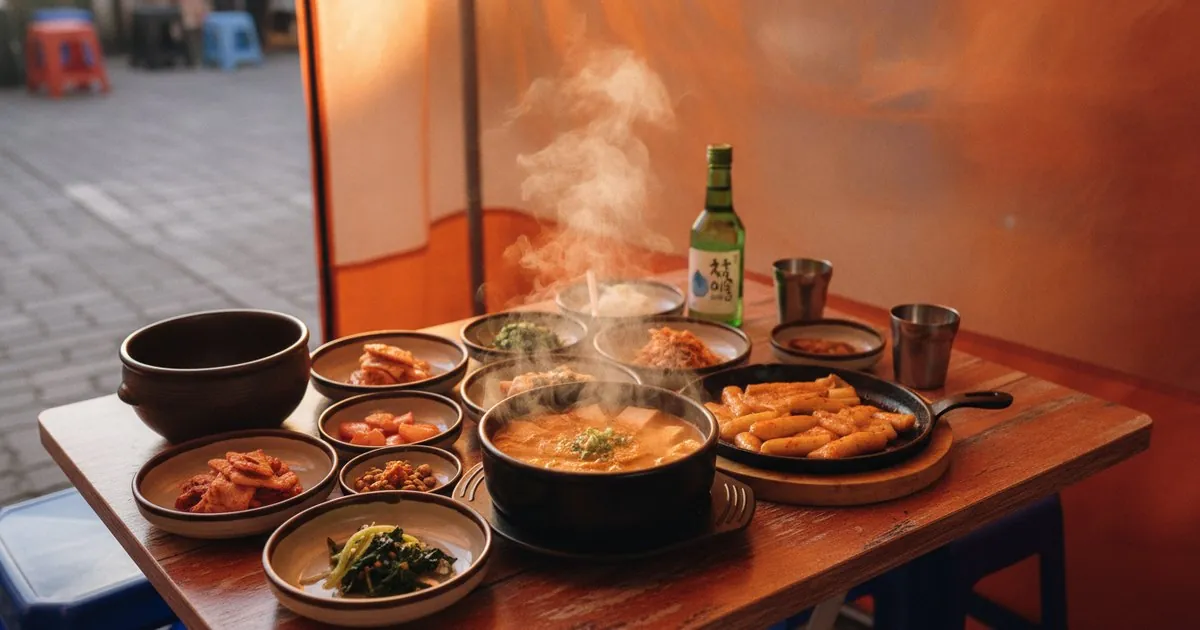
Step into any pojangmacha after sundown and a particular set of sensations hits you all at once: the amber glow of bare bulbs filtered through orange vinyl, steam rising from a communal pot of fish cake broth, the quiet clink of short soju glasses, and voices climbing louder as the night wears on. It's one of the most distinctly Korean experiences you can have — and understanding it unlocks a part of Korean food culture that almost never makes it into cookbooks.
This is the pojangmacha (포장마차): part food stall, part neighborhood bar, part after-work exhale. Once you understand what it actually is, the food tastes completely different.
What Is a Pojangmacha (포장마차)?
The word breaks down cleanly: pojang (포장) means "covering" or "wrapping," and macha (마차) means "cart" or "carriage." Put them together and you get "covered cart" — a literal description of what these stalls physically are. In everyday Korean speech, people compress it to pocha (포차), and you'll hear that abbreviation constantly in conversation and on the neon signs of the indoor bar spinoffs that borrow the aesthetic without the cold sidewalk.
A pojangmacha is a small tent stall — historically parked on a sidewalk, in an underpass, or tucked into an alley — where a single vendor serves hot food and cold alcohol from a setup no bigger than most people's home kitchens. Low plastic stools, laminate folding tables, and that signature orange or yellow vinyl roof are the visual trademarks. Most are run by one person: often a ajeossi or ajumma who knows the regulars by name, by preferred drink, and by precisely how much trouble they're in at home.
The defining feature isn't the tent structure or the plastic seating. It's the anju (안주) — food designed specifically to eat while drinking, calibrated to slow alcohol absorption, pace the evening, and give your hands something to do between pours. At a pojangmacha, food and drink arrive together and you rotate through both all night. That pairing philosophy shapes everything about how the menu is built and how portions are sized.
From Covered Wagons to Glowing Vinyl: A Brief History
The Post-War Birth
The modern pojangmacha emerged from necessity in the wreckage of the Korean War. During the 1950s, thousands of displaced people flooded into Seoul with no established livelihood. Small vendors began selling food from hand-pulled carts near Cheonggyecheon Stream in central Seoul — fast, cheap, requiring almost zero startup capital. Wooden poles draped with cotton cloth (gwangmok) provided shelter from rain. Carbide lamps threw a warm, smoky light.
The earliest menus were practical and humble: eomuk (fish cake), hobbang (steamed buns), sundae (blood sausage), bindaetteok (mung bean pancakes), and mandu (dumplings). Alcohol arrived by the shot — cheap soju alongside dried squid or whatever the vendor had sourced that day.
By the late 1970s and into the 1980s, the physical infrastructure had upgraded in stages. Wooden poles gave way to metal frames. Cotton covers were replaced by the now-iconic vinyl tarpaulin that glows orange from within and is instantly recognizable in the dark. Electric bulbs replaced carbide lamps, eventually giving way to LED strips on more modern setups.
| Era | Frame | Cover | Lighting |
|---|---|---|---|
| 1950s–60s | Wooden poles | Cotton (gwangmok) | Carbide lamps |
| 1970s | Metal | Vinyl/tarpaulin | Electric bulbs |
| 1980s+ | Reinforced metal | Heavy vinyl | Wired electricity, LED |
The Sparrow Era (Yes, Really)
Here's a detail that genuinely surprises most people encountering pojangmacha history for the first time: the original signature anju was chamse-gui (참새구이) — grilled sparrow. Vendors skewered small birds whole, charcoal-grilled them on the spot, and served them alongside soju shots. It sounds startling today, but grilled sparrow was an entirely ordinary drinking snack in 1950s and 1960s Korea, considered warming, protein-rich, and well-suited to cold evenings outdoors.
The sparrow era ended sharply and definitively in 1972, when South Korea's Wildlife Protection Act came into effect and banned the hunting and commercial sale of wild birds. Overnight, vendors had to pivot their anju offering. They turned to chicken, pork innards, and — critically — to the foods we now think of as quintessential pojangmacha fare: tteokbokki, spicy octopus, soondae. A single piece of wildlife legislation effectively wrote the modern pojangmacha menu.
Growth and the Palli-Palli Economy
Pojangmacha culture expanded dramatically in parallel with South Korea's economic miracle of the 1970s and 80s. The social driver was palli-palli (빨리빨리) — the Korean "hurry-hurry" cultural imperative that drove workers through punishingly long shifts in factories, construction sites, and offices. After ten or twelve hours of that, many workers didn't go straight home. A pojangmacha offered fast, cheap decompression: a beer or soju, a plate of tteokbokki, twenty minutes of human warmth before the subway.
Director Lee Jang-ho captured this world in his 1980 film A Fine, Windy Day, depicting pojangmacha as gathering places for Seoul's working class — an early cultural timestamp for their role as pressure valves for urban stress. By then, the pocha had become an institution, not merely a food stall.
What It's Like Inside a Pojangmacha
Picture a tent that seats maybe eight to twelve people, pressed along narrow benches and folding tables with centimeters to spare between you and the next stranger. You duck under the vinyl flap to enter. The vendor running the operation is simultaneously managing a gas burner, monitoring the eomuk broth for the right simmering temperature, topping up soju glasses, and keeping a running mental tab on who ordered what — without a single written ticket.
You don't browse a menu for long. You gesture at what you want, or simply ask what's fresh. Everything arrives fast. The eomuk broth is free — that's tradition, not charity. A ceramic cup sits in front of you and you ladle from the communal pot on the portable burner at the end of the counter. Nobody charges for a cup or two; even if they did, it would cost almost nothing.
The soundscape is specific and consistent: gas burners hissing at medium-low, broth simmering, the tok tok tok of someone chopping green onion on a small board, conversation overlapping across two languages (Korean, and increasingly the English of curious tourists), soju glasses clicking in the geonbae (건배, cheers) ritual.
The Essential Anju: What You Eat at a Pojangmacha
Eomuk (어묵) — Fish Cake Skewers
Flat or tubular fish cakes threaded onto bamboo skewers, simmered in a clear, slightly sweet anchovy-kelp broth. This is the canonical pojangmacha food — the one that signals "tent bar" to any Korean immediately. The broth should be pale golden and clean-tasting, with a quiet umami depth from the dried anchovies and kelp. The fish cakes themselves should be springy, with a gentle bounce when bitten — if they feel mushy or fall apart at the skewer, they've over-simmered. At H Mart, look for Sempio or Dongwon brand eomuk in the refrigerated section. The flat rectangular sheets are most traditional for pojangmacha-style skewers.
Tteokbokki (떡볶이) — Spicy Rice Cakes
The saucy, chewy, gochujang-red rice cakes that have conquered street food menus worldwide. At a pojangmacha, tteokbokki is typically saucier and slightly less sweet than the instant-cup version, with fish cakes simmered into the sauce for body and a depth that pure rice cakes alone can't provide. The sauce should coat your spoon and leave a glossy trail — not watery, not stiff enough to clump. For a full breakdown of technique and ratios, see our complete tteokbokki guide.
Soondae (순대) — Blood Sausage
Glass noodles and pork blood packed into pig intestine casing, sliced into rounds, and served with coarse salt and a dusting of gochugaru (red pepper flakes) or a side of doenjang paste. It looks confronting on first encounter and tastes — once you've given it a chance — like a mild, earthy, savory sausage with a unique chewy-noodle interior. The quality marker: the casing should offer slight resistance when you bite through it, then give way to a soft, noodle-textured filling. If it's rubbery all the way through, it's been reheated too many times or steamed too aggressively.
Nogari with Mayonnaise (노가리)
Dried young pollock — small, flat, stiff as cardboard — served with Korean-style mayonnaise (sweeter and lighter than Western mayo). You tear it into strips and chew slowly. The flavor unfolds in waves: bland, then lightly sweet, then saline, then a deep, persistent ocean umami. This is beer anju (maekju pairing), not soju anju — the lightness of beer suits the slow, meditative chewing. Find dried nogari at Korean grocery stores or order online; Ottugi Korean mayo is easy to source at H Mart.
Nakji Bokkeum (낙지볶음) — Spicy Stir-Fried Octopus
Small octopus stir-fried over high heat in a gochujang-heavy sauce until the tentacles curl, caramelize at the edges, and take on a slight char. This is one of the hotter offerings. Properly cooked nakji should be tender-firm — it yields quickly to the tooth without squeaking or requiring real effort. Rubbery octopus means it was overcooked or the heat wasn't high enough to sear rather than steam.
Soju, Makgeolli, and the Ritual of Drinking Together
At a pojangmacha, what you drink matters — but the how matters more than the what. Korean drinking culture has specific etiquette that feels natural once you understand the logic: you don't pour your own glass. You pour for others at the table, and someone pours for you. You hold your glass with two hands when receiving a pour as a sign of respect. The eldest person present typically drinks first.
Soju (소주) is the default choice — a clear, neutral spirit historically distilled from rice but now most commonly derived from sweet potato or tapioca, running approximately 16–25% ABV depending on brand and regional style. At a pojangmacha it arrives in a small green glass bottle and gets poured into shot-sized ceramic or glass cups (roughly 50ml / 1.7 oz per pour). It should be served very cold — ideally straight from the freezer. Room-temperature soju tastes sharp and medicinal; properly chilled, it goes down smooth.
Makgeolli (막걸리) — milky, mildly fizzy rice wine, around 6–8% ABV — is increasingly common, especially at pochas leaning into a traditional nostalgic Korea aesthetic. It arrives in a brass bowl and is ladled into individual cups. It pairs particularly well with bindaetteok (mung bean pancakes), where the wine's light funk complements the savory, slightly oily pancake.
Somaek (소맥) — a soju bomb dropped into beer (maekju) — is the social choice, ritualized around different stirring techniques that groups will debate with genuine enthusiasm.
The Legal Grey Zone and the Cash Economy
Pojangmacha operate in a formally ambiguous space that has defined their character for decades. Most run without standard business registration, without a fixed licensed address, without routine food safety inspection cycles, and without tax filing under a traceable business entity. Cash only, always. This isn't unique to Korea — it's the global condition of informal street food economies everywhere from Bangkok to Mexico City.
Seoul city authorities have historically managed rather than eliminated them. The Jongno 3-ga district, one of the densest pojangmacha zones, reportedly receives over 100 complaints per month at peak summer about sidewalk obstruction. Standard enforcement: a warning, a two-week suspension for severe cases, a negotiated compromise on seating footprint. Full crackdowns are politically costly — eliminating a beloved working-class institution draws significant backlash.
As of 2012, approximately 3,100 pochas were operating in Seoul. That number has declined since, with survivors concentrated in Gangbuk (north of the Han River) and in provincial cities where gentrification pressure is lower. Neighborhoods like Euljiro — particularly Nogari Alley — have repeatedly faced development threats that would relocate or eliminate long-standing stalls.
Modern Pojangmacha: Nostalgia, Reinvention, and the Indoor Pocha
The classic outdoor tent pojangmacha hasn't disappeared, but it's been joined — and in younger, trendier neighborhoods largely supplanted — by indoor pojangmacha bars that borrow the aesthetic without the cold pavement or the legal uncertainty. These are licensed restaurants designed to look like tent stalls: orange vinyl wall panels, plastic stools, bare bulbs on hanging cords, menus chalked on boards or printed on laminated signs. Entire streets of them have appeared in Hongdae, Sinchon, and Itaewon.
The tradeoff is real: indoor pochas are warmer, more consistent, and completely legal — but they lose something specific that the outdoor originals carry. Part of what makes a traditional pojangmacha emotionally resonant is its impermanence. The knowledge that this particular tent, run by this particular person, might not be there next month creates an intimacy that a permanent licensed premises can't replicate.
Korean dramas have preserved pojangmacha imagery in global pop culture. The glowing orange tent-bar scene has become reliable dramatic shorthand: characters process breakups under those bulbs, toast promotions, confess things they couldn't say sober. If you've watched My Mister, Because This Is My First Life, or a dozen others, you've seen this template deployed to good effect. For a full survey of K-drama food moments and where to find them, check our Crash Landing on You food guide.
Recreating the Pojangmacha Experience at Home
You can't fully replicate the real thing — the cold air outside the vinyl, the stranger's elbow in your side, the ajumma who refills your cup before you ask. But you can build a genuinely satisfying home version that captures the spirit of the thing.
The setup: Cover a folding table with kraft paper (disposable, communal). Use short candles or warm string lights rather than overhead lighting. Keep a pot of eomuk broth simmering at the center of the table throughout the meal. Serve everything on small plates and in small portions — the goal is rounds of food, not a single massive spread.
Shopping list (H Mart / Korean grocery):
- Eomuk (fish cake sheets or pre-skewered, refrigerated section)
- Cylindrical tteok (rice cakes, fresh or frozen — not the flat sliced kind)
- Gochujang and gochugaru for tteokbokki sauce
- Frozen soondae (most Korean grocers stock it year-round)
- Dried nogari and Ottugi Korean mayo
- Soju (Jinro Chamisul is the standard; Hite or OB for beer)
Whole Foods workarounds if no Korean grocer is nearby:
- Gochujang: Annie Chun's or CJ Haechandle appear in Whole Foods international aisles in most major cities.
- Fish cakes: Surimi (imitation crab sticks) can approximate the flavor in a broth, though the texture is softer. For the real thing, order from an online Korean grocery — it's worth the effort.
- Rice cakes: There is genuinely no substitute for tteok's chewiness. Order online or find an Asian grocery; the texture is non-negotiable for tteokbokki.
- Makgeolli: Increasingly stocked at Whole Foods in larger cities; otherwise find a Korean liquor importer online.
For the full home BBQ table experience — same communal spirit, different proteins — our Korean BBQ at home guide covers the setup comprehensively.
Common Mistakes to Avoid
1. Letting Eomuk Simmer Too Long — and Not Catching It in Time
Fish cakes move from springy to mushy faster than most people expect. At the pojangmacha, the vendor manages broth temperature constantly; at home, it's easy to set the pot and forget it. Keep the broth at a gentle simmer — small bubbles at the edges, not a rolling boil — and add your fish cakes no more than 15–20 minutes before eating. Press one with a spoon: it should push back. Bite through it: there should be a light bounce, not a collapse. If the cakes are falling apart or feel waterlogged, the broth has been too hot for too long. Lower the heat and add fresh cakes for your next batch.
2. Rushing the Tteokbokki Sauce Over High Heat
The instinct is to crank the burner to thicken the sauce quickly. The result: the outside of the rice cakes chars or sticks to the pan while the interior is still cold and firm. Cook tteokbokki over medium heat, add liquid in stages, and stir constantly. The sauce is ready when it coats the back of a spoon with a glossy film and the rice cakes have a slight sheen. To confirm the tteok is cooked through, cut one in half — it should be uniformly soft and pliable with no dense cold center. If the outside is done but the center isn't, add a splash of water (30ml / 2 tablespoons), reduce heat, cover for 2 minutes, and stir again.
3. Reheating Frozen Soondae Aggressively
Frozen soondae needs gentle, even heat. Microwaving on high power or dropping it into rapidly boiling water makes the casing rubbery and the interior dense. The correct approach: steam over medium heat for 8–10 minutes (or until uniformly warm throughout), or simmer in barely bubbling water with the heat as low as you can keep it. The casing should feel slightly resistant but not tight when done; the filling should be soft and yielding. A rubbery bite from edge to center means it got too hot too fast.
4. Serving Soju at the Wrong Temperature
Soju must be very cold — pulled from the freezer or at minimum from the back of the refrigerator. Room-temperature soju tastes sharp, astringent, and harsh in a way that chilled soju does not. Korean convenience stores and pojangmacha keep it refrigerated for this reason. This sounds trivial but it genuinely changes the palatability, especially across multiple pours. If you're hosting a home pocha night, put your soju in the freezer at least two hours ahead. It won't freeze at standard ABV levels.
5. Making Somaek Without Understanding the Pour Order
If you're mixing somaek (soju-beer bomb), the order and method matter. Pour beer first, then add soju — not the reverse. The traditional approach: fill a glass about two-thirds with cold beer, then tilt a shot glass of soju into it at a low angle so the soju sinks rather than splashing. A gentle figure-8 motion with chopsticks mixes it without destroying carbonation. Stirring aggressively kills the effervescence and changes the texture of every sip. Over-mixed somaek tastes flat and unbalanced.
6. Serving Anju in Full Western Portions
This is probably the most common structural mistake when recreating pocha food at home. Pojangmacha anju is deliberately small — portions calibrated to pace drinking, extend the evening, and give everyone a reason to order another round. If you bring out heaping serving-bowl portions all at once, you short-circuit the communal rhythm. Serve in small plates and in waves: eomuk and a first round of drinks, then tteokbokki, then soondae, then nogari later in the evening as things slow down. The pacing is the experience.
Frequently Asked Questions
What does pojangmacha mean in English? Pojangmacha (포장마차) translates literally as "covered cart" or "covered wagon" — pojang (포장) means covering or wrapping, macha (마차) means cart or carriage. The term is commonly shortened to pocha (포차) in everyday speech, and you'll see that abbreviation on indoor bar signs across Seoul's younger neighborhoods.
Is pojangmacha food safe to eat? Yes, with the standard street-food common sense that applies anywhere. Traditional pojangmacha operate outside formal health inspection systems, but the core dishes — eomuk broth, tteokbokki, soondae — all involve sustained high cooking temperatures that handle food safety effectively. Choose stalls with visible turnover: fresh batches cycling frequently, a consistent stream of regular customers, a vendor who's clearly been doing this for years. Avoid anything that looks like it's been sitting at ambient temperature for an extended period.
What's the difference between a pojangmacha and a hof? Hof (호프) refers specifically to Korean draft-beer bars — typically indoor establishments, more like a Western pub, focused on beer and fried chicken or other anju in a sit-down format. A pojangmacha can serve beer, but it's defined by its outdoor tent format and its broader street-food menu. The vibe is rougher, more transient, more working-class by tradition. A hof is where you settle in for two or three hours; a pojangmacha is where you stop for thirty minutes on the way home from the subway.
Can vegetarians eat at a pojangmacha? With real difficulty. Most pojangmacha anju is built around animal protein — fish cake, blood sausage, pork innards, octopus, dried fish. Tteokbokki is theoretically vegetarian if made without fish cakes or anchovy broth, but most vendors don't offer that variation. Your best options: bindaetteok (mung bean pancakes, sometimes made without meat), pajeon (green onion pancakes), or corn cheese if the stall offers it. It helps to ask directly and be specific about what you're avoiding.
Where are the best pojangmacha areas in Seoul? Jongno 3-ga has some of the oldest surviving outdoor tent pochas, with a particular association with older working-class regulars — the atmosphere there on a weeknight is as close to the 1980s pojangmacha as you'll find in modern Seoul. Euljiro (especially Nogari Alley near Euljiro 3-ga) is iconic and increasingly tourist-visited. Mapo and areas around Hongdae offer both outdoor originals and the indoor-pocha bar experience. For a first visit that prioritizes atmosphere over authenticity, Hongdae's indoor pocha streets are the most accessible entry point. For something more historically rooted, Jongno 3-ga at 9pm on a weeknight is genuinely hard to beat. ```
营养信息为估算值。请始终遵循安全的食品处理和制作规范。