
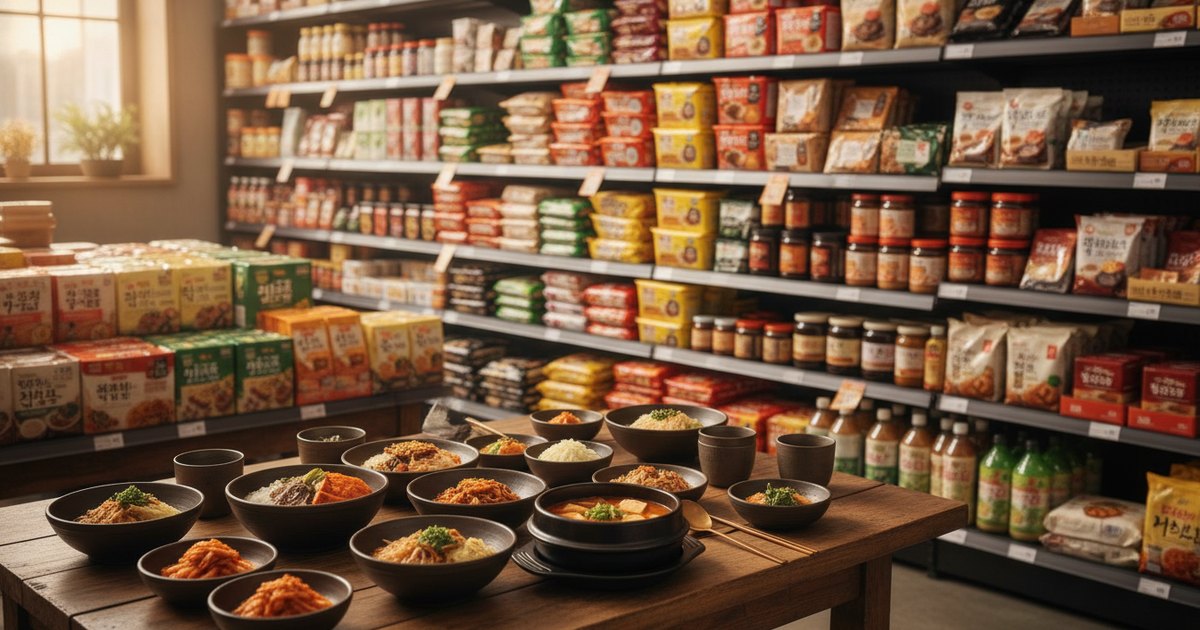
Walk through the sliding doors of any H Mart and your senses get a full briefing before you even grab a basket. The produce section smells of fresh perilla leaves and clean green onion. The banchan bar radiates warm sesame oil. Somewhere in the dry goods aisle, eight feet of soy sauce bottles stand shoulder to shoulder, their labels a mix of English and Korean script. For the roughly 30% of H Mart shoppers who aren't of Asian descent — and that number is growing every year — the experience is equal parts thrilling and a little bewildering.
This guide is here to cut through the confusion. Whether you're visiting H Mart for the first time or you've been browsing the aisles for years without a clear plan, here's exactly what to buy, why each ingredient matters, and — crucially — what it should look, smell, and feel like when you're holding it in your hand.
A Brief History: What "H Mart" Actually Means
Before we talk about what to fill your cart with, it helps to understand what H Mart actually is — because it's a genuinely remarkable American immigrant success story.
H Mart was founded in September 1982 by Il Yeon Kwon, a farmer's son from rural South Korea who immigrated to the United States in the late 1970s, at a time when Asian Americans made up barely 1.5% of the U.S. population. The first store opened in Woodside, Queens, New York City — a modest corner grocery that would eventually become the largest Asian specialty grocery chain in the country.
The "H" stands for 한아름 (Han Ah Reum), a Korean phrase meaning "an armful" — as in one arm full of groceries. It's a warm, domestic image, and that warmth carries through in how the stores feel today. Co-president Elizabeth Kwon has spoken publicly about deliberately designing H Mart locations to feel clean, modern, and approachable — intentionally countering outdated stereotypes about Asian grocery stores being difficult to navigate. The bilingual signage, organized layout, and thoughtful mix of specialty and everyday products all reflect that philosophy.
By 2026, H Mart operates 98 U.S. stores across 19 states, plus 20 locations in Canada and 2 in the United Kingdom. In June 2024, they opened a flagship location in Utah spanning 100,000 square feet — their largest to date.
Navigating the Store: A First-Timer's Orientation
Most H Mart locations share a recognizable layout: fresh produce and flowers near the entrance, refrigerated kimchi and banchan along one wall, dry goods and pantry staples through the middle aisles, and a food court or prepared foods section somewhere you'll inevitably spend more time than planned.
Signage is bilingual throughout, so you can usually find what you need even if you can't read Hangul. That said, knowing the Korean names for key ingredients will help enormously when you're comparing brands — especially for fermented condiments where packaging designs and bottle sizes vary wildly between manufacturers.
One practical note: bring a tote bag or a small wheeled cart if your local H Mart doesn't provide full-size shopping carts. Once you discover the banchan section and the produce wall, your arms will thank you.
The Foundation: The Three Jangs (장)
Korean cooking is built on a trio of fermented condiments collectively called jang (장). These are non-negotiable — there are no true Western substitutes for any of them, because each is the product of a specific fermentation process that creates flavor compounds you simply cannot replicate with anything from a standard supermarket. If you leave H Mart with nothing else, leave with these three.
Ganjang (간장) — Korean Soy Sauce
Korean soy sauce comes in two main types, and the distinction matters for real cooking results:
- Guk ganjang (국간장), also called soup soy sauce, is lighter in color but significantly saltier in flavor. It's used in clear soups, broths, and namul (seasoned vegetable side dishes). It has a more mineral, fermented complexity than Japanese soy sauce and will make your broth taste brighter without darkening it.
- Jin ganjang (진간장), or regular/dark soy sauce, is the all-purpose variety used in marinades, braises, and table sauces where a deeper, richer color and flavor are desirable.
Look for brands like Sempio or Chung Jung One — both reliably available at H Mart and well-regarded across the spectrum of Korean home cooking. You'll want at least one bottle of each type. The soup soy sauce bottle will say "국간장" in Korean or "soup soy sauce" in English.
Doenjang (된장) — Fermented Soybean Paste
Doenjang is frequently compared to Japanese miso, but they are genuinely different ingredients and should not be used interchangeably. Miso is fermented with koji (a mold inoculated into rice or barley), which gives it a sweeter, more refined, and milder flavor. Doenjang is fermented from meju — sun-dried soybean bricks cured in salt brine without any added mold starter — for months to years. The result is bolder, more pungent, and notably funky.
When you open a container of good doenjang, the smell should hit you assertively: earthy, savory, complex, almost barnyard-like in its intensity. That's the sign of proper fermentation. Use doenjang in doenjang jjigae (fermented soybean stew), as a base for vegetable dipping sauces, and in pork marinades where you need fermented depth that stands up to strong flavors. Sempio and Haechandle are solid starting brands at H Mart. If you see jars labeled "속성 된장" (quick-fermented), opt for the traditional variety instead — the flavor is noticeably more layered.
Gochujang (고추장) — Fermented Red Chili Paste
Gochujang has crossed over into mainstream Western cooking more visibly than any other Korean condiment — you'll find it at Trader Joe's, Whole Foods, and increasingly in regular supermarkets. But H Mart's selection is dramatically deeper, running from everyday mass-market brands to small-batch traditional producers.
The flavor is sweet, spicy, savory, and deeply fermented all at once — almost a condiment-sized representation of what Korean cuisine does best. It's used in tteokbokki (spicy rice cakes), bibimbap sauce, chicken marinades, and stews. For a full breakdown of how to cook with it across multiple applications, see our complete gochujang guide.
At H Mart, Haechandle and Sempio are reliable everyday options. If you spot a smaller-brand Sunchang gochujang (from Sunchang County, the traditional heartland of gochujang production in North Jeolla province), it's worth trying — the flavor is noticeably more complex and less one-note.
Gochugaru (고춧가루): The Spice You Cannot Skip or Substitute
Gochugaru — Korean red pepper flakes — looks superficially similar to the crushed red pepper you shake onto pizza, but it's a fundamentally different product. Standard crushed red pepper flakes register 15,000–30,000 Scoville Heat Units and are made from whole dried peppers including seeds and white membranes, which is where most of the harsh, sharp heat lives.
Gochugaru is made exclusively from the dried flesh of the pepper — no seeds, no membrane — which brings the heat down to a much gentler 1,500–10,000 SHU. The flavor is sweet, fruity, and mildly smoky with a warmth that builds slowly rather than biting immediately. The color is a vivid, uniform brick red.
This difference is critical when you make kimchi at home. The fermentation chemistry of kimchi depends on gochugaru's specific sugar content and mild heat profile. Substitute crushed red pepper and you'll get a much hotter, harsher kimchi with a different color and a less sweet aroma — technically fermented, but not what you're going for.
H Mart stocks gochugaru in two textures:
- Coarse (굵은 고춧가루) — for kimchi and dishes where visible texture and slight chew are part of the experience
- Fine (고운 고춧가루) — for sauces, marinades, and soups where you want even color and a smooth result
Buy both. The standard bag size at H Mart is typically 500g (~1.1 lb) or 1 kg (~2.2 lb). Transfer to an airtight container and keep it in the freezer after opening — gochugaru loses its vibrant color and sweet aroma quickly at room temperature.
Fresh Produce: What to Pick Up Every Visit
The produce section is where H Mart separates itself most visibly from mainstream grocery stores. These are the items you'll reach for constantly:
- Korean radish (mu / 무): Rounder and denser than Japanese daikon, pale green at the top fading to white below. It should feel heavy and firm — any soft spots or sponginess mean it's past its prime. Central to soups, radish kimchi (kkakdugi), and braised dishes.
- Perilla leaves (kkaennip / 깻잎): Large, dark green, with a distinctive minty-anise aroma that's nothing like basil and nothing like mint but somewhere intriguing in between. Used fresh in wraps, pickled in soy, or briefly sautéed.
- Napa cabbage (baechu / 배추): The foundation of classic kimchi. Look for tight, dense heads with crisp, fresh outer leaves. A standard head runs 2–3 kg (4.5–6.5 lb) — plenty for a first kimchi batch.
- Green onions (pa / 파): Korean cooking uses both green and white parts liberally and in quantity. H Mart carries thick-stalked varieties that hold up better in soups and stir-fries than the thinner supermarket types.
- Pre-peeled garlic: H Mart regularly stocks large bags of fresh pre-peeled garlic cloves — an enormous time-saver when a recipe calls for 15–20 cloves, which happens often in Korean cooking.
Noodles, Rice Cakes, and Glass Noodles
- Dangmyeon (당면): Translucent, springy glass noodles made from sweet potato starch. The essential noodle for japchae. They rehydrate in warm water before cooking and turn glossy and pleasantly chewy when properly done — if they're still stiff in the center, they need more soaking time.
- Tteok (떡): Rice cakes come in several forms. Cylinder-shaped tteokbokki tteok is what you want for spicy rice cake dishes. Oval-sliced garaetteok goes into rice cake soup. Fresh tteok from the refrigerated section is substantially better than the shelf-stable vacuum-packed kind — it's softer, more pliable, and cooks more evenly without needing to be soaked first.
- Short-grain white rice: H Mart stocks multiple brands of Korean and Japanese-style short-grain rice. The 20 lb (9 kg) bags offer excellent value if storage space allows.
Pantry Deep Cuts: The Supporting Cast
These ingredients rarely get the spotlight, but their absence is immediately noticeable:
- Sesame oil (참기름): Used as a finishing oil, not a cooking fat — add it at the end of cooking to preserve its aroma. A quality sesame oil smells intensely nutty and toasty straight from the bottle. H Mart also stocks perilla oil (들기름), which has an earthier, grassier note and is worth exploring once you're comfortable with the basics.
- Fish sauce (액젓): Korean varieties, particularly myeolchi aekjeot (anchovy fish sauce), are less sharp and more rounded than Southeast Asian fish sauces. Used in kimchi, soups, and anywhere you need savory depth without added color.
- Anchovy stock packets (다시팩): Pre-packaged bundles of dried anchovies, kelp, and aromatics. Simmer one packet in 1 liter (4 cups) of water for 20 minutes and you have myeolchi yuksu — the clear, umami-rich stock that's the base of most Korean soups. Far simpler than assembling the components separately, and the flavor difference versus plain water is not subtle.
- Toasted sesame seeds (볶음 참깨): Should smell nutty and fragrant when you open the bag. If they smell flat or faintly like cardboard, they're stale — move on to another brand.
What You Can (and Can't) Source Elsewhere
H Mart is essentially irreplaceable for: gochugaru, doenjang, guk ganjang, fresh tteok, perilla leaves, Korean radish, dangmyeon, anchovy stock packets, and any traditional small-batch condiment.
You can reasonably find these outside H Mart: gochujang (widely available now at mainstream stores), short-grain rice (most Asian grocery stores), sesame oil (most supermarkets carry a decent version), and firm tofu (any supermarket, though H Mart's range is broader).
For shoppers without an H Mart nearby, the H Mart online store ships dry pantry goods across the U.S. Gochugaru, dried noodles, soy sauce, and packaged condiments all travel well. Refrigerated items, fresh tteok, and produce are not available for online order — for those, seek out any local Korean or pan-Asian grocery store.
Common Mistakes to Avoid
1. Using Regular Red Pepper Flakes Instead of Gochugaru
This is the most frequent first-timer mistake, and the results are immediately obvious. The heat can be up to 20 times stronger than gochugaru, and the sweet, fruity, smoky character of Korean dishes depends specifically on the mild pepper flesh. If your kimchi or tteokbokki is coming out aggressively hot and looks more orange than brick-red, gochugaru is almost certainly the issue. No quantity adjustment to regular flakes will reproduce the right flavor — it's a different ingredient.
2. Treating Doenjang as a 1-to-1 Miso Replacement
Adding doenjang at the same quantities as a miso recipe calls for produces an overwhelmingly funky, intensely salty result. Doenjang is more concentrated and pungent — when adapting, start with half the amount your recipe specifies (for example, 1 tablespoon / 15 ml where miso called for 2 tablespoons / 30 ml), taste the dish at the halfway point, and build from there. The reverse also applies: miso cannot replace doenjang in a doenjang jjigae — that distinctive fermented intensity is the point of the dish, not background noise.
3. Storing Gochugaru at Room Temperature After Opening
Gochugaru degrades faster than almost any other spice once exposed to air and light. The vibrant brick-red color fades to a dull, washed-out orange-brown within weeks, and the sweet, smoky aroma becomes flat and generic — indistinguishable from cheap paprika. Transfer it to an airtight container and freeze it immediately after opening. Frozen gochugaru stays visually vivid and aromatically correct for up to a year. If your kimchi is coming out pale or your sauce looks dull, check your gochugaru's color and smell before adjusting anything else.
4. Buying the Wrong Soy Sauce Type for the Dish
Using jin ganjang (dark, all-purpose) where guk ganjang (soup soy sauce) is called for darkens your broth and gives it a heavier, more assertive flavor than intended. Korean clear soups — miyeok guk (seaweed soup), kongnamul guk (beansprout soup) — depend on the saline brightness of guk ganjang to taste clean and light. The label says "국간장" in Korean or "soup soy sauce" in English. If your broth looks darker than it should and tastes more intense than expected, check which soy sauce went in.
5. Buying Fresh Tteok and Not Using It Quickly Enough
Fresh rice cakes from the refrigerated section will harden to a rubbery, dense texture within one to two days if left unwrapped. If your tteok feels like stiff little cylinders, soak them in cold water for 20–30 minutes before cooking. If they still resist softening, blanch them briefly in simmering (not boiling) water for one minute. For anything older than 3 days, blanching is non-negotiable — the interior remains gummy no matter how long you cook them in sauce otherwise.
6. Skipping Anchovy Stock and Using Plain Water
It's tempting to substitute water for myeolchi yuksu (anchovy-kelp stock) and assume the other strong flavors in the dish will compensate. They won't. The stock provides a baseline umami foundation — savory, rounded, with no identifiable fishiness in the finished dish — that makes soups and stews taste complete and deeply seasoned rather than thin and one-dimensional. The packet method requires 20 minutes and one liter (4 cups) of water. That's genuinely the minimum effort investment, and the difference in the final dish is not subtle.
Frequently Asked Questions
Is H Mart only for Korean groceries? Not at all. While Korean ingredients form the core of H Mart's offering, most locations carry a broad range of Japanese, Chinese, Southeast Asian, and Pacific Islander products alongside Korean staples. You'll find Japanese snacks, Chinese pantry sauces, Filipino pantry ingredients, and a well-stocked international produce section under the same roof. It functions as a pan-Asian grocery with a Korean emphasis.
What should I buy on my very first H Mart visit if I'm on a budget? Prioritize building your pantry before buying fresh items. The essential starting haul: gochujang, doenjang, guk ganjang, jin ganjang, coarse and fine gochugaru, sesame oil, fish sauce, and anchovy stock packets. That selection typically costs $40–$60 USD depending on brand choices and quantities, and it unlocks the vast majority of foundational Korean recipes you'll want to make.
Can I order H Mart products online if there's no store near me? H Mart's online store (hmart.com) ships pantry staples across the U.S. Dry goods — gochugaru, dried noodles, soy sauce, and packaged condiments — ship well. Refrigerated items, fresh produce, and fresh tteok are not available online. For those ingredients, look for any local Korean or pan-Asian grocery store, or check if a large international market carries them.
How do I know if a gochujang is good quality without opening it? Check the ingredients list. Traditional gochujang should list glutinous rice, fermented soybean powder, red chili pepper, and salt — in roughly that order of prominence. If refined sugar or corn syrup appears as the first or second ingredient, the paste will taste one-dimensionally sweet rather than layered and complex. A well-made gochujang has a deep, matte red color and holds its shape when scooped — it shouldn't look watery or glossy through the packaging.
What's the difference between refrigerated kimchi and shelf-stable jarred kimchi at H Mart? Refrigerated kimchi (sold in larger tubs near the banchan section) is actively fermenting — it has living cultures and a flavor that continues to develop and sour over time. Shelf-stable jarred kimchi has been pasteurized, which kills the active cultures and locks the flavor in a milder, more consistent state. For eating fresh, either works. For cooking — kimchi jjigae, kimchi fried rice, kimchi pancakes — you want well-fermented refrigerated kimchi, ideally 3 to 8 weeks old, when the sourness is pronounced and the flavor is deep enough to anchor a dish. ```