
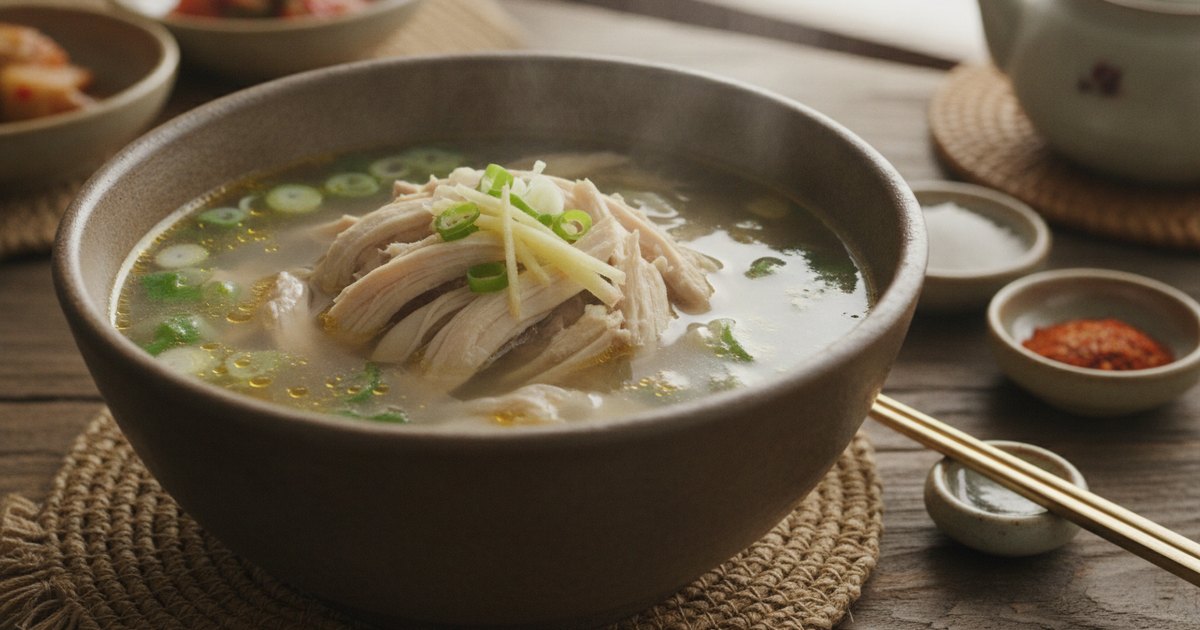
If you've ever wanted a bowl of soup that feels like a full reset — something clean and golden and quietly restorative — dakgomtang is your answer. Korea's clear-broth chicken soup is not a dish that announces itself. It doesn't have tteokbokki's sticky, fiery drama or the bold funk of a slow-braised stew. What it has is focus: a slow-simmered broth that tastes purely, unmistakably of chicken, poured over tender shredded meat and steamed rice, finished with sliced scallions and a whisper of sesame oil.
In Korea, dakgomtang (닭곰탕) occupies that rare space where comfort food and genuinely restorative eating overlap. The "gom" in gomtang (곰탕) refers to the long, patient simmering that draws collagen, gelatin, and concentrated flavor from the bones — the same approach that makes Korean beef bone soup (seolleongtang) so silky and substantial. Dakgomtang applies that logic to chicken: the broth is lighter in color but still full-bodied, with a natural, lip-coating quality that no store-bought broth can replicate.
This is the soup Koreans reach for when they're fighting a cold, recovering from a hard week, or simply craving something that asks nothing of them but a spoon. For Western home cooks, it's one of the most accessible Korean dishes you can tackle — no specialized equipment, no long list of fermented pantry items, just a chicken, a good-sized pot, and enough time to let the broth do its work.
What Makes Dakgomtang Different from Western Chicken Soup
On paper, dakgomtang might look like any clear chicken soup. The technique and philosophy, though, diverge in ways that matter.
The blanching step is non-negotiable. Korean clear-broth soups almost universally begin by blanching the protein in boiling water, then discarding that water and rinsing the meat thoroughly clean. This purges blood, bone fragments, and myoglobin — the compounds responsible for the gray-brown foam and off-flavors that cloud a broth started from cold. Western chicken stock often skims this scum from the surface; dakgomtang eliminates it at the source. The difference in the finished broth is immediate and unmistakable: cleaner, brighter, with none of that faint mineral graininess.
The aromatics are restrained and purposeful. You won't find celery, thyme, or bay leaves here. Dakgomtang uses a Korean aromatic trinity — garlic (a genuinely generous amount, 10 to 12 cloves), fresh ginger, and onion. Their collective job is to neutralize any residual poultry funkiness while contributing a subtle sweetness and warmth. The garlic quantity might surprise you; Korean long-simmered soups lean heavily on it, and extended cooking transforms those raw, pungent cloves into something mellow and almost sweet by the time the broth is done.
The finishing is minimalist but deliberately layered. The broth is seasoned separately from the chicken. The shredded meat gets its own treatment — a little salt, white pepper, sesame oil, and fresh scallion — so every element in the bowl carries its own distinct flavor rather than relying on the broth to do all the work.
Sourcing Ingredients in a Western Kitchen
Whole chicken: Any whole broiler or fryer works. For the richest, most gelatinous broth, choose a bird on the heavier end of the range — closer to 1.5 kg (3.3 lb). H Mart and 99 Ranch often carry Korean-style or similar broiler chickens that have a bit more depth, but a standard supermarket chicken will absolutely produce a beautiful result.
Guk ganjang (국간장): This is the one specialty item worth seeking out. Korean soup soy sauce is fermented longer than regular soy sauce, producing a more complex, less sweet flavor with a lighter color — it seasons without darkening the broth the way regular soy sauce does. You'll find it at any Korean grocery store, H Mart, or online. If you can't source it, season with fine sea salt only; it's the traditional and perfectly acceptable approach.
Gochugaru for dadaegi: The optional spicy condiment that accompanies dakgomtang uses Korean red pepper flakes — coarser and considerably less harsh than cayenne or Italian chili flakes. For more on navigating Korean chili products and how to use them beyond this recipe, our gochujang guide has you covered. Don't substitute cayenne; the flavor character is genuinely different.
Ginger: Fresh only. The aroma of fresh ginger during the simmer — warm, slightly citrusy, grounding — is part of what defines the broth's personality. Dried ground ginger produces a flat, dusty result by comparison.
Step-by-Step Instructions
Step 1: Blanch the Chicken
Rinse the whole chicken under cold running water. Trim any excess fat from the cavity opening. Place the chicken in your largest pot — a 6-quart (6-liter) pot or larger works well — and cover with cold water. Bring to a boil over high heat and blanch for 5 to 7 minutes.
Watch the surface: a roiling mass of gray-brown foam will rise and the water will turn murky. That's exactly what you're after. This is the purge. Once the 5 to 7 minutes are up, drain the pot completely. Rinse the chicken under cold running water, using your fingers to scrub away any clinging foam from the skin and from inside the cavity. Rinse the pot, too — you want no residual scum.
Step 2: Build the Broth
Return the cleaned chicken to the clean pot, breast-side down. Add the peeled garlic cloves, onion halves (cut side down for better browning and flavor), ginger coins, scallion white and light-green parts, and peppercorns. Pour in 2.5 to 3 liters (10 to 12 cups) of fresh cold water — enough to submerge the chicken by at least 2.5 cm (1 inch). Starting with cold water rather than hot allows the collagen and flavor compounds to extract more gradually, contributing to a cleaner, better-rounded broth.
Bring the pot to a boil over high heat, then immediately reduce to medium-low. Adjust the heat until you see small, occasional bubbles breaking the surface lazily — the "lazy bubble simmer" is the target. You should hear a very soft, almost inaudible sound from the pot. If you can hear consistent bubbling, the heat is too high. Partially cover the pot and leave it alone.
Step 3: Simmer
Simmer for 60 to 80 minutes. The broth will deepen in color from pale straw to a warm golden-amber as the collagen and fat from the chicken gradually enrich it. At around the 45-minute mark, lean over the pot: the aroma should be clean and warmly savory, with the garlic having shifted from sharp and raw to something mellow and almost sweet. If the broth still smells aggressively raw or flat, it needs more time.
Test doneness by pressing a spoon against the thigh — the meat should yield and separate with almost no resistance. For a standard 1 kg (2.2 lb) bird, 60 to 65 minutes is usually sufficient. For a larger 1.5 kg (3.3 lb) bird, go the full 75 to 80 minutes.
Step 4: Remove the Chicken and Strain
Using tongs or a large spider strainer, carefully lift the chicken from the broth. It will be very soft and may begin to fall apart, so work deliberately and support the bottom. Transfer it to a large plate or cutting board and let it rest for 10 to 15 minutes.
While the chicken rests, pour the broth through a fine-mesh sieve into a clean pot or large heatproof bowl, pressing gently on the aromatics to extract any remaining liquid. Discard the spent garlic, onion, ginger, scallion, and peppercorns — they've given everything they have. Use a ladle to skim excess fat from the surface of the strained broth, but don't chase every drop; a thin golden sheen is part of the flavor and body.
Step 5: Shred the Chicken
Once the chicken is cool enough to handle safely, remove and discard the skin — it's done its work flavoring the broth and is now texturally unpleasant in the bowl. Pull the meat from the bones by hand or with two forks, working in large, generous pieces roughly the size of your thumb. Resist the urge to shred it finely; large pieces hold their succulence better and give the finished bowl proper substance and bite.
In a bowl, season the shredded chicken with a light pinch of salt, a pinch of white pepper, and about 1 teaspoon of sesame oil. Toss gently to coat. Top generously with thinly sliced scallion greens.
Step 6: Season the Broth and Serve
Taste the broth. It should be clean and naturally savory, with a rounded depth from the long simmer. Begin seasoning with fine sea salt or guk ganjang, adding small amounts and tasting between each addition. The broth should finish bright and pleasantly savory but not salty — over-seasoning is a common misstep here, especially with guk ganjang.
Bring the seasoned broth back to a gentle simmer. To serve, place a generous scoop of steamed short-grain rice in a large, deep bowl. Arrange the dressed shredded chicken on top. Ladle the hot broth over and around the rice and chicken until the bowl is full. Finish with a few rings of sliced scallion green and a small pinch of white pepper.
Serve immediately, with kimchi alongside and, if making it, the dadaegi in a small dish at the table.
The Dadaegi (Optional Spicy Condiment)
Combine the gochugaru, minced scallion, minced garlic, sesame oil, soy sauce, and sesame seeds in a small bowl. Stir until everything is coated and the paste is cohesive. Set it on the table. A teaspoon stirred into the bowl transforms the soup entirely — the gentle, clean broth picks up a bright, warming heat without losing its character. The dadaegi is traditional and highly recommended if you enjoy spice.
Variations and Serving Ideas
Dakgomtang is almost always served with kimchi — the acidic, fermented crunch is the ideal foil for the clean, mild broth. For a more elaborate spread, simple banchan like blanched spinach with sesame or lightly pickled cucumbers round out the meal without competing with the soup.
For a quicker weeknight version, substitute the whole chicken with bone-in, skin-on drumsticks or thighs — about 600 to 700 g (1.3 to 1.5 lb). The broth will be less gelatinous but still genuinely good, and the cook time after blanching drops to about 45 to 50 minutes. This is the everyday shortcut that many Korean home cooks use.
To make it a one-bowl noodle soup, cook thin wheat noodles or somyeon separately (boil until just tender, then rinse under cold water to prevent sticking) and place them in the bowl with the rice omitted or alongside it. This variation overlaps with the tradition of dak kalguksu (닭칼국수) and is deeply comforting on a cold night.
Common Mistakes to Avoid
1. Skipping or rushing the blanching step. This is the single most consequential shortcut in dakgomtang. Without blanching, the blood and myoglobin in the chicken bones coagulate throughout the broth rather than being discarded upfront. The resulting soup will have a distinctly flat, slightly gamey flavor and a murky appearance that no amount of skimming can fully correct. The blanching step takes 5 to 7 minutes; it is not optional if you want the clean, clear broth that defines this dish.
2. Simmering at too high a temperature. The physics are straightforward: vigorous boiling physically agitates the fat droplets in the broth and forces them into an emulsion with the liquid. Once emulsified, the fat cannot be skimmed away, and the broth turns irreversibly cloudy. The diagnostic sound of a correct simmer is almost silence — a very occasional soft bubble. If you can clearly hear the pot, reduce the heat. Cloudy dakgomtang tastes fine but is not what this dish is meant to be.
3. Over-seasoning with guk ganjang. Korean soup soy sauce is saltier than it might appear, and its flavor concentrates as you add it to an already-reduced broth. A very common misstep is adding two tablespoons at once and ending up with a soup that tastes more of soy than of chicken. Add it one teaspoon at a time, tasting after each addition. If you overshoot, a small amount of water and a short additional simmer can help correct it, but it's difficult to fully walk back.
4. Shredding the chicken into thin, stringy strips. Fine shredding produces meat that dries out quickly and disappears into the broth with no textural presence. Dakgomtang calls for large, pull-apart pieces — substantial enough that you can pick them up with chopsticks as a distinct element. Aim for pieces closer to thick-pulled pork than to minced chicken salad.
5. Removing all the fat from the broth. A completely defatted broth tastes noticeably thinner and less satisfying. The natural chicken fat carries flavor compounds that enrich the final broth in a way nothing else replicates. Skim the visible, pooling fat — particularly the bright yellow deposits that collect at the edges — but leave a thin, golden film across the surface intact. That sheen is part of the finished dish, not a flaw.
6. Not resting the chicken before shredding. Pulling meat from the carcass immediately out of a near-boiling pot is both painful and counterproductive. The muscle fibers are still tightly contracted from the heat, and the meat will tear unevenly and lose more juice than it should. Ten to fifteen minutes of resting on a plate allows the internal temperature to drop to a safe handling range and lets the fibers relax — the meat then separates in cleaner, more cohesive pieces with noticeably better texture.
Frequently Asked Questions
Can I make dakgomtang in a pressure cooker or Instant Pot?
Yes, with a few adjustments. Blanch and rinse the chicken on the stovetop first as normal — the Instant Pot is not effective for the blanching step. Then pressure cook on HIGH for 25 to 30 minutes with aromatics and water, followed by a full natural pressure release (about 20 minutes). The broth will be slightly cloudier than the stovetop version due to the pressurized turbulence, but the flavor will be rich and the process takes about half the time. Skim fat thoroughly after straining.
What exactly is guk ganjang, and can I skip it entirely?
Guk ganjang (국간장) is a Korean soy sauce made specifically for soups and stews. It undergoes a longer fermentation than regular soy sauce, developing a deeper umami with a less sweet, more complex flavor profile, and it seasons without dramatically darkening the broth. You can absolutely season your dakgomtang with fine sea salt only — many traditional recipes do exactly that. If you use regular soy sauce as a substitute, start with half the amount called for and taste carefully, as its flavor is more assertive and its color more prominent.
How do I store and reheat leftovers properly?
Store the broth and shredded chicken in separate airtight containers in the refrigerator for up to 3 days. The broth will solidify into a gel when cold — this is the collagen doing its job, and it's a very good sign of a well-made broth. Reheat the broth in a saucepan over medium heat until steaming, then add the shredded chicken only in the last minute or two to warm through. Prolonged reheating of the chicken directly in the broth makes it stringy and dry. The broth freezes well for up to 2 months; freeze it in portion-sized containers for easy weeknight meals.
Why did my broth come out cloudy?
Three likely culprits: the blanching water was not fully discarded (or the pot was not rinsed), the broth simmered at too high a temperature for too long, or residual scum remained on the chicken or in the pot after the blanching rinse. A cloudy dakgomtang is still delicious and nutritious — the cloudiness is an aesthetic issue, not a flavor one. For future batches, focus on a thorough rinse after blanching and maintaining a true gentle simmer throughout.
What other Korean soups should I try if I love dakgomtang?
If the clean, restorative quality of dakgomtang appeals to you, samgyetang (ginseng chicken soup) is the natural next step — it adds ginseng, jujubes, and glutinous rice stuffed inside a whole small chicken for a more intensely nourishing result. On the heartier end, kimchi jjigae (see our recipe here) uses fermented kimchi as the base for a deeply savory, funky pork-and-tofu stew that couldn't be more different in character but is equally essential to Korean home cooking. Both are excellent transitions from dakgomtang's clean-broth style into richer territory. ```