
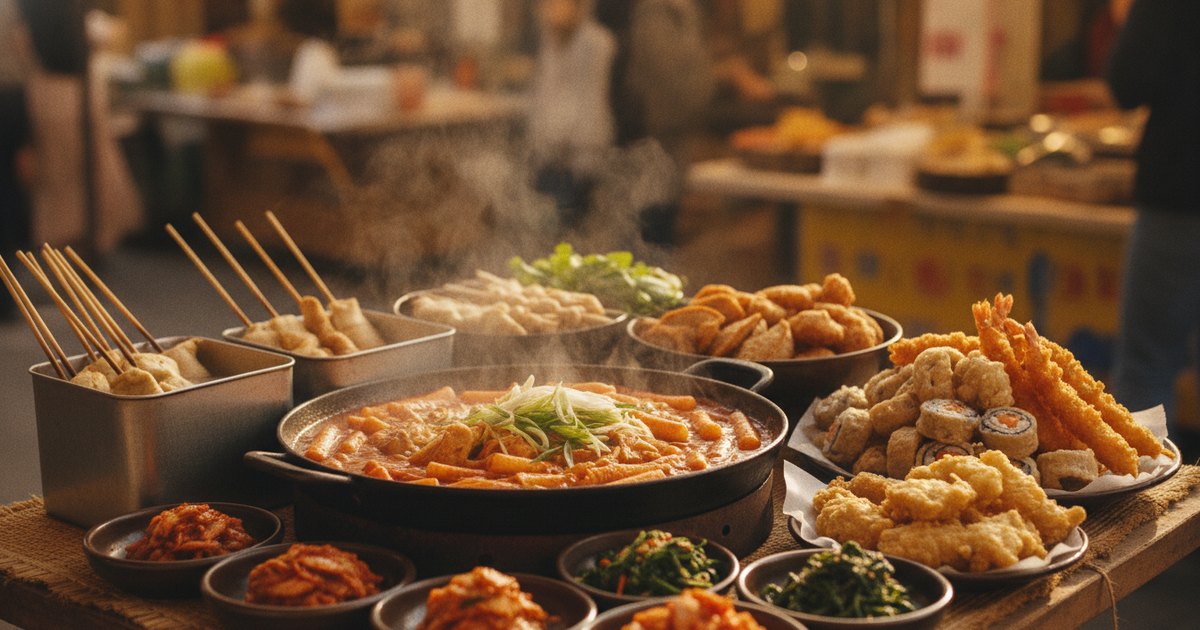
Korean street food doesn't just feed people — it tells a story. Every sizzling bindaetteok pancake, every chewy rice cake coated in fire-red sauce, every paper cup of steaming soondae carries decades of economic history, culinary ingenuity, and cultural identity. Whether you're planning a trip to Seoul, trying to decode what you just ate at a Korean market in your city, or searching for your next weeknight obsession, this guide covers everything you need to know.
Let's start where Korean street food culture starts: the pojangmacha.
The Soul of Korean Street Food: Pojangmacha (포장마차)
The word pojangmacha breaks down cleanly: pojang (포장) means "covered" or "wrapped," and macha (마차) means "wagon." Covered wagons — as direct and romantically gritty as it sounds.
These small tented stalls first appeared in Seoul in the 1950s, springing up along the Cheonggyecheon stream in the years after the Korean War. Vendors who had lost their livelihoods in the conflict sold what they could from exposed wheeled carts: roasted sparrow, dried squid, boiled silkworm pupae (beondegi), and cheap soju. It was survival food, and it was genuinely delicious in the way that survival food so often is — honest, direct, and deeply comforting.
By the 1960s and 70s, the carts had evolved. Orange tarpaulins went up, plastic stools appeared, and the stalls became gathering places as much as food stops. Korea's famous palli-palli (빨리빨리) culture — the "hurry hurry" energy of rapid industrialization — created a city that worked late, drank hard, and needed somewhere warm to land at midnight. The pocha (포차, the affectionate abbreviation) was that somewhere.
Today, well over 3,000 pojangmacha operate in Seoul, with Jongno district holding the most famous concentration. The Korean government has moved to formally recognize pojangmacha as cultural heritage, which tells you everything about their status. They're not just food stalls; they're institutions. Indoor restaurants throughout Seoul now deliberately borrow the aesthetic — orange tarp, cramped seating, laminated menus — as a kind of shorthand for authenticity and warmth. When you see it in a Korean drama, you're seeing something real.
Gwangjang Market (광장시장): The 1905 Original
If you visit one food market in Seoul, make it Gwangjang. Founded in 1905, it is the oldest continuously operating traditional market in Korea — and among the oldest in all of East Asia. The name, gwangjang (광장), translates roughly to "to gather and keep together," which remains an accurate description more than a century later.
Location: 88 Changgyeonggung-ro, Jongno-gu, Seoul
Getting there: Metro Line 1, Jongno 5-ga Station, Exit 8
Hours: Approximately 9 AM–11 PM; many vendors close Sundays
Budget: ₩3,000–12,000 (about $2.20–$9 USD) per dish; ₩10,000–20,000 ($7–$15 USD) for a full, satisfying market meal
Gwangjang gained significant international visibility after being featured in Netflix's Street Food: Asia, and tour operators now openly brand it as the "Netflix Market." The influx of international visitors has changed the atmosphere at peak hours — arrive before noon on weekdays if you want a calmer version of the experience. But the food is unchanged. These vendors have been perfecting their craft for decades; they don't need a camera for motivation.
The food hall is built around long rows of low tables, vendors presiding over their stations with the authority of people who know exactly what they're doing. Smoke rises from griddles. Oil pops audibly. You point, you sit, and something extraordinary arrives in front of you.
The Essential Korean Street Food Lineup
Tteokbokki (떡볶이): From Royal Courts to Street Corner Royalty
Tteokbokki's origin story has two very distinct chapters. The first is aristocratic: gungjung tteokbokki (궁중떡볶이), a Joseon Dynasty royal court dish made with rice cakes, tender beef, sesame oil, and soy sauce, first documented in the Siuijeonseo — a late 19th-century royal cookbook. This was a refined, relatively mild preparation. Our dedicated gungjung tteokbokki guide covers the full history and method.
The second chapter is decidedly street-level. In 1953, a woman named Ma Bok-rim (마복림) began selling rice cakes at her stall in Sindang-dong (신당동), Seoul. She developed a transformative blend of gochujang (fermented red pepper paste) and chunjang (black bean paste), creating the fiery, thick, intensely savory sauce that defines street tteokbokki today. Ma Bok-rim passed her recipe to her daughters-in-law before her death in 2011 at age 91. Her family still operates restaurants in what is now officially called "Sindang-dong Tteokbokki Town." The Oxford English Dictionary has since added "tteokbokki" as an official entry.
For a complete home-cooking breakdown, our tteokbokki guide walks you through everything from sauce ratios to rice cake sourcing.
What to look for at a stall: The sauce should smell aggressively of gochujang and toasted sesame oil from several feet away — it caramelizes on the flat griddle and turns a deep, glossy brick-red. The rice cakes should have visible resistance when you bite into them: chewy and yielding, but never collapsing. If they dissolve, they've been cooked too long. Good tteokbokki sauce clings to the back of a spoon thickly. If it runs off, it hasn't reduced enough.
At home: Frozen garaetteok (cylindrical rice cakes) are available at H Mart, most Asian grocery stores, and increasingly at Whole Foods. The cylindrical shape holds sauce better than the flat oval variety — if that's all you can find, they'll work but will cook slightly faster.
Mayak Gimbap (마약 김밥): The "Narcotic" Rice Roll
The name is blunt: mayak (마약) means narcotic, or drug. Gwangjang Market vendors are not being hyperbolic. These mini seaweed-and-rice rolls — dense with sesame seeds and fragrant with roasted sesame oil — are genuinely difficult to stop eating. They're smaller than standard gimbap, roughly 3–4 cm (about 1½ inches) in diameter, packed tight with well-seasoned rice, pickled yellow radish, and thin carrot strips, then sliced into coin-sized rounds.
At Gwangjang, expect to pay around ₩3,000 (about $2.20 USD) for approximately 10 pieces. They arrive with a small cup of soy-mustard dipping sauce — typically soy sauce, rice vinegar, and a little Korean or Dijon mustard — that adds clean brightness without overwhelming the sesame base. Don't skip the sauce. It's what makes the richness pop.
The rolls should be firm enough to hold their shape when you pick one up with chopsticks, with the outer nori smelling lightly toasted and dry, not damp or rubbery. A rubbery nori exterior means the rolls sat too long or were stored improperly. For the standard version, our gimbap guide gives you the foundational technique.
Bindaetteok (빈대떡): The Mung Bean Pancake
Bindaetteok is Gwangjang's most theatrical food. Vendors pour thick batter — ground soaked mung beans, pork, kimchi, and scallions — onto wide, generously oiled cast-iron griddles, pressing it flat with a spatula. The sizzle is immediate and loud. It smells of savory, slightly fermented bean with the high note of hot sesame oil.
The finished pancake is roughly 20–25 cm (8–10 inches) across and about 1.5 cm (⅝ inch) thick: deeply golden and shatteringly crispy on both sides, with a soft, creamy interior. It's served with a dipping sauce of soy sauce, rice vinegar, and thinly sliced white onion — clean and acidic, cutting through the richness of the pancake exactly as it should.
At home: The sourcing challenge is dried mung beans, but any Asian grocery carries them, and they're widely available online. Soak 200g (1 cup) overnight, drain well, then blend coarsely — you want visible grain and texture, not a smooth paste. The key detail: your skillet needs 2–3 tablespoons (30–45 ml) of neutral oil and must be properly hot before the batter goes in. Test with a small drop — it should sizzle immediately and aggressively.
Yukhoe (육회): Korean Beef Tartare
Gwangjang is specifically famous for yukhoe, and it's worth understanding why this dish thrives in a market setting. The beef must be extremely fresh hanwoo (한우) — Korea's premium native cattle breed — cut into fine julienne strips and dressed with sesame oil, minced garlic, and thin slices of Asian pear for sweetness, with a raw egg yolk resting on top.
The flavor is clean and delicate with a back-note of sesame. The texture is silky and almost yielding — nothing like the aggressively seasoned European tartare tradition. This is about the quality of the beef, not masking it. Gwangjang vendors' rapid turnover and established decades-long reputations make this one of the most reliable places in the world to try it if you're cautious about raw meat.
Soondae (순대): Blood Sausage Done Right
Soondae is the dish Western visitors most often hesitate over — and most often become converts to. It's a Korean-style blood sausage: pig intestine casing stuffed with cellophane noodles, barley, and pork blood, then steamed or boiled. It's served with a small plate of coarse salt and ground gochugaru (red pepper flakes) on the side, plus a bowl of rich, murky pork organ broth for dipping.
The texture is dense and springy, with an earthy depth that is significantly milder and cleaner than European blood sausages. There's none of the metallic intensity people often expect. Dip a round in the salted gochugaru and taste it before forming an opinion. The gochugaru's warmth and the salt together completely transform the profile.
Hotteok (호떡): The Sweet Street Snack
No complete market circuit ends without hotteok — a yeast-leavened dough pancake filled with brown sugar, cinnamon, and crushed peanuts or sunflower seeds, pressed flat on a well-oiled griddle until crispy outside and molten inside. They're sold from small carts and handed over in paper cups so the filling doesn't run.
The critical detail for anyone eating one fresh off the griddle: the sugar filling reaches nearly scalding temperature. Wait thirty seconds after receiving it. This is not optional. Our hotteok guide covers the home version in full, including the proofing timing that separates fluffy hotteok from dense, disappointing ones.
How to Navigate a Korean Street Food Market Like a Local
Go hungry, go early. The best vendors sell out. At Gwangjang, 10 AM is early; 1 PM on a Saturday is a crowd you'll navigate around rather than through.
Order small, order often. Point at what interests you and hold up one finger. Most vendors are experienced with curious visitors who want to try multiple things. This is how you cover the most ground.
Bring cash. Traditional Korean markets remain largely cash-based, particularly for individual street food stalls. Have ₩20,000–30,000 (roughly $15–$22 USD) in small notes ready before you arrive.
Embrace the pace. This is not table-service dining. You eat quickly, standing or perched on a low stool, and move on when you're done. That rhythm is the whole point. Don't linger conspicuously — it disrupts the flow for vendors and other customers.
Ask before photographing. The Netflix effect has made some Gwangjang vendors camera-weary. A smile and a questioning gesture first makes the difference between a warm welcome and a declined request.
Sourcing Korean Street Food Ingredients in Western Kitchens
The accessibility of these ingredients outside Korea has improved dramatically in the past decade.
- Gochujang (fermented red pepper paste): Available at H Mart, most Asian grocery stores, Whole Foods (Bibigo brand), Target, and online. Our gochujang guide breaks down brand differences and heat levels.
- Rice cakes (tteok): Frozen at H Mart and Korean grocers; increasingly in Asian sections of mainstream supermarkets. Thaw overnight in the refrigerator submerged in cold water.
- Gochugaru (Korean red pepper flakes): Not interchangeable with generic chili flakes — the flavor is fruitier, less harsh. H Mart stocks it reliably; see our gochugaru guide for what to look for.
- Dried mung beans: Any Asian grocery, health food store, or online retailer.
- Sesame oil: Available everywhere, but buy from an Asian brand. The flavor of properly toasted Asian sesame oil is notably richer and deeper than generic versions.
- Nori (seaweed sheets): Now available at most grocery stores. For rolling gimbap, buy the full-size sheets, not the snack packs.
For a comprehensive shopping list and store guide, our H Mart shopping guide is the most practical starting point.
Common Mistakes to Avoid
1. Using the Wrong Rice Cake Shape for Tteokbokki
Tteokbokki requires garaetteok — the long, cylindrical rice cakes — not the flat oval coins used in rice cake soup (tteokguk). The cylinder shape exposes more surface area to the sauce and produces the right chewy bite. If your rice cakes dissolve, turn to paste, or fall apart during cooking, they were either overcooked, improperly thawed from frozen (still icy at the center), or the wrong type entirely. Fix: defrost fully, submerge in cold water for 20–30 minutes to soften before adding to the sauce, and pull them off heat the moment they're heated through and coated — roughly 8–10 minutes in actively simmering sauce is the limit.
2. Blending Mung Bean Batter Too Smooth for Bindaetteok
Over-blending the soaked mung beans strips the pancake of its defining texture. The batter should be a coarse, porridge-like grind with visible grain — not a smooth, uniform paste. A pancake made from over-blended batter will be dense, pale, and flat, with none of the irregular surface that crisps up beautifully on a hot griddle. Fix: use a food processor with short pulses, not a high-speed blender, and stop the moment you have a rough, slightly chunky consistency. If it looks like hummus, you've gone too far.
3. Underoiling Korean Pancakes
Both bindaetteok and hotteok require significantly more oil than a typical Western pancake. The oil is what creates the shatteringly crispy, golden exterior — it's not background grease to prevent sticking. Use 2–3 tablespoons (30–45 ml) of neutral oil per 25 cm (10-inch) pancake in a fully preheated pan. If the batter doesn't sizzle loudly and immediately on contact, the pan isn't hot enough and you'll get a pale, soft, greasy result rather than a crisp one.
4. Letting Tteokbokki Sauce Stay Too Thin
Authentic street tteokbokki sauce is thick, deeply concentrated, and coats the back of a spoon — it clings to the rice cakes and doesn't puddle at the bottom of the pan. Home versions frequently end up watery because the sauce isn't reduced before the rice cakes go in, or too much water or stock is added. The sauce should reduce by roughly one-third before you add the rice cakes. Test it: lift a rice cake out and hold it sideways. If the sauce runs right off cleanly, keep reducing.
5. Serving Mayak Gimbap Without the Dipping Sauce
The soy-mustard dipping sauce is not an optional garnish — it's structurally part of the dish. Without it, the sesame richness has nothing to cut against and the rolls taste flat and one-dimensional. The ratio: 2 tablespoons (30 ml) soy sauce, 1 tablespoon (15 ml) rice vinegar, 1 teaspoon (5 ml) Korean or Dijon mustard, ½ teaspoon (2.5 ml) sesame oil, a pinch of sugar. Stir it together before you start rolling so it's ready when the gimbap is.
6. Underproofing Hotteok Dough
Hotteok is a yeasted bread dough, and it needs its full 60–90 minute rise at room temperature before cooking. Underproofed dough produces hotteok that are dense, tough, and chewy — the filling compacts rather than turning fluid and molten. You should be able to press a finger gently into the risen dough and have the indentation spring back slowly. If it springs back immediately, it needs more time. There is no speed shortcut here.
Frequently Asked Questions
Is it safe to eat yukhoe (raw beef) at a Korean market?
At well-established markets like Gwangjang, yukhoe vendors operate under the weight of decades of reputational accountability and extremely high turnover of fresh meat — the beef is typically sourced fresh daily and used within hours. That said, any raw meat carries inherent risk. If you're immunocompromised, pregnant, or personally cautious, skip it and eat everything else. There's genuinely no shortage of extraordinary options.
What's the best time to visit Gwangjang Market?
Weekday mornings between 10 AM and noon offer the best combination of freshness, manageable crowds, and full vendor inventory. Weekend afternoons have become genuinely very busy with international tourists since the Netflix feature. The food is the same whenever you arrive, but your elbow room varies considerably.
Can I make Korean street food at home without a Korean grocery store nearby?
More so than ever, yes — for most dishes. Gochujang is now carried at Whole Foods and Target. Sesame oil and nori are in mainstream supermarkets. Rice cakes and gochugaru still really require an Asian grocery or an online order for the authentic version. Our H Mart shopping guide maps out where to find each ingredient category.
What does eating at a pojangmacha actually feel like?
Cramped, warm, slightly smoky, and more convivial than almost any other dining experience. You're elbow-to-elbow with strangers who briefly become your companions. The food arrives fast, soju glasses get refilled without ceremony, and nobody lingers in a self-conscious way. It's one of the most unpretentious dining experiences anywhere in the world, which is precisely why it has survived and been officially protected for decades.
Which Korean street foods are best for making at home for a group?
Gimbap holds well for 2–3 hours at room temperature, making it ideal for parties and gatherings — just keep it tightly wrapped in plastic until serving. Tteokbokki reheats beautifully: add a small splash of water or stock, reheat gently over medium-low heat, and stir. Hotteok is best served within minutes of cooking but can be kept warm in a low oven at 90°C (200°F) for up to 20 minutes without losing too much of their texture. ```