
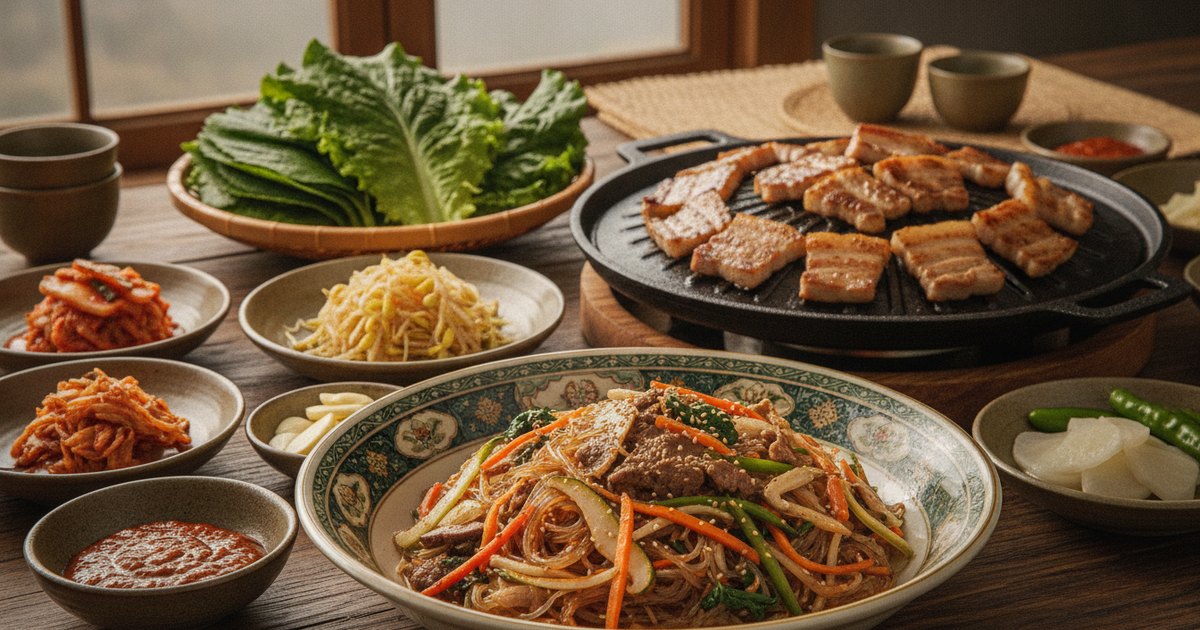
BTS's V — born Kim Taehyung — has never been shy about his relationship with food. While his fashion instincts and artistic sensibilities tend to dominate headlines, his food preferences tell an equally compelling story: a genuine, unpretentious devotion to Korean regional cooking and the kind of comfort dishes that show up at family tables across the peninsula. From driving three hours across Gangwon Province for a single bowl of buckwheat noodles to sharing his favorite late-night convenience store combo on national television, Taehyung's food world is surprisingly consistent — and surprisingly cookable.
This guide breaks down every verified food preference V has shared publicly, with context on what each dish is, why it tastes the way it does, and exactly how to recreate it in a Western kitchen.
The Food Personality of Kim Taehyung
If you had to describe V's eating style in one phrase, it would be comfortably regional. He gravitates toward dishes with deep roots in Korean culinary geography — cold buckwheat noodles from the mountains of Gangwon Province, cockles from Beolgyo in South Jeolla, blue crab doenjang jjigae that any Korean grandmother might simmer on a Tuesday morning. His public food mentions are remarkably consistent across variety shows and vlogs: he returns to the same dishes, the same flavor profiles (nutty, umami-rich, restrained heat), and occasionally the same restaurants.
He is also, by his own implicit admission across multiple appearances, a hardcore noodle fan — a descriptor that surfaces in the context of japchae, makguksu, and cup ramyeon alike. Noodles in nearly every form appear to be his comfort anchor.
His Signature Favorite: Perilla Oil Makguksu (들기름 막국수)
When V appeared on Channel Fifteen Nights (채널십오야), the wildly popular variety program hosted by PD Na Young-seok, during an MZ Mukbang segment, he was asked directly: what's your favorite food? His answer was immediate — perilla oil makguksu, and specifically the bowl served at Songjiho Makguksu (송지호막국수) in Goseong-gun, Gangwon-do. He mentioned driving two to three hours from Seoul specifically to eat it.
That's not a casual lunch decision. That's a culinary pilgrimage.
What Is Makguksu?
Makguksu (막국수) is a cold buckwheat noodle dish originating from Gangwon Province, where buckwheat has been cultivated for centuries in the region's mountainous, short-season terrain. The noodles are dense, slightly granular, and deeply earthy — nothing like the smooth wheat noodles most Western kitchens are familiar with. They arrive chilled, typically served one of two ways: mul makguksu (물막국수), in a cold tangy broth made from radish kimchi water or dongchimi, or bibim makguksu (비빔막국수), tossed in a vivid gochujang-based sauce.
What V specifically loves is the perilla oil version (들기름 막국수) — a nuttier, far less spicy interpretation where the cooked buckwheat noodles are tossed simply in fragrant perilla oil, finished with soy sauce, toasted sesame seeds, and sometimes a soft-boiled egg and julienned cucumber. The flavor is cool, nutty, and subtly mineral — nothing aggressive, everything satisfying. If you've tasted a great sesame noodle and wished it were earthier and more complex, this is where that craving leads.
Songjiho Makguksu is listed on VisitKorea's official tourism site (5866 Donghae-daero, Jugwang-myeon, Goseong-gun, open 11:00–19:00) and was already a beloved regional institution before V ever mentioned it. The restaurant also appeared in In the Soop: Friendship Trip — Episode 1 — cementing its status. Note for research-minded readers: some online sources incorrectly place the restaurant in Wonju; both are in Gangwon Province, but VisitKorea confirms the location is Goseong, not Wonju.
Korean entertainment media has also noted that V and Jungkook (BTS) share a documented love of makguksu — fans have long called it a "Taekook thing." For a broader look at what all seven BTS members eat, our full guide to what BTS eats covers the whole lineup.
Making Perilla Oil Makguksu at Home
The biggest Western kitchen hurdle is sourcing buckwheat noodles (메밀면). H Mart carries them reliably; look for brands like Wang or Sempio in the dry noodle aisle. Allow about 100g (3.5 oz) of dry noodles per serving. Cook in a large pot of boiling unsalted water for 3–4 minutes, then immediately transfer to a bowl of ice water — the cold shock stops carryover cooking and firms the strands. Drain thoroughly and shake off excess water before dressing.
The dressing is intentionally minimal: 1½ tablespoons (22ml) perilla oil (들기름), 1 tablespoon (15ml) soy sauce, a small pinch of sugar, and ½ teaspoon (2.5ml) sesame oil for finish. Perilla oil is pressed from the seeds of Perilla frutescens — it has a distinctly green, herbal-nutty aroma, warmer and more pungent than sesame oil, and the two are emphatically not interchangeable. Perilla oil is available at H Mart, Korean online grocers like Weee!, and Amazon; store it refrigerated after opening.
Toss the cold noodles in the dressing right before serving — waiting causes the noodles to absorb the oil unevenly. Top with julienned cucumber (skin on), a halved soft-boiled egg, and a generous scatter of toasted sesame seeds. The dish should smell faintly grassy and nutty, and the noodles should have a slight chew without being sticky.
Japchae: The Dish He Keeps Coming Back To (잡채)
Across variety show appearances, vlogs, and consistent fan-aggregated interviews, japchae (잡채) is the single dish most frequently named as V's all-time favorite. He has mentioned pairing it with "any type of meat," and the noodle-fan descriptor surfaces specifically in this context. Unlike his other preferences, which tend toward regional specificity, japchae is his constant — the dish he apparently never tires of.
Japchae is one of Korea's most celebratory preparations: chewy glass noodles (당면, dangmyeon) made from sweet potato starch, stir-fried with a vivid lineup of vegetables — spinach, carrots, shiitake mushrooms, onion, bell pepper — plus beef and a savory-sweet soy-sesame sauce. The noodles are translucent when cooked, deeply absorbent, and uniquely stretchy in a way no wheat or rice noodle replicates. It appears at chuseok, birthdays, and family celebrations — and considering V's well-documented sentimentality, it's easy to see why this is his anchor dish.
For a full step-by-step breakdown, our japchae recipe covers every technique in detail. The key variables for getting it right: cook 200g (7 oz) dangmyeon for four servings in aggressively boiling water for 6–7 minutes until just tender (not mushy — taste at 6 minutes), rinse under cold water, and immediately toss in a small coat of sesame oil to prevent clumping. Stir-fry each vegetable component separately in a very hot pan; combining them all at once steams instead of sears, and you lose the distinct textural identity of each element. The sauce ratio that works consistently: 3 tablespoons (45ml) soy sauce, 1½ tablespoons (22ml) sesame oil, 2 tablespoons (25g) sugar for four servings.
Dangmyeon is increasingly easy to find — H Mart carries several brands, and Whole Foods stocks it in the international foods section. Sempio and Ottogi are both reliable. Do not substitute rice vermicelli; the springy, elastic chew of sweet potato glass noodles is the whole point.
Doenjang Jjigae with Blue Crab (꽃게 된장찌개)
On the same Channel Fifteen Nights appearance where V named perilla oil makguksu, he also called out doenjang jjigae with blue crab (꽃게 된장찌개) as one of his top comfort foods. This is a more layered, regionally elevated version of Korea's everyday soybean paste stew — the blue crab (kkotge, 꽃게) releases natural sweetness into the simmering broth that the standard tofu-and-zucchini version simply doesn't have. The result is a stew that's simultaneously funky from aged doenjang, deeply savory, and gently sweet from the shellfish — a combination that reads as far more sophisticated than its short ingredient list suggests.
Doenjang is aged Korean soybean paste, fermented longer and with a more pungent, complex character than Japanese miso. For Western sourcing, H Mart stocks Sempio and Haechandle doenjang reliably; white or red miso works in a pinch but produces a noticeably different result. For the blue crab, frozen crab legs or whole small crabs from an Asian seafood market do the job well — one small whole crab per two servings, cleaned and cut into sections, added at the beginning of simmering, will fully infuse the broth within 15 minutes. The broth should smell deeply savory with a faint oceanic sweetness; if it smells flat, more doenjang — not salt — is the fix (see Common Mistakes below).
Cockle Bibimbap: The Dish That Put a Restaurant on the Map (꼬막비빔밥)
In July 2022, V posted a drive vlog to his BTS VLOG channel documenting a visit to Yurine Beolgyo (유린 벌교) — a restaurant in Yangpyeong that airlifts its cockles directly from Beolgyo, South Jeolla Province, the region recognized throughout Korea as producing the country's finest cockles (kkotge, 꼬막). He ordered the soy sauce version — specifically not the spicy gochujang variant — which allows the clean, briny sweetness of the shellfish to be the dominant note rather than heat.
The fan impact was swift. ARMY made the restaurant a pilgrimage destination almost immediately. By April 2023, Japan's major travel guidebook Rurubu had featured it as a V-associated destination — a level of soft-power reach that a single vlog can apparently generate when the right person posts it.
Cockle bibimbap is considerably simpler than a classic mixed-rice bibimbap: steamed rice topped with blanched, seasoned cockles, sesame oil, and the sauce of your choice. Our bibimbap guide covers the core technique; substituting cockles for the usual protein is straightforward. Blood cockles (also sold as ark clams) are available frozen at Asian seafood markets and some Filipino or Vietnamese grocery stores. Blanch for 2–3 minutes until they open — discard any that don't — then season with soy sauce, minced garlic, a few drops of sesame oil, and a pinch of sugar. The cockle meat should be tender and slightly firm, with a clean brininess and no rubbery chew; overcooked cockles turn chalky.
Korean BBQ: Chadolbagi, Samgyeopsal, and the Hanwoo Question (차돌박이 + 삼겹살)
V doesn't take sides in the perennial Korean BBQ debate between beef and pork — he orders both. Chadolbagi (차돌박이), thinly shaved beef brisket that chars in mere seconds on a screaming-hot grill, and samgyeopsal (삼겹살), thick-cut pork belly, reportedly both appear on his order. He has also specifically mentioned Hanwoo (한우) — Korea's native premium cattle breed, prized for extraordinary intramuscular fat and a naturally sweeter, richer flavor than commodity beef — as his preferred beef.
For anyone setting up a Korean BBQ night at home, our Korean BBQ at home guide covers grill setup, banchan pairings, and the full wrapping technique. For sourcing chadolbagi in a Western city: H Mart and most Korean grocery stores carry pre-sliced beef brisket at the correct thickness (approximately 2mm / ¹⁄₁₆ inch). If none is available nearby, partially freeze a piece of beef brisket and slice it on a mandoline or ask a butcher to slice it thin. Samgyeopsal is simply thick-cut pork belly — available at any well-stocked Western grocery store, no specialty sourcing required. For the Hanwoo experience, A5 Wagyu is the closest Western equivalent for marbling quality and fat-sweetness character.
The Convenience Store Combo That Went Viral
On the September 6, 2023 episode of You Quiz on the Block (유 퀴즈 온 더 블럭), hosted by comedian Yoo Jae-suk, V shared one of his more relatable food confessions: his favorite Korean convenience store pairing is a tuna mayo triangle gimbap combined with a spaghetti cup ramyeon. It's a combination that needs no explanation to anyone who has stood in a Korean GS25 or CU late at night — practical, deeply satisfying, and the two textures genuinely complement each other. The triangle gimbap contributes compact, rice-based richness; the spaghetti ramyeon provides hot, tangy contrast.
For a Western kitchen approximation, triangle gimbap can be made at home — our gimbap guide includes the rolling technique and filling variations. Korean cup ramyeon, including the spaghetti-style variants, is available at H Mart, many Walmart locations with international food sections, and online through Weee! or Amazon.
Western Kitchen Sourcing Guide: Eating Like V Without a Flight to Seoul
A quick-reference shopping list for the key ingredients across V's documented favorites:
| Ingredient | Korean Name | Where to Find |
|---|---|---|
| Perilla oil | 들기름 | H Mart, Korean grocery, Amazon |
| Buckwheat noodles | 메밀면 | H Mart, Weee!, online |
| Glass noodles (dangmyeon) | 당면 | H Mart, Whole Foods, Walmart |
| Doenjang (soybean paste) | 된장 | H Mart, Mitsuwa (or use red miso) |
| Blue crab | 꽃게 | Asian seafood markets (frozen) |
| Cockles / blood cockles | 꼬막 | Asian, Filipino, Vietnamese grocers |
| Thin-sliced beef brisket | 차돌박이 | H Mart (pre-sliced), Korean butcher |
| Thick pork belly | 삼겹살 | Any supermarket |
| Hanwoo-equivalent beef | 한우 | A5 Wagyu (substitute) |
When buying perilla oil, check the label carefully — it should list perilla seed (Perilla frutescens) as the sole ingredient. Some cheaper blends cut it with vegetable oil and the flavor is noticeably thinner.
Common Mistakes to Avoid
These are the specific failure points that most often derail home cooks attempting V's favorite dishes — with diagnostics and fixes for each.
1. Overcooking buckwheat noodles (makguksu) Buckwheat noodles have almost no margin between underdone and falling-apart mush. At 3 minutes they hold their texture; at 5 minutes the strands start disintegrating. Set a timer and begin tasting at 2.5 minutes — the noodle should yield with slight resistance, not feel sandy or raw. Transfer immediately to an ice bath the moment they're done; carryover cooking in a colander without cold water ruins them even if you timed it correctly.
2. Substituting sesame oil for perilla oil They look nearly identical in the bottle and both come from seeds, but perilla oil (들기름) has a distinctly greener, more herbal, almost mint-adjacent nuttiness that sesame oil doesn't possess. Sesame oil makes a pleasant cold noodle dish — it just isn't makguksu. If you're cooking for anyone who knows what the real thing tastes like, the swap will be immediately obvious. Source perilla oil before attempting the dish rather than improvising.
3. Skipping the sesame oil toss on dangmyeon (japchae) Sweet potato glass noodles are aggressively sticky. Drain them, set them aside for even 90 seconds without coating them, and you'll be trying to pry apart a gelatinous mass. The fix is simple and non-negotiable: the instant they're drained and rinsed in cold water, add 1 teaspoon (5ml) of sesame oil and use tongs to separate every strand. Do this before you start stir-frying anything else.
4. Flat-tasting doenjang jjigae broth Doenjang varies considerably in saltiness and intensity by brand. A stew that tastes dull or thin after simmering almost always needs more doenjang — not added salt. Sprinkling in raw salt disrupts the fermented flavor balance and makes the stew taste sharp instead of rounded. Stir in another half-tablespoon of doenjang, simmer 2 more minutes, taste again. If it's still lacking depth, a small splash of gukganjang (국간장, Korean soup soy sauce) brings it into focus without the sharpness of table salt.
5. Skipping the cockle soak Blood cockles frequently arrive with fine sand lodged between the shell ridges. Skipping the soak means that sand ends up in your bibimbap — and one gritty bite ruins the dish. Soak cockles in cold water with 30g (1 oz) salt per 1 liter (1 quart) for 20–30 minutes, then scrub the shells under running water before blanching. The soaking water will often turn visibly gritty, which tells you the step was necessary.
6. Cooking chadolbagi on insufficiently hot surface Thin-shaved beef brisket requires intense, immediate heat to caramelize instead of steam. If your pan isn't visibly smoking when the first piece of meat hits it, you'll get pale gray slices that taste boiled rather than grilled. Use a cast iron skillet or heavy stainless pan over maximum heat, and cook in a single sparse layer — no more than 4–5 slices at a time. Crowding the pan drops the surface temperature instantly and triggers steaming. The slices should sizzle aggressively on contact and show browning within 20–30 seconds per side.
Frequently Asked Questions
What is V's absolute favorite food? Based on his Channel Fifteen Nights appearance, V named perilla oil makguksu (들기름 막국수) as his favorite food — specifically the version from Songjiho Makguksu restaurant in Goseong, Gangwon Province. He described driving 2–3 hours from Seoul just to eat there, which speaks for itself.
Does V like spicy Korean food? His verified favorites skew noticeably toward the non-spicy end of the Korean flavor spectrum: perilla oil makguksu is mild and nutty, cockle bibimbap in the soy sauce version is gentle and savory, japchae is sweet-savory, and doenjang jjigae is funky rather than hot. His comfort food profile is clearly not centered on heat — though that doesn't rule out spice entirely.
What Korean BBQ does V order? V reportedly orders both chadolbagi (thin-shaved beef brisket) and samgyeopsal (pork belly) — he doesn't choose between the two. He has also specifically cited Hanwoo (한우), Korea's premium native cattle breed, as his preferred beef choice when available.
What was V's convenience store order on You Quiz on the Block? On the September 6, 2023 episode of You Quiz on the Block, V revealed that his favorite convenience store combination is tuna mayo triangle gimbap paired with spaghetti cup ramyeon — a pairing familiar to any late-night Korean convenience store regular.
Is the restaurant from V's cockle bibimbap vlog still popular? Yes — Yurine Beolgyo restaurant in Yangpyeong became an ARMY pilgrimage site almost immediately after V's July 2022 drive vlog. By April 2023, Japan's Rurubu travel guidebook had featured it as a V-associated destination, indicating the restaurant's V-driven popularity had extended well beyond Korean ARMY into international travel media.
Hungry for more? Explore the full picture of what BTS eats across all seven members, or get everything you need to host your own Korean BBQ night with our Korean BBQ at home guide. ```