
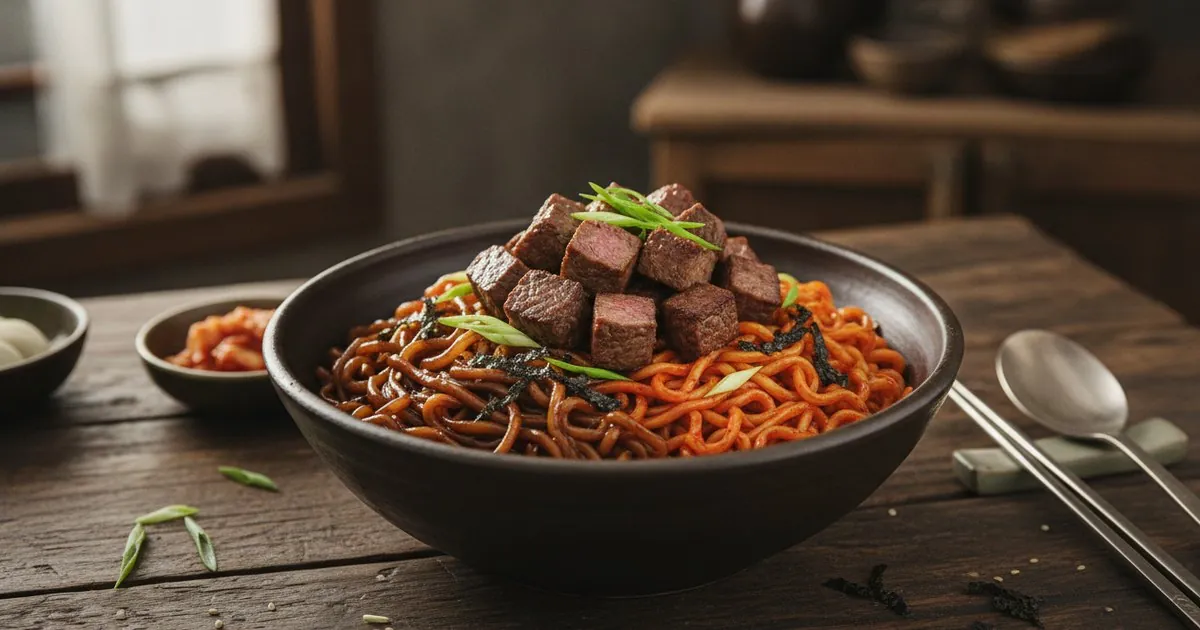
In Bong Joon-ho’s Parasite — the first non-English-language film to win the Academy Award for Best Picture — there is a scene where a housekeeper is asked to make ram-don. The request arrives as text message, sudden and demanding. She opens two packets of instant noodles. She cuts a piece of premium Korean beef. She plates the result with practiced efficiency. The family eats it like it’s nothing.
For audiences watching this scene, two things happened simultaneously: they understood exactly what the film was communicating about class and labor and invisible work, and they desperately wanted to eat what was on that screen.
This is the power of food in Korean cinema and television. The meal is never just a meal.
What Is Jjapaguri?
The dish has two names. In Korea, it’s called jjapaguri (짜파구리) — a portmanteau of Jjapagetti (짜파게티) and Neoguri (너구리), the two instant noodle packets that make it up. In the English subtitles of Parasite, translator Darcy Paquet rendered it as ram-don — a combination of “ramen” and “udon,” describing the two noodle styles involved. Both names work. Most international audiences know it as ram-don; most Koreans know it as jjapaguri.
The dish itself has a history that predates the film significantly. Korean children and adults have been combining Chapagetti and Neoguri for years — the black bean sauce of Chapagetti and the seafood broth of Neoguri create a combination that’s both richer and more complex than either packet on its own. Food mashups are a deeply Korean convenience-store tradition, and this particular combination was already a beloved hack before Parasite made it internationally famous.
What the film added — and what the scene makes clear — is the sirloin steak on top. That’s the Parks’ contribution: the upgrade that transforms a working-class instant noodle combination into something expensive enough to serve in a wealthy home without embarrassment. The contrast between the humble noodles (working people’s food, essentially) and the premium beef (something the Parks barely think about as an extravagance) is the entire socioeconomic argument of Parasite in a single bowl.
Understanding the Two Packets
Chapagetti (짜파게티)
Chapagetti is Nongshim’s riff on jjajangmyeon — the beloved Korean-Chinese black bean noodle dish that is the single most ordered delivery food in Korea. The original jjajangmyeon features thick, hand-pulled wheat noodles topped with a slow-cooked sauce of fermented black bean paste (chunjang), pork, and onions. It’s rich, deeply savory, slightly sweet, and almost entirely black — a color that Koreans find deeply comforting and visitors sometimes find alarming.
Chapagetti approximates this in instant form with remarkable success. The sauce packet is thick and glossy, the vegetable flakes reconstitute to add some texture, and there’s an oil packet that enriches the final sauce. The noodles are chewier and darker than typical ramyeon noodles.
One important note: Chapagetti is a dry/sauce noodle, not a soup noodle. When you make the full jjapaguri combination, you drain most of the cooking water and finish with a sauce rather than a broth — more like pasta than soup.
Neoguri (너구리)
Neoguri, as covered in our Jungkook’s Bulgeuri Ramen recipe, is Nongshim’s seafood-flavored ramyeon. Its soup powder creates a mild, slightly spicy, kelp-forward broth that adds crucial depth to any combination it’s part of.
In jjapaguri, the Neoguri’s soup powder gets added to the drained noodles along with the Chapagetti sauce components. The result is a black bean sauce with an underlying current of seafood umami — something the straight Chapagetti version doesn’t have. It’s a subtle addition that makes the sauce rounder and more complex.
The Neoguri’s thick udon-style noodles, mixed with Chapagetti’s darker, slightly thinner noodles, create the textural variety that gives jjapaguri its distinctive eat — you get different widths and chewiness levels in the same bowl.
The Steak Element: Class in a Skillet
Here’s where we need to talk about what the steak actually does to this dish, beyond its symbolic weight in the film.
Instant noodles with a rich black bean sauce are already quite good. But they lack textural protein contrast and fat complexity. The steak cubes provide both. A properly seared piece of sirloin or ribeye — crusty on the outside, slightly pink inside, still juicy — cuts through the dense noodle mass in a way that makes the whole bowl feel like a proper meal rather than a snack.
The key is the sear. You want a hot pan, dry meat, and enough confidence to leave it alone for 60-90 seconds per side before moving it. Resist the urge to push it around. The crust you’re building — the Maillard reaction creating hundreds of flavor compounds on the surface of the meat — is what makes this element work.
The butter baste at the end isn’t optional in the film (the housekeeper Moon-gwang uses it), and it’s not optional here either. Butter-basted steak has a glossy, rich coating that complements the glossy, rich noodle sauce in a way that feels intentional and complete.
For the film-accurate version, use Korean hanwoo beef or any well-marbled sirloin or ribeye. Premium steak is the point; it’s what turns proletarian noodles into something the Parks feel comfortable eating. If you’re making this for a normal Tuesday, quality supermarket sirloin works fine.
Making It at Home: The Key Steps
A few specific techniques that make the difference between good jjapaguri and great jjapaguri:
Don’t over-drain. When you drain the noodles, reserve some cooking liquid. The Chapagetti sauce tends to get pasty if the noodles are too dry. A splash or two of cooking water — added while tossing everything together over low heat — keeps the sauce glossy rather than gummy.
Add the Neoguri soup powder to the drained noodles, not the cooking water. The Neoguri broth is what you’d normally eat as soup — but for jjapaguri, you want that flavor in the sauce, not the broth. Drain the water, then add the powder directly to the noodles along with the Chapagetti components.
Rest the steak before cutting. This is standard steak advice, but it matters even more when you’re cutting the meat into small cubes. Cutting too early lets all the juices run out onto the cutting board. Wait two full minutes, then cut. You’ll see the difference in how juicy the interior stays.
Serve immediately. The Chapagetti-based sauce absorbs into the noodles quickly. These noodles are best in the first five minutes after plating — they won’t ruin after that, but the ideal glossy-sauce-coating moment is brief.
The Parasite Scene: What It Actually Shows
The scene functions as a pivot point in Parasite’s second act. The Parks are at their weekend camping trip and call ahead to have the housekeeper prepare ram-don. The request is made casually, as an afterthought, by Mrs. Park. For the Parks, it’s a whim; for Moon-gwang (and, in her absence, the Kim family now running the household), it’s labor.
The visual contrast — instant noodle packets being opened with practiced hands, premium beef being seared — is the film’s argument made tangible. The working class makes the food. The wealthy class eats it without thinking about who made it. The jjapaguri with hanwoo beef is exactly the kind of thing that seems modest (it’s instant noodles!) while being utterly un-self-aware about its own extravagance (the beef costs fifty times what the noodles do).
This is what Korean food cinema does at its best. The food isn’t garnish or set dressing; it carries argument, character, and history in a way that exposition can’t.
Variations Worth Knowing
Vegetarian version: Skip the steak entirely. Jjapaguri without meat is still a very good bowl of noodles. Add sautéed mushrooms (shiitake or oyster work beautifully) for an umami-rich alternative — the Chapagetti’s black bean sauce is vegan-friendly by default.
Egg version: A fried egg, sunny-side up, with a runny yolk laid over the noodles is a more accessible (and cheaper) protein addition. The yolk running into the black bean sauce is its own visual moment.
Spicy upgrade: Add a teaspoon of gochujang to the sauce mixture. It darkens the color of an already dark sauce, adds heat, and creates a slightly different flavor profile — more Korean-domestic than Chinese-Korean-adjacent.
Spam version: Cubed spam, pan-fried until crispy, is the budget protein upgrade. It lacks the class symbolism of hanwoo beef but it’s genuinely delicious and fits the convenience-store-food lineage of the base dish.
Korean Convenience Culture
Jjapaguri exists within a broader Korean tradition of creative instant noodle combinations, convenience-store hacks, and food mashups that are deeply embedded in everyday Korean life. Our guide to Korean convenience store food covers the full landscape — from the CU and GS25 culture to the specific combinations and hot bar items that make Korean convenience stores uniquely satisfying places to eat.
More BTS instant noodle exploration: the Bulgeuri Ramen recipe from Jungkook’s famous livestream follows a similar two-packet logic (Buldak + Neoguri this time) that’s become equally iconic in its own right.
Common Mistakes to Avoid
Over-draining the noodles and ending up with a gummy paste. The Chapagetti sauce packet is thick and starchy by design — it’s meant to cling to slightly moist noodles, not bone-dry ones. Shake every drop of water out before adding the sauce components and the result seizes into a dense clump that coats nothing. Fix: leave 2–3 tablespoons of starchy cooking liquid in the pot, then toss everything over low heat, adding small splashes of reserved liquid until the sauce moves glossily around the noodles.
Skipping Chapagetti’s oil packet. The small oil sachet isn’t just extra fat — it emulsifies the black bean sauce and gives it the glossy, restaurant-style sheen that makes jjapaguri look as good as it tastes. Leave it out and the sauce turns dull and slightly chalky. Add it along with the sauce powder and vegetable flakes after draining, and toss over low heat until fully incorporated.
Adding the Neoguri soup powder to the boiling water. If the broth powder goes into the cooking liquid before you drain, most of that seafood umami disappears down the drain — and you lose control of the final salt level. Add the Neoguri powder directly to the drained noodles in the pot, alongside Chapagetti’s sauce components. It blooms in the residual heat and concentrates into the sauce instead of being wasted.
Starting with cold, wet steak. Taking beef straight from the refrigerator to a hot pan produces an uneven cook — cold center, overcooked exterior — and surface moisture creates steam that prevents crust formation entirely. Pat the steak dry with paper towels, let it rest at room temperature for 15–20 minutes beforehand, and make sure the pan is genuinely preheated before the meat goes in. The Maillard crust is what makes the beef contribute flavor complexity, not just bulk protein.
Cutting the steak with the grain. For jjapaguri, cut the beef into roughly 2cm cubes against the grain so the muscle fibers are short and the bites are tender. Cutting with the grain produces stringy, chewy pieces that fight the noodles instead of complementing them. Aim for cubes large enough to sear properly — too small and they steam in their own moisture and turn gray rather than brown.
Tossing the finished noodles over high heat. Once drained, the goal is even coating, not further cooking. High heat at this stage scorches the black bean sauce on the bottom of the pot before it fully distributes, creating bitter spots and uneven seasoning throughout the bowl. Keep the burner at low to medium-low, toss constantly, and pull the pot off heat the moment everything is glossy and combined.
Frequently Asked Questions
What does “ram-don” mean? Ram-don is a portmanteau invented by the English subtitle translator for the film Parasite. It combines “ramen” (the Japanese word for noodle soup that’s become generic for instant noodles globally) and “udon” (the thick Japanese wheat noodle that Neoguri’s noodles resemble). In Korean, the same dish is called jjapaguri (짜파구리) — a combination of the two brand names, Chapagetti and Neoguri.
Which packet do you actually drain when making jjapaguri? You cook both noodle packets in the same boiling water, then drain most (but not all) of that water. The Chapagetti is meant to be a dry/sauce noodle rather than a soup, so you remove most of the cooking liquid. You then add the Chapagetti sauce packet, the Chapagetti vegetable flakes, the Chapagetti oil packet, AND the Neoguri soup powder — all to the drained noodles — and toss over low heat with a splash or two of reserved cooking water to achieve the right glossy consistency.
Can I use a different cut of beef instead of sirloin? Yes. Any well-marbled, tender steak works — ribeye is arguably better than sirloin (more fat = more flavor), tenderloin works if you want maximum tenderness, and flat iron or strip steak are economical alternatives. Avoid braising cuts (chuck, brisket, short rib) — you want something that sears well in high heat quickly.
Is jjapaguri actually eaten this way in Korea, or is the steak a film invention? Jjapaguri (Chapagetti + Neoguri mixed together) is a genuinely popular everyday combination in Korea that predates the film. The addition of premium steak is the film’s invention — in everyday Korean eating, the dish might be eaten plain or with a fried egg. The film specifically uses the expensive meat to make its class argument. You can absolutely make and enjoy jjapaguri without the steak.
Did Parasite actually win the Oscar for Best Picture? Yes — in 2020 (for the 92nd Academy Awards), Parasite became the first non-English-language film to win the Academy Award for Best Picture. It was also the first Korean film to win the Palme d’Or at Cannes (in 2019). Director Bong Joon-ho also won Best Director and Best Original Screenplay. The film’s success caused international audiences to seek out the food appearing in the film, with jjapaguri as the most Googled result.
Where can I find Chapagetti and Neoguri? Both are made by Nongshim, one of Korea’s largest food companies, and are widely available. Look in Korean grocery stores (H-Mart, Hana, Zion Market), most Asian grocery stores, international sections of major supermarkets, and on Amazon. Chapagetti specifically increased in availability internationally after Parasite’s Oscar win and the associated food interest.