
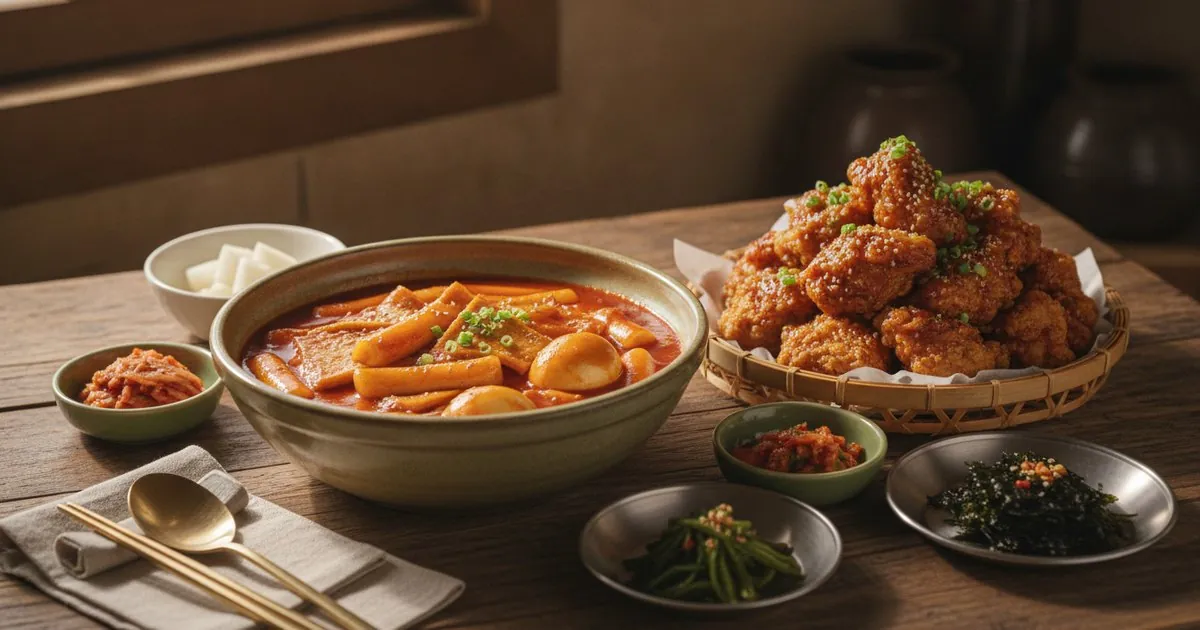
If you’ve spent any time in the Stray Kids fandom, you already know that food is a recurring, genuine thread through SKZ content. This isn’t manufactured variety-show-filler enthusiasm. It shows up in Bubble posts, late-night vlogs, cooking show appearances, and one particularly memorable moment where Uncle Roger lost his mind over a member’s wok technique. Food is woven into who these guys are — and that makes their preferences one of the most interesting windows into Korean food culture for Western fans who want to understand what’s actually on the table.
This post unpacks the dishes each member gravitates toward, explains why those foods taste the way they do, and gives you the practical information to explore them in your own kitchen. No flights to Seoul required.
Bang Chan — Sydney-Born, Spice-Loving, and Perpetually Missing His Mum’s Curry
Bang Chan (Christopher Bang) is one of those rare food personalities where the backstory genuinely informs the palate. He grew up in Sydney, Australia, before moving to Seoul as a trainee, which means his food memories are layered: Tim Tams and Fairy Bread alongside Korean home cooking, then years of dorm life in Seoul, then global touring. That bicultural nostalgia shows up in what he reaches for.
Yangnyeom Gejang (양념게장) — The Dish That Makes You Eat Rice You Didn’t Plan To
In food preference games — a staple format of K-pop content — Bang Chan consistently lands on yangnyeom gejang, spicy marinated raw crab. It’s one of Korean cuisine’s most polarizing dishes, which makes his consistent enthusiasm for it interesting.
Here’s what yangnyeom gejang actually is: live blue crab, cleaned and halved, steeped for 24 to 48 hours in a marinade built on gochugaru (Korean red pepper flakes), fish sauce, soy sauce, garlic, ginger, green onion, sesame, and sugar. The salt and acid don’t cook the crab in the traditional sense, but they do transform it — the flesh becomes silky and almost custard-soft, and the roe turns intensely rich and jammy. The flavor is oceanic, funky, fiery, and deeply savory all at once.
Koreans call it bap도둑 — “rice thief” — because a small portion will have you unconsciously eating bowl after bowl of short-grain rice before you realize what happened. Bang Chan’s attachment to it fits perfectly: this is the kind of dish that rewards adventurousness and gets under your skin permanently once you’ve tried a good version.
Western kitchen approach: If you’re new to gejang, the smartest move is buying a prepared version from the refrigerated banchan section at H Mart before attempting a home version. You’ll understand the flavor target before investing in fresh crab. See our banchan guide for how gejang fits alongside other banchan dishes in a proper spread.
Buldak Ramen and the Complexity of Korean Spice
Bang Chan has cited buldak ramen (Samyang’s incendiary fire noodles) as a top pick in noodle preference content, which creates an interesting contradiction: on the Heat Eaters episode of First We Feast (aired August 5, 2024), he was reportedly recorded with the lowest spice tolerance among the SKZ members who appeared. That’s not hypocrisy — it reveals something true about how Koreans experience heat.
Korean chili heat in dishes like buldak, yangnyeom gejang, and tteokbokki is deeply layered: the gochugaru brings fruity warmth, fermented pastes add umami, and sweetness balances the burn. That’s a different sensory experience from escalating raw Scoville heat on a wing show. Bang Chan loves complex, flavorful Korean spice. That’s not the same as wanting to suffer for heat’s sake.
For anyone who wants to go deeper with Samyang products beyond just boiling noodles, check out our guide to buldak ramen hacks — there are some genuinely clever ways to use the sauce packets in other dishes.
Curry Rice and What It Tells You About Home Cooking
One of the most documented food moments in recent SKZ content came from Mysterious Kitchen (April 2021, reported by Koreaboo): Bang Chan mentioned missing his family’s food — specifically his mother’s curry rice and lamb chops — and the members worked to recreate those flavors. He said he could eat ten portions of his mum’s version. That’s the kind of statement that only gets made about food that’s tied to place and memory.
Korean-style curry rice (카레라이스) is worth knowing if you don’t already. It runs sweeter and more viscous than Indian curry, closer to Japanese-style curry in texture — a thick, comforting sauce over short-grain rice with carrots, potatoes, and onion. Golden curry roux blocks (widely available at H Mart, Asian grocery stores, and Amazon) are an entirely legitimate shortcut here. Sauté roughly 200g (7 oz) of diced onion in 1 tablespoon (15 ml) of oil until golden, add your other vegetables, pour in 600 ml (2½ cups) of water or stock, simmer until tender, then melt in 3–4 roux cubes. The result is deeply satisfying and takes about 30 minutes.
Lee Know — The Member Who Will Casually Make You Beef Wellington
Lee Know (Minho) occupies a different food lane from Bang Chan. Where Bang Chan is the enthusiastic eater, Lee Know is, by broad consensus across fan content, variety show appearances, and Bubble posts, the most technically accomplished cook in Stray Kids.
His documented cooking portfolio — confirmed through vlogs and multiple production credits — includes steak, pasta, soups, stews, homemade bread, and desserts. The data point that tends to settle any debate about whether this is idol-cooking-for-show: he reportedly made a Beef Wellington for Felix’s birthday. Beef Wellington requires precise duxelles preparation, managing moisture levels so the puff pastry doesn’t go soggy, and nailing a beef tenderloin to exact internal temperature while the pastry cooks around it. If you’re doing that for a birthday, cooking is genuinely something you care about.
His TV Cooking Appearances
Lee Know has appeared on multiple Korean food production sets:
- EBS1’s Best Cooking Secrets (October 2021) — confirmed by his Wikipedia profile
- MBC’s Flushed-Cheek Feast of Hermits (February 13, 2021) — alongside Hyunjin
- Mysterious Kitchen (April 2021) — where he served as the primary chef cooking for the full group
These aren’t celebrity cameos where someone stirs a pot and smiles at a camera. Appearing on EBS1 food programming in a cooking capacity is a different kind of credential. It suggests the production teams found his skills worth centering a segment around.
The Chimaek Connection
Fan sources consistently describe Lee Know as a devoted chicken enthusiast — someone with a genuine, expressive excitement about a well-made piece of fried bird. That makes him a natural representative of chimaek culture (치맥): fried chicken + beer, late-night delivery, shared with people you like.
Korean fried chicken is categorically different from its American counterpart. It’s typically double-fried — first at a lower temperature to cook through, then a second fry at higher heat to shatter the crust — and finished in glazes that balance sweet, spicy, and savory in proportions that make the sauce inseparable from the experience. Our full Korean fried chicken guide covers the double-fry technique and sauce variations in detail if you want to attempt it at home.
The Fried Rice Moment That Uncle Roger Approved
During All-Night SKZ in 2021, Bang Chan cooked fried rice for Felix, Seungmin, and Changbin — and the clip was later noted in an IBTimes piece on K-pop idols who cook when online food personality Uncle Roger praised his wok-tossing technique with the signature “Fuiyoh!” response. That reaction means something specific: Bang Chan was achieving genuine wok hei, the slight char and smoke that develops when protein and rice hit a properly screaming-hot wok and brown before any moisture builds up.
Getting wok hei at home is a legitimate technique challenge. Home burners top out around 7,000–15,000 BTU; professional wok burners run 60,000 to 250,000 BTU. You compensate by:
- Heating a carbon steel wok until visibly smoking before adding 1 tablespoon (15 ml) of oil with a high smoke point (avocado or refined sunflower work well)
- Cooking in smaller batches — no more than 2 portions (about 400g / 14 oz of cooked rice) at a time — to prevent the pan temperature from crashing
- Using rice that was cooked the previous day and refrigerated uncovered for at least part of that time, so surface moisture has escaped
- Keeping everything moving with quick, confident tosses rather than stirring
When it’s working, you’ll hear a sustained sizzling roar rather than wet steaming sounds, and you’ll smell a faint smoky char beneath the aromatics. That’s the target.
The Broader SKZ Food Universe
Beyond individual members, a few dishes keep appearing in SKZ content as collective favorites that paint a clear picture of the group’s shared tastes.
Jokbal and bossam (족발 / 보쌈): Slow-braised pork trotters and pork belly respectively, these are cornerstones of Korean late-night delivery culture that idols reference constantly. Bossam’s tender pork, layered with kimchi, raw garlic, salted shrimp, and fresh chilies inside a napa cabbage leaf, is one of those combinations where the whole is significantly greater than its parts. See our dedicated bossam post for the full breakdown.
Bungeoppang (붕어빵): These fish-shaped street pastries filled with sweet red bean paste represent comfort and winter nostalgia in Korean food culture. The shell is slightly crispy; the filling is warm, dense, and subtly sweet with an earthy nuttiness from the beans. Bungeoppang makers (metal molds for your stovetop) are available on Amazon for around $25–35 and make a genuinely fun project.
Gukbap (국밥): Rice fully submerged in a rich, usually clear broth — the Korean equivalent of chicken noodle soup as comfort food. Bang Chan has been linked to it in some industry profiles. It’s restorative, deeply warming, and the kind of thing you want after a long day. The broth is the heart of the dish: it should taste clear but full, built from bones (pork or beef) simmered for two to four hours.
Common Mistakes to Avoid
Whether you’re making yangnyeom gejang sauce, cooking buldak noodles the way Bang Chan likes them, or attempting wok-fried rice with proper technique, these are the specific failure modes to watch for:
1. Using non-Korean chili powder for yangnyeom gejang sauce The sauce should smell fruity, sweet, and robustly spicy — not dusty or sharp. Generic chili powder or paprika won’t get you there. Korean gochugaru has a specific flavor profile: mild heat with fruity, slightly smoky undertones. Use fine-ground Korean gochugaru (the finer grade, not the coarse flake used for kimchi) for the sauce base. If the raw sauce smells acrid or metallic rather than bright and fruity, you’ve got the wrong chili. Our gochugaru guide explains the difference between grades and what each is used for.
2. Skipping the crab cleaning step For homemade gejang, every crab must be scrubbed under cold water, with the gills removed and the interior rinsed thoroughly. Any residual impurities ferment into the marinade during the steeping period and turn the flavor murky and unpleasant rather than clean and briny. The raw crabs should smell clean and oceanic before they go into the marinade. A strong ammonia smell at any point means the crabs aren’t fresh enough for this preparation — this dish depends entirely on ingredient quality.
3. Too much residual water in buldak-style noodles The defining characteristic of properly made buldak noodles is that they’re saucy and intensely coated — every strand should glisten. The most common mistake is treating them like regular broth ramen and not draining thoroughly. After cooking, drain completely and return to the pot with only about 2–3 tablespoons (30–45 ml) of the cooking water before adding the sauce packet. The sauce should cling and coat. If it pools at the bottom of the bowl, there’s too much liquid and the flavor will feel diluted.
4. Wet day-old rice going into the wok Refrigerating rice overnight doesn’t automatically make it wok-ready. Rice straight from the fridge can be clumped and still carry surface moisture from condensation, which creates steam instead of the sear you need. Before it goes in the wok, spread the rice across a sheet pan and let it sit at room temperature for 20–30 minutes, or microwave it uncovered for about 90 seconds to drive off surface moisture. Individual grains should feel slightly tacky but dry, not damp, before they hit the hot oil.
5. Rushing the onion for Korean curry Korean curry’s sweet, rounded depth comes from properly caramelized aromatics. The error is adding water and the roux block too early, which stews the onion rather than building the fond you need. Sauté the diced onion over medium heat until it’s fully translucent and beginning to turn golden at the edges — this takes a genuine 8–10 minutes. It should smell sweet, almost jammy. That color and aroma are the flavor base. Shortcuts here result in a curry that tastes thin and slightly raw underneath.
6. Serving yangnyeom gejang without enough rice Gejang is calibrated to be eaten in small pieces over a full portion of short-grain rice. It is not a standalone protein. A first-timer who plates a large claw piece and eats it without rice will be overwhelmed by the intensity of the brine and spice and may conclude incorrectly that they don’t like it. The correct serving ratio is a piece of crab meat roughly the size of a 50-cent coin pulled directly over a full scoop of hot steamed rice. The rice absorbs the sauce, tempers the salt and heat, and completes the dish. Without it, you’re missing the architecture.
FAQ
What does yangnyeom gejang taste like, and is it safe to eat raw crab?
The flavor is deeply oceanic, spicy, and savory — with a silky, nearly custard-like texture from the partial transformation the crab proteins undergo during marination. The safety question is legitimate: this dish requires very fresh, ideally live crabs and careful preparation. Commercially produced versions sold at H Mart and Korean grocery stores are made under food-safety standards and are a smart starting point before attempting a home version. If you’re making it yourself for the first time, source from a reputable Asian seafood market and follow the cleaning steps carefully.
Where can I buy ingredients for these dishes if I’m not near an H Mart?
H Mart is the best one-stop option for Korean pantry staples, fresh produce, and seafood. For cities without one, Amazon now stocks most dry pantry items reliably: gochugaru, buldak noodle varieties, curry roux blocks, gochujang. Whole Foods carries gochujang in most US locations. For a full breakdown of what to prioritize on a Korean grocery run, see our H Mart shopping guide.
Did Stray Kids actually appear on First We Feast’s spicy wing show?
Yes — SKZ appeared in a Heat Eaters episode on First We Feast that aired August 5, 2024. Bang Chan was noted as having the lowest spice tolerance among the appearing members, which surprised fans familiar with his stated love of yangnyeom gejang and buldak. The distinction worth understanding: enjoying the layered, complex heat of fermented Korean chili preparations is genuinely different from tolerating escalating raw Scoville heat in isolation. Bang Chan’s preferences are internally consistent — he loves flavor-forward spice, not punishment-style heat.
Is Lee Know actually a skilled cook, or is this just K-pop content?
The evidence is reasonably strong. Multiple appearances on Korean food television — including EBS1’s Best Cooking Secrets and MBC’s Flushed-Cheek Feast of Hermits — in actual cooking roles suggests production teams assessed his skills as genuine. The reported Beef Wellington for Felix’s birthday, if accurate, requires real technique: managing moisture in the pastry, timing the beef to temperature, executing duxelles properly. That’s not beginner-level cooking regardless of who does it.
What’s the best SKZ-inspired dish to start with if I’m completely new to Korean food?
Korean fried chicken (chimaek culture) is the most accessible entry point — the double-fry technique is learnable, the flavors are immediately satisfying, and it makes sense alongside beer in any culture. Kimchi fried rice using store-bought kimchi is an even lower-barrier first dish: it takes about 15 minutes, requires almost no specialized equipment, and delivers an accurate introduction to the interplay of fermented funk, chili heat, and umami that defines so much of Korean cooking. If you’re wondering how BTS members approach similar culinary territory, our what BTS eats post makes for interesting reading alongside this one.